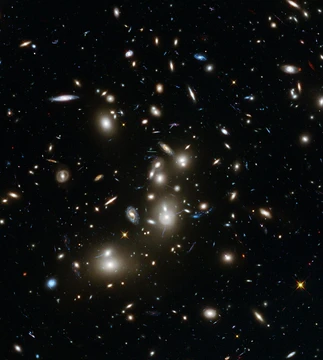
Abell 2390
Massive X-ray rich cluster with a cooling core.

Abell 2390 is a large cluster of galaxies in the constellation Pegasus. It is categorized as both an X-ray and rich galaxy cluster, with a cooling rate measured between 200 and 300 solar masses per year. The cluster features a cD galaxy, Abell 2390 BCG, which is linked to a complex radio source known as B2151+141.
Studies of the cluster’s member galaxies show they have varying morphological types. Only a few of these galaxies exhibit star formation, suggesting that starbursts are not a major driver of the cluster’s evolution. The distribution of dark matter in Abell 2390 has been detected through the weak gravitational distortion of background galaxies. Meanwhile, X-ray observations from ROSAT/HRI reveal that the cluster’s X-ray emission is elliptical in shape and distorted by its large-scale substructure.
The brightest cluster galaxy, LEDA 140982, is a supergiant elliptical and a Fanaroff-Riley class II radio galaxy. It hosts a powerful radio source with extended optical emission lines. Research from 2006 found that the galaxy’s radio source is unusual, featuring a misaligned, compact twin jet structure shaped by the host galaxy’s own structure. This may result from precession of its central supermassive black hole. The galaxy also contains molecular gas, some of which appears in a one-sided plume extending from its center.
Quick Facts
- Epoch
- J2000
- Constellation
- Pegasus
- Ra
- 21 · 53 · 34.6
- Dec
- +17 · 40 · 11
- Brightest Member
- LEDA 140982
- Richness
- 1
- Redshift
- 0.22800
- Distance
- 919 Mpc 0.705
- Temperature
- 8.89 keV
- Mass
- 10.7414
- Flux
- (9.60 ± 23.4%)-12 erg s / −1 / cm / −2 / (0.1–2.4 keV)
Facts from the source article.
Lore & Background
Abell 2390 is a massive galaxy cluster located in the constellation Pegasus. It is classified as an X-ray and rich galaxy cluster, with a measured cooling rate of 200–300 M☉yr−1. The cluster contains a cD galaxy called Abell 2390 BCG (short for brightest cluster galaxy), associated with a complex radio source, B2151+141. A study of the galaxy members found each has a different morphology classification, and only a few galaxies show star formations, indicating starbursts play no major role in propelling the cluster's evolution.
The brightest cluster galaxy of Abell 2390 is the supergiant elliptical galaxy, LEDA 140982. It is a Fanaroff-Riley class II radio galaxy hosting a luminous powerful radio source with extended optical emission lines. According to studies published in 2006, the source of LEDA 140982 is found peculiar with a misaligned, compact twin radio jet structure created by the host galaxy's apparent structure, possibly caused by the precession of its central supermassive black hole. The galaxy also contains molecular gas, with some located in a one-sided plume from the galaxy's center.
Based on weak gravitational distortion of galaxies lying in the background, dark matter distribution is detected in Abell 2390. Its X-ray distribution in the cluster is elliptical and distorted by its sub-structure on a large scale according to an X-ray ROSAT/HRI observation.
Reader's Guide
Abell 2390 is significant as a massive galaxy cluster studied for its X-ray properties, cooling rate, and dark matter distribution. Its classification as an X-ray and rich cluster, with a cooling rate of 200–300 M☉yr−1, highlights its role in understanding cluster evolution. The presence of a cD galaxy with a complex radio source and a Fanaroff-Riley class II radio galaxy with a misaligned twin jet structure provides insight into active galactic nuclei and black hole precession. The detection of dark matter via weak gravitational lensing and the elliptical, distorted X-ray distribution from ROSAT/HRI observations underscore the cluster's substructure and dynamic nature. Studies of its galaxy members show varied morphologies and limited star formation, suggesting starbursts are not a major driver of evolution. The cluster's legacy lies in its contribution to multi-wavelength studies of galaxy clusters, including X-ray, radio, and optical observations, and its role in probing dark matter and cooling flows.
Did You Know?
- Dark matter distribution in Abell 2390 was detected using weak gravitational distortion of background galaxies.
- Only a few galaxies in the cluster show star formation, indicating starbursts are not major drivers of evolution.
More in Galaxy Clusters and Groups 1-24
Spotted an error? Know more?
Reader corrections go straight into our review queue. Suggest an edit · How this site is sourced