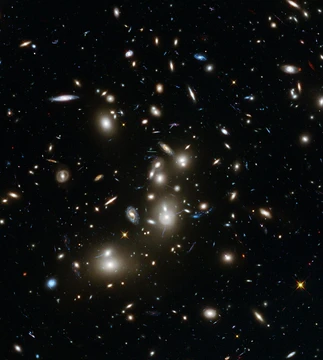
Abell 2255
A rich, nearby galaxy cluster with a turbulent intracluster medium.

Abell 2255, also called A2255, is a dense galaxy cluster in the constellation Draco. It sits at a redshift of 0.0806, making it relatively close by, and contains between 300 and 500 galaxies within a radius of 16.3 million light-years. The cluster’s intracluster medium (ICM) is notably turbulent and disorderly, featuring shocks, chaotic filaments, strong magnetic fields, and related activity. X-ray data from XMM-Newton reveal temperature asymmetries in the ICM, suggesting the cluster underwent a merger with another cluster roughly 150 million years ago.
Among its member galaxies are the Beaver Galaxy, Double Galaxy, Embryo Galaxy, Goldfish Galaxy, and the Original TRG. The ICM itself is far from uniform; it is a messy network of large galactic filaments, radio galaxies, radio halos, turbulent gas, relativistic particles, and intense magnetic fields. The cluster contains elongated filamentary structures stretching between 260,000 and 360,000 light-years—more than three times the width of the Milky Way—though their thickness is less than a tenth of our galaxy’s width. These filaments formed from turbulent motion within the cluster and later mixed with the dust and gas of the ICM.
At the cluster’s center lies a large number of head-tail radio galaxies, along with a complex radio halo that was among the first detected in an interacting medium. This halo spans up to 1 megaparsec, and its origin remains unclear, largely due to its enormous size. The magnetic field of Abell 2255 extends to the cluster’s outskirts and is over 100 times denser than what primordial magnetic fields would predict. This field accelerates particles to near-light speeds, which in turn helps amplify the field itself.
The cluster also hosts many relativistic particles moving at speeds close to light, emitting radio radiation as they interact with the magnetic fields. Kinetic energy from shocks and turbulence efficiently transfers to these particles, boosting them to high speeds, and the dense magnetic fields further accelerate them. It is likely that this acceleration occurs after the particles leave their home galaxies and enter the cluster’s radio components.
Quick Facts
- Redshift
- 0.0806
- Names
- A2255
- Constellation
- Draco
- Notes
- Chaotic intracluster medium and Original TRG galaxy
- Member No
- 300-500
- Epoch
- J2000
Facts from the source article.
Lore & Background
Abell 2255 contains several notable galaxies such as the Beaver Galaxy, Double Galaxy, Embryo Galaxy, Goldfish Galaxy, and the Original TRG. The cluster's intracluster medium is known to not be smooth but is instead a messy and intricate system of large galactic filaments, radio galaxies, radio halos, turbulent intracluster mediums, relativistic particles, and strong magnetic fields. X-ray observations of temperature asymmetries in the ICM from XMM-Newton indicate that the cluster had recently gone through a merger event with another galaxy cluster around 0.15 billion years ago.
The cluster has elongated filamentary structures that stretch from 260,000 to 360,000 light years—over three times the width of the Milky Way—though their thickness is less than a tenth of the Milky Way's width. Turbulent motion within the cluster caused the formation of these filaments, which then mixed with dust and gas in the ICM. Located toward the center of the cluster are a large number of head-tail radio galaxies along a radio halo that was one of the first detected in the interacted medium; its origin remains unknown, and its size up to 1 Mpc poses a difficulty for explanation.
Abell 2255 has a magnetic field that extends toward the outskirts of the cluster, over 100 times denser than expected from primordial magnetic fields. This field accelerates particles to speeds near the speed of light, which in turn helps amplify the field. The cluster also contains many relativistic particles moving at speeds close to the speed of light, emitting radiation in the radio band when interacting with the magnetic fields. Kinetic energy from shocks and turbulence efficiently transfers energy into these particles, and the dense magnetic fields also contribute to their acceleration. It is likely that the acceleration of these particles occurs once they leave their galaxy and enter the radio components.
Reader's Guide
Abell 2255 is significant as a nearby laboratory for studying the complex dynamics of galaxy cluster mergers and their effects on the intracluster medium. The X-ray evidence of a recent merger event around 0.15 billion years ago provides a time frame for understanding how such collisions generate shocks, turbulence, and filamentary structures spanning hundreds of thousands of light years. The cluster's radio halo, one of the first detected in an interacting medium, remains poorly understood, particularly its large size of up to 1 Mpc. The magnetic field, over 100 times denser than primordial expectations, and the presence of relativistic particles accelerated to near-light speeds highlight the role of kinetic energy transfer from shocks and turbulence. The cluster's legacy lies in its demonstration of how mergers can create a chaotic environment that amplifies magnetic fields and accelerates particles, offering insights into the evolution of galaxy clusters and the physics of the intracluster medium.
Did You Know?
- Abell 2255 contains some 300-500 galaxies.
- The cluster's filamentary structures stretch from 260,000 to 360,000 light years.
- XMM-Newton observations indicate a merger event occurred around 0.15 billion years ago.
More in Galaxy Clusters and Groups 1-24
Spotted an error? Know more?
Reader corrections go straight into our review queue. Suggest an edit · How this site is sourced