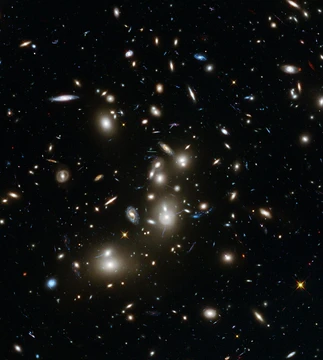
Abell 2218
A galaxy cluster that magnifies distant galaxies through gravitational lensing.

Abell 2218 is a massive galaxy cluster situated more than 2 billion light-years from Earth in the constellation Draco. Its immense gravity bends spacetime, turning the cluster into a powerful gravitational lens that magnifies and warps any galaxies behind its core into elongated arcs. These lensed galaxies are all stretched toward the cluster's center, and some appear multiple times—most often as a pair of images with a third, fainter counterpart. Because we are looking between two dense clumps of mass, in a saddle-shaped region where magnification is especially strong, the number of lensed galaxies is unusually high.
The cluster's lensing effect has revealed the most distant known object in the universe as of 2004: a galaxy roughly 13 billion years old, seen as it was just 750 million years after the Big Bang. The colors of the lensed galaxies depend on their distance and type. An orange arc is an elliptical galaxy at a moderate redshift of 0.7, while blue arcs are star-forming galaxies at intermediate redshifts between 1 and 2.5. In the lower part of the image, a pair of images shows a newly discovered star-forming galaxy at a redshift of about 7.
Clusters like Abell 2218 also help astronomers determine the amount and distribution of dark matter.
- Distance
- over 2 billion light-years
- Constellation
- Draco
- Redshift of orange arc galaxy
- z=0.7
- Redshift range of blue arc galaxies
- z=1–2.5
- Redshift of distant star forming galaxy
- about redshift 7
- Age of most distant known object as of 2
- some 13 billion years old
- Time since big bang for that object
- just 750 million years after the Big Bang
Lore & Background
Abell 2218 is a large cluster of galaxies over 2 billion light-years away in the constellation Draco. Acting as a powerful lens, it magnifies and distorts all galaxies lying behind the cluster core into long arcs. The lensed galaxies are all stretched along the cluster's center and some of them are multiply imaged. Those multiple images usually appear as a pair of images with a third — generally fainter — counter image, as is the case for the very distant object. The lensed galaxies are particularly numerous, as we are looking in between two mass clumps, in a saddle region where the magnification is quite large.
The color of the lensed galaxies is a function of their distances and types. The orange arc is an elliptical galaxy at moderate redshift (z=0.7). The blue arcs are star-forming galaxies at intermediate redshift (z=1–2.5). There is a pair of images in the lower part of the picture of the newly discovered star-forming galaxy at about redshift 7. Clusters of galaxies such as Abell 2218 have also been used to infer both the amount and distribution of dark matter.
Reader's Guide
Abell 2218 was used as a gravitational lens to discover the most distant known object in the universe as of 2004. The object, a galaxy some 13 billion years old, is seen from Earth as it would have been just 750 million years after the Big Bang. This discovery highlights the cluster's role in probing the early universe. Additionally, the cluster's lensing properties allow astronomers to study the distribution of dark matter, as the gravitational lensing effect reveals the mass distribution within the cluster. The numerous lensed arcs, including the orange elliptical galaxy at z=0.7 and blue star-forming galaxies at z=1–2.5, provide a rich sample for understanding galaxy evolution and the structure of the universe. The multiple imaging of distant objects, such as the star-forming galaxy at about redshift 7, demonstrates the cluster's utility in detecting and characterizing extremely remote galaxies.
Did You Know?
- It was used as a gravitational lens to discover the most distant known object as of 2004, a galaxy 13 billion years old.
- The lensed galaxies include an orange elliptical at redshift 0.7 and blue star-forming galaxies at redshifts 1–2.5.
- The cluster's lensing reveals a saddle region between two mass clumps where magnification is large.
More in Galaxy Clusters and Groups 1-24
Spotted an error? Know more?
Reader corrections go straight into our review queue. Suggest an edit · How this site is sourced