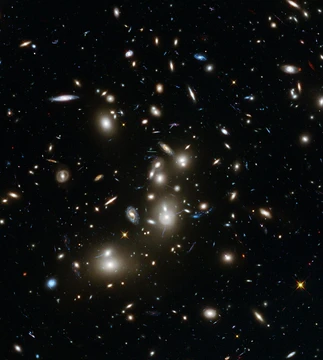
Abell 2163
Richest, hottest Abell cluster; merging; faint weak lensing signal.

Abell 2163 is a galaxy cluster listed in the Abell catalogue, notable for being one of the richest and most distant clusters in that catalogue. It is distinguished as the hottest galaxy cluster in the Abell catalogue based on data from the Chandra X-ray Observatory, and it is also a merging cluster.
Quick Facts
- Credit
- ESA/Hubble & NASA
- Epoch
- J2000
- Ra
- 16 · 15 · 34.1
- Dec
- -06 · 07 · 26.04
- Constellation
- Ophiuchus
- Richness
- 2
- Redshift
- 0.2030
- Distance
- 828 Mpc 0.705
- Temperature
- 11.5–14.6 keV
- Mass
- 4.6 × 10 / 15
- Luminosity
- 6 × 10 / 45 / erg/s
- Flux
- 1.4-11 erg s / −1 / cm / −2 / (0.5–2 keV)
Facts from the source article.
Lore & Background
Abell 2163 is a merging cluster, with its central region showing very similar mass and galaxy distributions as determined by weak gravitational lensing. These analyses reveal two coincident maxima and a flat shape elongated in the east-west direction. However, the weak lensing signal is surprisingly faint compared to what could be expected from the cluster's X-ray properties. Detailed studies are limited to the inner 8’×8’ region and do not include peripheral clumps such as A2163-B. La Barbera et al. (2004) estimated photometric redshifts of galaxies in A2163-B, showing that this structure lies at the typical redshift of the main cluster (z = 0.215 ± 0.0125). The cluster also hosts an extremely bright and large radio halo and is one of the brightest known clusters.
Reader's Guide
Abell 2163 holds significance as one of the richest and most distant clusters in the Abell catalogue, and as the hottest cluster in that catalogue according to Chandra X-ray data. Its status as a merging cluster provides a laboratory for studying cluster dynamics and the interplay between dark matter, gas, and galaxies. The weak lensing analysis reveals a surprising discrepancy: the lensing signal is fainter than expected from X-ray properties, suggesting possible complexities in the mass distribution or projection effects. The presence of an extremely bright and large radio halo further marks it as a notable radio source. The peripheral clump A2163-B, confirmed at the same redshift, indicates that the cluster's structure extends beyond the studied central region. These features make Abell 2163 a key object for understanding cluster evolution, merger processes, and the relationship between different observational tracers of mass.
Did You Know?
- Abell 2163 is the hottest galaxy cluster in the Abell catalogue, as shown by Chandra X-ray data.
- The cluster's central region has two coincident mass and galaxy density maxima elongated east-west.
- The weak lensing signal from Abell 2163 is surprisingly faint compared to expectations from its X-ray properties.
- The peripheral clump A2163-B lies at a redshift of z = 0.215 ± 0.0125, matching the main cluster.
More in Galaxy Clusters and Groups 1-24
Spotted an error? Know more?
Reader corrections go straight into our review queue. Suggest an edit · How this site is sourced