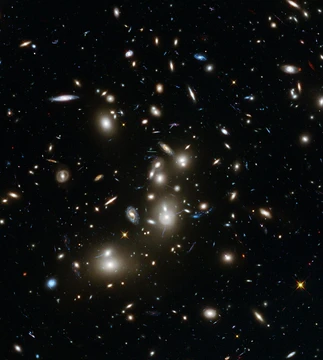
Abell 2147
A galaxy cluster in the Hercules Superclusters core.

Abell 2147 is a galaxy cluster in the Abell catalogue, located within the core of the Hercules Superclusters (SCI 160) in Serpens Caput. It is notable for its proximity to the cluster Abell 2152 and its possible association with the Hercules Cluster (Abell 2151), as it shares the same redshift of 550 million light years.
Quick Facts
- Epoch
- J2000
- Constellation
- Virgo
- Ra
- 16 · 02 · 17.2
- Dec
- +15 · 53 · 43
- Richness
- 1
- Redshift
- 0.03500 (10 493 km/s)
- Distance
- 149 Mpc 0.705
- Flux
- (53.20 ± 7.0%)-12 erg s / −1 / cm / −2 / (0.1–2.4 keV)
Facts from the source article.
Lore & Background
Abell 2147 is situated approximately two degrees south southwest of the Hercules Cluster (Abell 2151). The article notes that it is possible Abell 2147 is actually part of the Hercules Cluster, given that it shares the same redshift of 550 million light years. The cluster contains mostly faint, small and scattered galaxies.
A radial emission profile was constructed for Abell 2147 using exposure corrected, combined GIS-2 and GIS-3 sky images from the ASCA satellite. The cluster center was determined via a centroid routine using reference sky coordinates. The radial profile does not reflect the true cluster profile due to the complicated point spread function of the ASCA mirrors and the GIS detector. The background level was iteratively determined by stepping inward from the end of the profile and averaging with a three sigma clipping algorithm. The extraction region was chosen at the radius where the radial profile reached 5 times sigma times the background level. SIS extraction radii were set at 0.70 times the GIS extraction radius.
Reader's Guide
Abell 2147 is significant as a member of the Abell catalogue and as a component of the Hercules Superclusters core. Its radial profile analysis, though acknowledged as not reflecting the true cluster profile due to instrumental complexities, provides a methodological example of how cluster emission is extracted from ASCA data. The uncertainty regarding whether Abell 2147 is a separate cluster or part of the Hercules Cluster (Abell 2151) highlights the challenges in defining cluster boundaries based on redshift. The cluster's faint, small, and scattered galaxies contrast with richer, more concentrated clusters. The brightest cluster galaxy is UGC 10143. The entry also references external links to Chandra X-ray Observatory images and an image showing its location relative to other Abell clusters, underscoring its role in comparative cluster studies.
More in Galaxy Clusters and Groups 1-24
Spotted an error? Know more?
Reader corrections go straight into our review queue. Suggest an edit · How this site is sourced