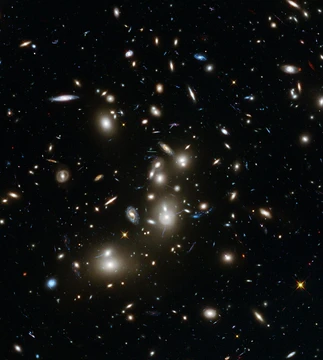
Abell 2142
A massive merging galaxy cluster studied in X-rays.

Abell 2142 (A2142) is an X-ray luminous galaxy cluster in the constellation Corona Borealis, resulting from an ongoing merger between two galaxy clusters. It is one of the most massive objects in the universe, spanning six million light years across and containing hundreds of galaxies.
- Catalogue
- Abell catalogue of rich clusters of galaxies
- Published
- 1958
- Constellation
- Corona Borealis
- Redshift
- 0.0909
- Heliocentric recession velocity
- 27,250 km/s
- Visual magnitude
- 16.0
- Distance
- 1.2 billion light years (380 Mpc)
- Size
- six million light years across
Lore & Background
Abell 2142 is the result of an ongoing merger between two galaxy clusters. The combined cluster contains hundreds of galaxies and enough gas to make a thousand more. An X-ray image taken on 20 August 1999 with the Chandra X-ray Observatory's Advanced CCD Imaging Spectrometer (ACIS) shows a bright but relatively cool 50 million degree Celsius central region embedded in a large elongated cloud of 70 million degree Celsius gas, all within a faint outer halo of 100 million degree Celsius gas. The bright source in the upper left is an active galaxy in the cluster.
The cluster has attracted attention because of its potential to shed light on the dynamics of mergers between galaxies. Clusters of galaxies grow through gravitational attraction of smaller groups and clusters. During a merger the kinetic energy of colliding objects heats the gas between subclusters, causing marked variations in gas temperature. These variations contain information on the stage, geometry and velocity of the merger.
Chandra has been able to measure variations of temperature, density, and pressure with high resolution. The pressure and density maps show a sharp boundary that can only exist in the moving environment of a merger. A2142's observed X-ray emissions are largely smooth and symmetric, suggesting it is a result of a merger viewed at least 1–2 billion years after the initial core crossing. The relatively cool central area suggests that the heating caused by previous shock fronts missed the central core, interacting instead with the surrounding gas.
Reader's Guide
Abell 2142 is significant as a laboratory for studying the dynamics of galaxy cluster mergers, which are among the most energetic events in the universe. The article notes that previous instruments such as ROSAT and ASCA lacked the capabilities of Chandra and XMM-Newton, which enabled detailed mapping of temperature, density, and pressure variations. Maxim Markevitch of the Harvard-Smithsonian Center for Astrophysics led the international team analyzing the observations, stating that the pressure and density maps show a sharp boundary unique to a moving merger environment. The smooth and symmetric X-ray emissions indicate the merger is at a late stage, at least 1–2 billion years after core crossing, with the central core having avoided direct heating from shock fronts. This cluster provides insight into how clusters grow through gravitational attraction and how kinetic energy from collisions heats intracluster gas, offering constraints on merger stage, geometry, and velocity.
More in Galaxy Clusters and Groups 1-24
Spotted an error? Know more?
Reader corrections go straight into our review queue. Suggest an edit · How this site is sourced