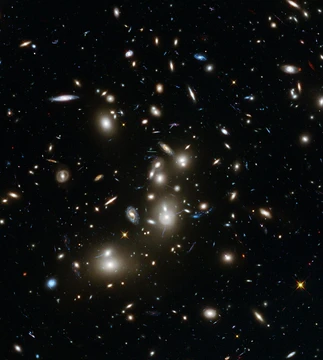
Abell 1413
A rich type I cluster with an extreme brightest cluster galaxy.

Abell 1413 is a massive, rich type I galaxy cluster located on the border of Leo and Coma Berenices, roughly 640 Mpc (2.1 billion light-years) away. It stands out because of its brightest cluster galaxy (BCG), an extreme example of its kind and one of the largest galaxies ever found.
The cluster was first recorded in 1958 by American astronomer George O. Abell, as part of his original catalogue of 2,712 galaxy clusters, based on data from the Palomar Observatory Sky Survey.
Classified as type I, the cluster has a single, massive central galaxy that dominates its smaller members. In 1971, Thomas W. Noonan estimated its richness at 60% that of the Coma Cluster, assuming the central cD elliptical is not a foreground object.
The BCG of Abell 1413, also known as MCG 04-28-097, is a supergiant elliptical and the cluster’s dominant member. As early as 1965, astronomers William Wilson Morgan and Janet Rountree Lesh noted its extreme nature, calling it a “very large and luminous central galaxy” that might be the largest cD elliptical discovered, and suggested checking whether it was a foreground object. Over the next decade, further studies confirmed its extreme properties: it ranks among the most luminous galaxies known, has a titanic envelope visible on deep photographic plates, and exhibits an extremely large effective radius. It is also the most elliptical brightest cluster galaxy ever observed—a rare trait for such galaxies, and Abell 1413 BCG is the most extreme example.
The cluster lies about 2 billion light-years away, between Leo and Coma Berenices. It is one of 4,073 Abell clusters at a redshift indicating they are moving away from Earth and relatively nearby. Abell 1413 holds roughly 300 galaxies together with its strong gravity. Intense interactions within the cluster heat its gas to about 100 million degrees, producing strong X-ray radiation. Using the Canada-France-Hawaii Telescope, scientists observed the cluster and catalogued over 250 galaxies. They consider Abell 1413 to be relaxed, despite its highly elliptical shape. The cluster’s ellipticity is about 0.8 at large radii and 0.35 at the center, and it is aligned north-south, a few degrees westward.
Quick Facts
- Epoch
- J2000
- Ra
- 11 · 55 · 18.9
- Dec
- +23 · 24 · 31
- Richness
- 3
- Bmtype
- I
- Redshift
- 0.1427
- Distance
- 639.59 Mpc 0.687
- Temperature
- 7.38 keV
- Mass
- 7.5714
Facts from the source article.
Lore & Background
Abell 1413 is one of the original 2,712 galaxy clusters compiled in the Abell catalogue, compiled by the American astronomer George O. Abell in 1958, using data retrieved from the National Geographic Society – Palomar Observatory Sky Survey. It is classified as a type I galaxy cluster, characterized due to the presence of a single, massive galaxy in its center that dominates its smaller members. Thomas W. Noonan in 1971 characterized the cluster as having 60% the richness of the Coma Cluster, based on the assumption that the central cD elliptical is not a foreground object.
The brightest cluster galaxy of Abell 1413, or Abell 1413 BCG (MCG 04-28-097), is the supergiant elliptical galaxy that is the dominant member of the cluster. As early as 1965, astronomers William Wilson Morgan and Janet Rountree Lesh pointed out the galaxy's extreme nature, citing it as a 'very large and luminous central galaxy' that could possibly be the largest of all cD ellipticals discovered, and hence must be checked for being a possible foreground object. During the following decade, several other papers observed the cluster, particularly its cD galaxy, revealing its very extreme properties. It was found to be among the most luminous galaxies known, and a titanic envelope was observed using very deep photographic plates. Following studies would then publish extremely large effective radii for the central galaxy. Abell 1413 BCG is also notable due to its extreme ellipticity, making it the most elliptical brightest cluster galaxy known.
Reader's Guide
Abell 1413 is significant as a massive, rich type I galaxy cluster that contains one of the most extreme brightest cluster galaxies known. Its BCG is among the most luminous galaxies ever observed, with an extremely large effective radius and the highest ellipticity of any known brightest cluster galaxy. The cluster itself is notable for its high temperature—material heated to 100 million degrees due to strong interactions—emitting strong X-ray radiation. Scientists using the Canada-France-Hawaii telescope observed Abell 1413 and built a sample of over 250 galaxies, concluding that the cluster is relaxed despite its highly elliptical shape. The cluster ellipticity at large radii is around 0.8, while at the center it is about 0.35, and the cluster is aligned in the North-South direction, a few degrees westward. Its inclusion in the original Abell catalogue and subsequent studies have made it a key object for understanding cD galaxies and cluster dynamics.
Did You Know?
- Abell 1413 was first noted by George O. Abell in 1958 as part of the original Abell catalogue of 2,712 clusters.
- The brightest cluster galaxy of Abell 1413 is the most elliptical brightest cluster galaxy known.
- The cluster holds about 300 galaxies together with its strong gravity, and material is heated to 100 million degrees.
- Scientists using the Canada-France-Hawaii telescope built a sample of over 250 galaxies from Abell 1413.
More in Galaxy Clusters and Groups 1-24
Spotted an error? Know more?
Reader corrections go straight into our review queue. Suggest an edit · How this site is sourced