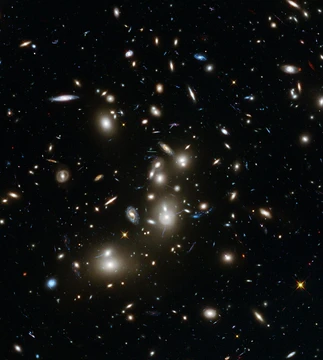
Abell 133
A dynamically complex cluster with a radio relic and cooling core.

Abell 133 is a galaxy cluster in the Abell catalogue, originally listed in 1958 and included in the Revised Abell Catalogue of 1989. It is notable for its complex dynamics, including a cooling flow core, a central active galactic nucleus (AGN), and a radio relic indicative of a past cosmic collision. The cluster is a member of the Pisces–Cetus Supercluster, alongside Abell 85 and about 20 other clusters.
Quick Facts
- Epoch
- J2000
- Constellation
- Cetus
- Ra
- 01 · 02 · 39.0
- Dec
- -21 · 57 · 15
- Brightest Member
- ESO 541-13
- Member No
- 120
- Richness
- 0
- Bmtype
- I
- Velocity Dispersion
- 735 km/s
- Redshift
- 0.0566 (16 968 km/s)
- Distance
- 234 Mpc 0.705
- Temperature
- 4.14 keV
Facts from the source article.
Lore & Background
Abell 133 has a central dominant galaxy (cD galaxy) designated ESO 541-13, a peculiar supergiant elliptical with a diameter of 257.53 kpc (over 840,000 light-years). The cluster hosts a hot intracluster medium (ICM) with an X-ray temperature of 4.0 keV, and its gas is enriched primarily by Type Ia supernovae, as indicated by an oxygen-to-iron abundance ratio of 0.454 ± 0.071. A prominent feature is a 'tongue' of X-ray emitting gas (temperature ≈ 1.3 keV) extending from the cD galaxy toward the northwest, partially overlapping a radio relic. This tongue is likely formed by Kelvin-Helmholtz instability as cold gas around the cD galaxy moves through the hot ICM at a velocity of 400 km/s.
The cluster's dynamics are disputed: some studies describe it as dynamically disturbed, with elliptical X-ray emission, offset cool gas, and substructure in galaxy distribution, while others find no significant dynamical disturbance and classify it as relaxed. A background cluster is projected along the same line of sight, but faint galaxy analysis confirms the low-mass galaxy population belongs to Abell 133. The AGN at the center is in a quiescent state, with a low strength (P5GHz ≤ 0.20) and an offset between the X-ray peak and supermassive black hole of 1.40 ± 0.54 kpc. The radio relic, 56 kpc (182,648 light-years) long, is strongly confined by the ICM, with external pressure about four times higher than its internal pressure.
Reader's Guide
Abell 133 serves as a key example of a galaxy cluster with both relaxed and disturbed characteristics, illustrating the complexity of cluster evolution. Its cooling flow core, AGN feedback, and radio relic provide insights into the interplay between supermassive black holes, intracluster gas, and cluster mergers. The detection of a 'tongue' of X-ray gas and the relic suggests a past collision with another cluster or subcluster, while the quiescent AGN and lack of cold gas phases indicate a current state of relative calm. The cluster's membership in the Pisces–Cetus Supercluster places it within a larger cosmic structure. Studies using Chandra and VLA observations have tracked two supermassive black holes in dwarf galaxies undergoing a cosmic collision within Abell 133, named 'Mirabilis'. The cluster's gas clumping factor increases at large radii, and its temperature decreases outward while entropy increases, hinting at AGN heating. Overall, Abell 133 is a valuable laboratory for studying galaxy cluster dynamics, AGN feedback, and the nature of dark matter, with gas mass comprising about 9.6% of its total mass and dark matter the remaining 90.4%.
Did You Know?
- Abell 133 has a bird-like morphology, with diffuse gas emission forming a bird-like feature uplifted by a buoyantly rising radio bubble.
- The cluster's cD galaxy ESO 541-13 is an ultra-steep spectrum radio source, indicating old, aging electrons.
- A background giant radio galaxy at z=0.293 has its northern lobe overlapping the X-ray relic in Abell 133.
- The cluster's gas mass is 17.4 × 10¹² M☉, while its total mass is 182 × 10¹² M☉, implying 90.4% dark matter.
More in Galaxy Clusters and Groups 1-24
Spotted an error? Know more?
Reader corrections go straight into our review queue. Suggest an edit · How this site is sourced