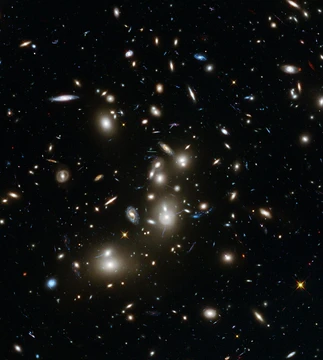
Abell 1033
A galaxy cluster with reborn radio emission from a shock wave.

Abell 1033 sits in the constellation Leo Minor, about 1.6 billion light-years away. This cluster holds roughly 350 galaxies and has been examined across the electromagnetic spectrum, with X-ray data from the Chandra X-ray Observatory revealing strong radio emissions. Scientists think its central supermassive black hole once shot out jets of high-energy electrons into intergalactic space. Those emissions eventually dimmed as the electrons lost energy and the cloud scattered. But a later collision between Abell 1033 and another cluster likely created a shock wave that revived the electrons, sparking fresh, bright radio emissions—possibly within the last few tens of millions of years. A team led by Italian researchers, using low-frequency radio data from the European LOFAR and the Indian Giant Metrewave Radio Telescope, detected unusually bright clouds of these relativistic particles.
Quick Facts
- Epoch
- J2000
- Ra
- 10 · 31 · 33.7
- Dec
- +35 · 04 · 34
- Constellation
- Leo Minor
- Distance Ly
- 1.62 billion
- Redshift
- 0.1259
- Radial Velocity
- 37,744 km/s
- Notes
- Bautz–Morgan classification: III
- Other Designations
- ZwCl 1028.9+3521
Facts from the source article.
Lore & Background
The supermassive black hole at the center of Abell 1033 once emitted jets of high-energy electrons that propagated into intergalactic space. Over time, these emissions faded as the electrons lost energy and the cloud dispersed. However, a subsequent collision between Abell 1033 and another cluster likely generated a shock wave that re-energized the electrons, resulting in renewed bright radio emission. This 'rebirth' may have occurred relatively recently in astronomical terms, possibly within the past few tens of millions of years. An Italian-led study conducted at low radio frequencies, using data from the European LOFAR and the Indian Giant Metrewave Radio Telescope, detected unusually bright clouds of relativistic particles.
Reader's Guide
Abell 1033 is significant as a case study of how galaxy cluster collisions can re-energize old radio emissions. The detection of unusually bright clouds of relativistic particles at low radio frequencies, observed by LOFAR and GMRT, provides evidence for the 'rebirth' of radio emission from a supermassive black hole's faded jets. This phenomenon, possibly occurring within the past few tens of millions of years, demonstrates the dynamic interplay between black hole activity and cluster mergers. The cluster's study across multiple wavelengths, including X-ray observations by Chandra, underscores the importance of multi-wavelength astronomy in understanding such processes. Its legacy lies in illustrating how shock waves from cluster collisions can revive dormant cosmic structures, offering insights into the life cycles of relativistic particles in intergalactic space.
Did You Know?
- Abell 1033 is located in the constellation Leo Minor.
- It contains about 350 galaxies.
- A collision with another cluster likely generated a shock wave that re-energized electrons, causing renewed radio emission.
- An Italian-led study used LOFAR and GMRT to detect unusually bright clouds of relativistic particles.
Frequently Asked Questions
What is Abell 1033 and where is it in the sky?
Abell 1033 is a galaxy cluster of roughly 350 members located in the constellation Leo Minor, approximately 1.6 billion light-years from Earth.
What is the 'reborn radio emission' of Abell 1033?
The cluster's central supermassive black hole once fired jets of high-energy electrons into intergalactic space, but that radio glow faded as the electrons lost energy. A later collision with another cluster produced a shock wave that re-energized those electrons, bringing the radio signal back to life.
Which observatories have observed Abell 1033?
Scientists have studied the cluster using the Chandra X-ray Observatory, LOFAR, and the Giant Metrewave Radio Telescope, giving them a multi-wavelength picture of its structure and emissions.
How did the collision revive the radio emission?
After the original jet-driven emission dimmed and the electron cloud scattered, a shock wave generated by a merger with a neighboring cluster swept through the residual material and re-accelerated the electrons, reigniting the radio glow.
Why is Abell 1033 important to astronomers?
It provides a rare natural example of a shock wave restarting radio emission that had already gone dark, offering insight into how energy is transferred and redistributed in the intergalactic medium during cluster mergers.
More in Galaxy Clusters and Groups 1-24
Spotted an error? Know more?
Reader corrections go straight into our review queue. Suggest an edit · How this site is sourced