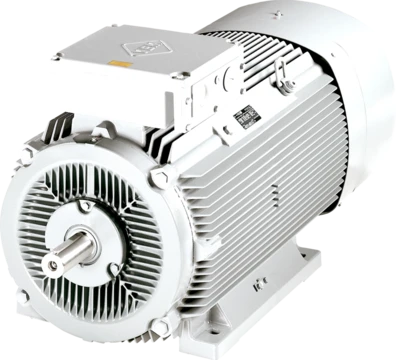
Field-oriented control
Vector control decouples flux and torque in AC motors.

Field-oriented control (FOC), also called vector control, is a variable-frequency drive (VFD) control method for three-phase AC motors, such as brushless DC motors. It identifies stator currents as two orthogonal components—one defining magnetic flux and the other torque—allowing decoupled control similar to a separately excited DC motor. FOC is notable for enabling high-performance motor operation, including smooth full-speed range control, full torque at zero speed, and fast dynamic response, and is increasingly used in lower-performance applications due to advantages in motor size, cost, and power consumption.
- Pioneers
- K. Hasse (Technische Universität Darmstadt) and F. Blaschke (Siemens)
- Year pioneered
- 1968 and early 1970s
- Key concept origin
- Park transformation, conceptualized in a 1929 paper by Robert H. Park
- Commercialization era
- Early 1980s, after microprocessor commercialization
- Control methods
- Direct (DFOC) and indirect (IFOC) vector control
Lore & Background
The development of vector control was pioneered by K. Hasse at Technische Universität Darmstadt and F. Blaschke at Siemens, starting in 1968 and the early 1970s. Hasse proposed indirect vector control, while Blaschke proposed direct vector control. Werner Leonhard of Technical University Braunschweig further developed FOC techniques, helping AC drives become competitive with DC drives. However, general-purpose AC drives did not become available until after the commercialization of microprocessors in the early 1980s, as earlier FOC required many electronic components such as sensors and amplifiers, making it costlier and more complex than DC drives.
The technical foundation of FOC relies on the Park transformation, first conceptualized in a 1929 paper by Robert H. Park. This transformation converts the three-phase time-varying system into a two-coordinate linear time-invariant (LTI) system, enabling the use of simple PI controllers. The stator current space vector is defined in a (d,q) coordinate system, with the d-axis aligned with field flux and the q-axis with torque. Common reference frames include stationary, synchronously rotating, and rotor reference frames. Two vector control methods exist: direct (DFOC), which calculates flux magnitude and angle directly from voltage or current models, and indirect (IFOC), which derives the flux space angle from measured stator currents and rotor speed using slip frequency.
Reader's Guide
Field-oriented control is significant because it allows AC induction and synchronous motors to be controlled with the dynamic torque response of a separately excited DC motor, without affecting field flux linkage when torque is controlled. This decoupled control enables high-performance applications requiring smooth operation over the full speed range, full torque at zero speed, and fast acceleration and deceleration. The article notes that FOC is becoming increasingly attractive for lower-performance applications due to its superiority in reducing motor size, cost, and power consumption. It is expected that with increasing microprocessor computational power, FOC will eventually nearly universally displace single-variable scalar control (volts-per-Hertz, V/f control). The legacy of FOC is tied to the Park transformation, which was ranked the second most impactful power engineering paper of the twentieth century. Sensorless control, which derives rotor speed from measured stator voltage and currents, is noted as attractive for cost and reliability reasons, though open-loop sensorless FOC has a minimum speed limitation of about 0.8 Hz at 100% torque, compared to standstill for closed-loop operation.
Did You Know?
- Field-oriented control was pioneered by K. Hasse and F. Blaschke starting in 1968 and the early 1970s.
- The Park transformation, essential to FOC, was first conceptualized in a 1929 paper by Robert H. Park.
- General-purpose AC drives using FOC became available only after microprocessor commercialization in the early 1980s.
- Indirect vector control (IFOC) is more commonly used than direct vector control because it operates more easily from zero speed to high-speed field-weakening.
More in Electric Motors 1-24
Spotted an error? Know more?
Reader corrections go straight into our review queue. Suggest an edit · How this site is sourced