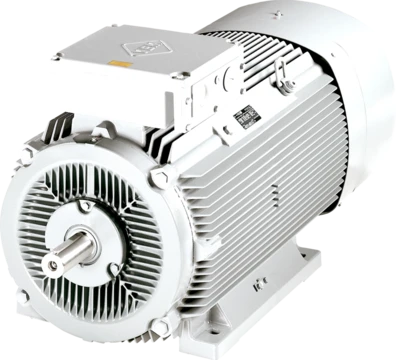
Axial flux motor
Axial flux motors offer higher torque density and flat construction for diverse applications.

An axial flux motor—also called an axial gap motor or pancake motor—is a type of electric motor where the gap between the rotor and stator, and thus the direction of magnetic flux, runs parallel to the rotation axis. This contrasts with the more common radial flux motor, which uses a concentric cylindrical design where flux flows radially. In an axial flux design, torque scales with the cube of rotor diameter, while in a radial flux design it only scales with the square. For a given volume, axial flux motors also offer a larger magnetic surface and more surface area for cooling.
**Characteristics**
**Advantages** Because the motor can be built on any flat surface—like a printed circuit board—by adding coils and a bearing, integration into electronics is straightforward. Coil winding and joining coils to the core can be simpler, and flat coils allow the use of rectangular copper strips, which simplifies high-current windings. The rotor can often be made significantly lighter, and the magnetic path length is potentially shorter. Most structural parts are flat and don’t require specialized casting or tooling. Since the magnetic path through the windings is straight, grain-oriented electrical steel—which offers higher permeability and lower core losses—is easy to use.
**Disadvantages** The rotor is typically much wider, which increases rotational inertia, and higher centrifugal forces can limit maximum rotational speed. Flux distribution can be uneven due to wedge-shaped segments, and those segments narrow toward the center, leaving less room for windings and connections.
**Design** Axial flux motors can use single or dual rotors and single or dual stators. The dual-stator, single-rotor configuration is more common in high-power applications, though it requires a yoke (housing) that adds iron losses. A single-stator, dual-rotor design can eliminate the yoke, saving weight and improving efficiency; in this case, the rotors and their iron plates move at the same speed and direction as the magnetic field. In one example, grain-oriented steel (30Q120) was used for stator teeth in an induction motor with 18 teeth between two rotors. Each tooth was wound with coils connected in series—six per phase—and the magnetic potential includes contributions from the air gap, stator tooth, rotor yoke, and rotor tooth.
- Torque scaling
- cube of rotor diameter (axial) vs quadratic (radial)
- Yasa 750r mass
- 37 kg
- Yasa 750r torque
- 800 Nm
- Yasa 750r power density
- >5 kW/kg
- Yasa 750r axial length
- 98 mm
- Yasa 550kw prototype mass
- 13.1 kg
- Yasa 550kw prototype power density
- 42 kW/kg
- Lucid motor power density comparison
- 16 kW/kg
- Emrax 228 power density
- 4.58 kW/kg
- Emrax 268 power density
- 5.02 kW/kg
Lore & Background
Although this geometry has been used since the first electromagnetic motors were developed, its usage was rare until the widespread availability of strong permanent magnets and the development of brushless DC motors, which could better exploit this geometry's advantages. Axial geometry can be applied to almost any operating principle (e.g. brushed DC, induction, stepper, reluctance) that can be used in a radial motor. Even within the same electrical operating principle, different application and design considerations can make one geometry more suitable than the other. Axial geometries allow some magnetic topologies that would not be practical in a radial geometry. Axial motors are typically shorter and wider than an equivalent radial motor.
Axial motors have been commonly used for low-power applications, especially in tightly integrated electronics since the motor can be built directly upon a printed circuit board (PCB), and can use PCB traces as the stator windings. High-power, brushless axial motors are more recent, but are beginning to see usage in some electric vehicles. One of the longest produced axial motors is the brushed DC Lynch motor, where the rotor is almost entirely composed of flat copper strips with small iron cores inserted, allowing power-dense operation.
AFMs can use single or dual rotors or single or dual stators. The dual stator/single rotor design is more common in high power applications, although it requires a yoke (housing) with accompanying iron losses. Single stator/dual rotor designs can dispense with the yoke, saving its weight and increasing efficiency. In the latter, the rotors and their iron plates that close the flux move in the same direction/speed as the magnetic field. Some AFMs can be easily stacked to provide higher power output in modular fashion.
Reader's Guide
The axial flux motor's significance lies in its unique geometry, which provides a torque increase proportional to the cube of rotor diameter—superior to the quadratic scaling of radial flux motors—and a larger surface area for cooling. This allows for more compact, power-dense designs, particularly advantageous in electric vehicles and aviation. The article notes that Mercedes-Benz subsidiary YASA has produced axial flux motors for concept, prototype, and racing vehicles, including the Koenigsegg Regera, Ferrari SF90 Stradale, and McLaren Artura. YASA announced a prototype 550 kW motor weighing 13.1 kg, achieving a power density of 42 kW/kg, which the company claimed to be the highest ever achieved. The Rolls-Royce ACCEL, holder of the current world speed record for an electric aircraft, uses three axial flux motors. In June 2026, Mercedes-Benz started large-scale production of AFMs in their Berlin-Marienfelde factory, with the first application in the High Performance Mercedes‑AMG GT 4-Touring Coupe. The geometry also enables low-power applications, such as motors built directly on PCBs, and general-purpose units from companies like Emrax and Conifer for HVAC fans, pumps, and small electric vehicles. The article emphasizes that axial flux motors allow magnetic topologies impractical in radial designs, and their flat construction simplifies manufacturing with grain-oriented electrical steel.
Did You Know?
- Torque in an axial flux motor increases with the cube of rotor diameter, while in a radial flux motor it increases only quadratically.
- YASA's 37 kg stackable 750R motor delivers 800 Nm and >5 kW/kg with an axial length of 98 mm.
- In June 2026, Mercedes-Benz started large-scale production of axial flux motors at their Berlin-Marienfelde factory.
The Geometry That Changes the Math
The defining characteristic of an axial flux motor is that the magnetic gap between rotor and stator runs parallel to the shaft axis rather than perpendicular to it. This seemingly small geometric shift carries profound mathematical consequences. In a conventional radial flux design, torque scales with the square of rotor diameter, but in the axial configuration it scales with the cube. That cubic relationship means that as the rotor grows wider, the torque gain accelerates dramatically compared to a radial machine. For any given volume, the axial geometry also exposes a larger magnetic surface area and a greater overall surface area available for thermal management. The motor's characteristic shape—short and wide, often nicknamed a pancake—is a direct consequence of this parallel flux path, and it opens up structural and packaging possibilities that a cylindrical radial motor simply cannot match.
Design Topologies and Engineering Trade-offs
Axial flux motors come in several structural arrangements. The dual-stator, single-rotor layout dominates high-power applications but demands a yoke or housing to close the magnetic circuit, introducing additional iron losses. The alternative single-stator, dual-rotor configuration eliminates the yoke entirely, saving weight and boosting efficiency, though both rotors and their iron plates must rotate in the same direction and speed as the magnetic field. On the materials side, the straight magnetic path through the windings makes grain-oriented electrical steel—such as the 30Q120 grade used in one induction motor example featuring 18 stator teeth—straightforward to employ, yielding higher permeability and lower core losses. The flat, planar nature of most components means they can be manufactured without specialized casting or tooling, and rectangular copper strips simplify high-current winding. However, the wider rotor geometry increases rotational inertia and centrifugal forces, capping maximum speed, while wedge-shaped segments create uneven flux distribution and leave less room for windings near the center.
The Automotive Powerhouse
The automotive sector has become the most visible proving ground for axial flux technology. Mercedes-Benz's subsidiary YASA—standing for Yokeless and Segmented Armature—has supplied these motors to a remarkable roster of high-performance vehicles, including the Jaguar C-X75 concept, the Koenigsegg Regera, Ferrari's SF90 Stradale and 296 GTB, the Lamborghini Revuelto, and the McLaren Artura. In July 2025, YASA unveiled a prototype delivering 550 kW from just 13.1 kg, a power density of 42 kW/kg that the company claimed as the highest ever achieved, compared to Lucid Motors' state-of-the-art 500 kW motor at 31.4 kg and 16 kW/kg. The company is also exploring in-wheel motor placement, leveraging the AFM's low mass to avoid penalizing unsprung weight. In June 2026, Mercedes-Benz commenced large-scale production of these motors at its Berlin-Marienfelde plant, with the first application slated for the High Performance Mercedes-AMG GT 4-Touring Coupe.
From Aircraft to Everyday Machines
Beyond the automotive world, axial flux motors are reshaping aviation and general-purpose machinery. The Rolls-Royce ACCEL, which holds the current world speed record for an electric aircraft, relies on three axial flux motors, while YASA is developing units for the three-motor Rolls-Royce Spirit of Innovation, targeting 50 kW/kg to make electric flight viable. In 2025, Flying Whales announced that Evolito would supply axial flux motors for its aircraft. In the general-purpose market, Emrax offers a product line including the 228, 268, and 348 models with power densities between 4.58 and 5.02 kW/kg. Conifer plans iron-based units from 1 to 25 hp for HVAC fans, pumps, tools, and in-wheel motors for scooters, ATVs, and urban delivery vehicles. The geometry's ability to be built directly on a printed circuit board, using PCB traces as stator windings, has made it a natural fit for tightly integrated low-power electronics since the earliest electromagnetic motors, though widespread adoption only accelerated with strong permanent magnets and brushless DC technology.
Frequently Asked Questions
Who is Axial flux motor?
An axial flux motor (also called a pancake motor or axial gap motor) is an electric motor in which the air gap between rotor and stator—and therefore the magnetic flux path—runs parallel to the shaft axis rather than perpendicular to it. It is the flat, disc-shaped counterpart to the more familiar cylindrical radial flux motor.
What are Axial flux motor's powers/role?
Its defining strength is torque density: because torque scales with the cube of rotor diameter (versus only the square for radial designs), it packs dramatically more torque into a given footprint. A real-world example is the YASA 750R, which delivers 800 Nm from a 37 kg unit that is just 98 mm axially long, exceeding 5 kW per kilogram.
Why is Axial flux motor important?
For a given volume it exposes a larger magnetic surface area and more area for cooling, which translates directly into higher continuous power and greater thermal headroom. That flat geometry also lets designers slot the motor into spaces a radial motor simply cannot fit, opening up vehicle and aircraft layouts that were previously impossible.
Who is Axial flux motor's rival?
Its long-standing counterpart is the radial flux motor, the concentric cylindrical design that dominates most industrial and consumer applications. The radial design's torque grows with the square of diameter, so at larger diameters the axial flux motor's cubic scaling gives it a clear density advantage, though radial motors still hold an edge in manufacturing maturity and cost at scale.
More in Electric Motors 1-24
Spotted an error? Know more?
Reader corrections go straight into our review queue. Suggest an edit · How this site is sourced