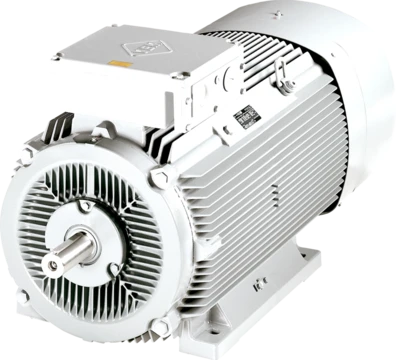
Brushed DC electric motor
Internally commutated DC motor using brushes for contact.

A brushed DC electric motor uses a direct current power source and relies on electric brushes for contact, with internal commutation. These motors were the first commercially significant use of electricity to produce mechanical motion, and DC power distribution systems powered motors in commercial and industrial buildings for over a century. Speed can be adjusted by changing the operating voltage or the magnetic field strength. Depending on how the field is connected to the power supply, the motor’s speed and torque can be set for steady speed or for speed that changes inversely with the mechanical load. Brushed motors are still used in electrical propulsion, cranes, paper machines, and steel rolling mills. However, because the brushes wear out and need replacement, brushless DC motors, which use power electronics, have taken over many applications.
In a simple two-pole brushed DC motor, current passes through a coil wound around a soft iron core inside an external magnetic field. One side of the coil experiences an upward force, the other a downward force, following Fleming’s left-hand rule, causing the coil to rotate. To keep rotation in one direction, the commutator reverses the current every half-cycle. A problem arises when the coil’s plane is parallel to the magnetic field—when the rotor poles are 90 degrees from the stator poles—torque becomes zero. In the illustrated motor, this happens when the core is horizontal. The motor cannot start from this position, but if already spinning, momentum carries it through. Another issue: at this zero-torque position, both brushes touch both commutator plates, creating a short circuit. The power leads are shorted together, and the coil is also shorted through both brushes. This short wastes power without producing motion or even coil current. In low-current battery-powered demonstrations, this is usually harmless, but in a motor designed for hundreds of watts, it could overheat the commutator, damage brushes, or weld metallic brushes to the commutator (carbon brushes would not weld). Such a short drains batteries quickly and forces power supply components to be over-engineered.
A simple fix is to make the gap between commutator plates wider than the brush ends. This eliminates the short but increases the zero-torque range.
- Type
- Brushed DC electric motor
- Commutation
- Internal, using electric brushes
- Power source
- Direct current
- First commercial use
- First commercially important application of electric power to driving mechanical energy
- Dc distribution system duration
- More than 100 years
Lore & Background
Brushed DC motors can be varied in speed by changing the operating voltage or the strength of the magnetic field. Depending on the connections of the field to the power supply, the speed and torque characteristics can be altered to provide steady speed or speed inversely proportional to the mechanical load. A simple two-pole DC motor has a problem: when the plane of the coil is parallel to the magnetic field, torque is zero, and the motor would not be able to start in that position. Additionally, at that zero-torque position, both commutator brushes bridge both commutator plates, causing a short circuit that wastes power and can cause overheating or brush damage. One simple solution is to put a gap between commutator plates wider than the brush ends, which eliminates the shorting but increases the zero-torque range and causes pulsed torque. Many common small brushed DC motors use three-pole armatures, which allow the brushes to bridge two adjacent commutator segments without shorting, produce a closer step-wise approximation to ideal sinusoidal coil current, and reduce arcing.
Reader's Guide
Brushed motors continue to be used for electrical propulsion, cranes, paper machines and steel rolling mills. Since the brushes wear down and require replacement, brushless DC motors using power electronic devices have displaced brushed motors from many applications. The article notes that a two-pole motor with a gap between commutator plates can be effectively turned off by stalling it in a zero-torque position, but this design is impractical for working use due to lack of self-starting from all positions and pulsed torque. Three-pole armatures are common in toys and small consumer appliances, offering more even torque and less arcing. The back EMF generated by a spinning motor opposes the applied voltage, and the current through the motor drops as rotational speed increases; only when a load slows the rotor does current draw increase. The mechanical power produced by the motor is given by P = I * V_cemf.
Did You Know?
- Brushed motors were the first commercially important application of electric power to driving mechanical energy.
- In a two-pole motor, when the coil plane is parallel to the magnetic field, torque is zero and the motor cannot start from that position.
- Three-pole armatures allow brushes to bridge two adjacent commutator segments without causing a short circuit.
Origins and the Second Industrial Revolution
DC motors were the first type of electric motor to see widespread adoption. Their early success was tied directly to the infrastructure already in place: direct-current lighting power distribution systems provided a ready-made source of electricity. This practical advantage gave them a head start over other motor designs. The introduction of DC motors alongside electrical grid systems for running machinery beginning in the 1870s is credited with launching what is often called a second Industrial Revolution. The series-wound variant, which delivers its peak torque at low rotational speeds, found a natural home in traction applications including electric locomotives and trams. The ability to draw power directly from rechargeable batteries also made DC motors the driving force behind the earliest electric vehicles, a lineage that continues in today's hybrid and fully electric cars. Even in the modern era, DC motors remain visible in everything from small toys and disk drives to massive steel rolling mills and paper machines, demonstrating a versatility that has spanned well over a century of industrial development.
Electromagnetic Core Mechanism
At the heart of a brushed DC motor lies a straightforward electromagnetic principle. A coil of wire carrying current produces a magnetic field whose direction and strength are governed by the current flowing through it. In a typical design, the stator holds a stationary set of magnets—either permanent or electromagnets—while the armature carries one or more windings of insulated wire wrapped around a soft iron core that concentrates the field. The wire usually makes multiple turns, and in larger motors several parallel current paths may exist. The ends of these windings connect to a commutator, which ensures each coil is energized in proper sequence and links the rotating windings to the external power supply through brushes. By switching coils on and off in a specific order, the motor creates a rotating magnetic field. This field interacts with the stator's field to produce torque on the armature, causing rotation. The total current, coil size, and core material all determine the strength of the generated field. In some designs, the stator uses electromagnets rather than permanent magnets, offering greater control over the motor's behavior.
The Brush and Commutator System
The brushed DC motor's defining feature is its mechanical commutation system, which transfers electrical power from the stationary exterior to the spinning windings inside the rotor. Carbon or graphite brushes, sometimes reinforced with dispersed copper for better conductivity, press against a rotating commutator to maintain electrical contact. A spring-loaded brush holder keeps constant pressure as the soft brush material gradually wears down to match the commutator's diameter. For brushes carrying more than a couple of amperes, a flying lead is molded into the brush body and connected to the motor terminals. Very small brushes may simply slide against a metal holder or rely on a contact spring pressing on the brush end. In tiny, short-lived motors like those in toys, a folded strip of metal may serve as the brush. The trade-off of this design is clear: brushed motors offer low initial cost, high reliability, and straightforward speed control, but they demand regular maintenance—replacing worn brushes and springs, and cleaning or replacing the commutator—especially under high-intensity use, which limits their lifespan.
Applications, Speed Control, and the Path Forward
Brushed DC motors occupy an enormous range of applications. Small versions power tools, toys, and household appliances, while the universal motor—a lightweight brushed design—can run on either direct or alternating current, making it ideal for portable power tools. At the large end, DC motors drive electric vehicle propulsion, elevators, hoists, and steel rolling mills. Speed control is a key advantage: adjusting the supply voltage or varying the current in the field windings allows operation across a wide speed range. Modern control systems use power electronics to chop the DC current into on-and-off cycles, effectively lowering the voltage. The series-wound type, with its high low-speed torque, has long served in traction. When external mechanical power is applied, a DC motor reverses its role and acts as a generator, a principle exploited in regenerative braking on hybrid and electric vehicles and in energy recovery on electric trains. However, the rise of power electronics has made it feasible to replace many DC motors with AC motors and variable frequency drives, a transition already visible in mine hoist drives and other heavy industrial settings.
Frequently Asked Questions
Who is the Brushed DC electric motor?
The Brushed DC electric motor is a direct-current motor that relies on physical brushes pressing against a rotating commutator to handle its internal commutation. It holds the distinction of being the earliest commercially significant device that turned electrical energy into useful mechanical motion.
What are the Brushed DC electric motor's powers or abilities?
It converts a steady DC supply into rotational torque, and its speed can be dialed up or down simply by adjusting the operating voltage or the strength of its magnetic field. Depending on how the field winding is wired to the source, it can be set for a constant speed or for a speed that shifts inversely with the mechanical load.
Why is the Brushed DC electric motor important to the broader canon?
It was the first commercially important application of electric power to drive mechanical energy, proving that electricity could do real industrial work at scale. DC distribution networks built around it powered commercial and industrial buildings for well over a hundred years.
How does the Brushed DC electric motor handle commutation?
It performs commutation internally: a pair of carbon brushes maintains sliding contact with a segmented copper ring (the commutator) fixed to the rotor. As the armature spins, the brushes automatically reverse current in each coil segment, keeping the torque direction consistent without any external switching circuitry.
More in Electric Motors 1-24
Spotted an error? Know more?
Reader corrections go straight into our review queue. Suggest an edit · How this site is sourced