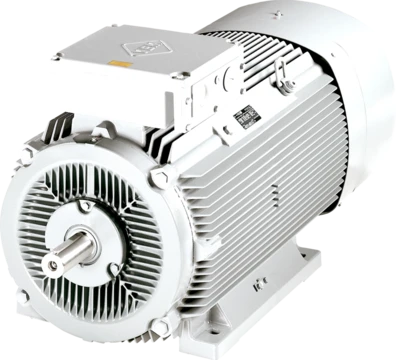
Electric motor
Converts electrical energy to mechanical energy via magnetic fields.

An electric motor turns electrical energy into mechanical energy. It does this by using the interaction between a magnetic field and an electric current flowing through a wire coil, which creates a Lorentz force that applies torque to the motor’s shaft. A generator works in the opposite way, converting mechanical energy back into electrical energy, but the two devices are mechanically identical. Motors can run on direct current (DC) from batteries or rectifiers, or on alternating current (AC) from the power grid, inverters, or generators. They are sorted by factors like power source, construction, intended use, and type of motion output. Designs include brushed or brushless types, single-phase, two-phase, or three-phase configurations, axial or radial flux, and air-cooled or liquid-cooled systems.
Standardized electric motors supply power for industry. The biggest ones, exceeding 100 megawatts, are used for marine propulsion, pipeline compression, and pumped-storage systems. Other common uses include industrial fans, blowers, pumps, machine tools, household appliances, power tools, vehicles, and disk drives. Tiny motors appear in electric watches. In some setups, like regenerative braking in traction motors, an electric motor can run in reverse as a generator to capture energy that would otherwise be lost as heat and friction. These motors produce either linear or rotary force (torque) to drive an external mechanism, making them a type of actuator. They are usually built for continuous rotation or for linear movement over a distance large compared to their size. Solenoids also convert electrical power to mechanical motion, but only over a short range.
**Components**
An electric motor has two mechanical parts: the rotor, which moves, and the stator, which stays still. Electrically, it has two parts: the field magnets and the armature. One of these is attached to the rotor, the other to the stator, and together they form a magnetic circuit. The magnets create a magnetic field that passes through the armature. These magnets can be electromagnets or permanent magnets. Usually, the field magnet sits on the stator and the armature on the rotor, but this arrangement can be swapped.
**Rotor**
The rotor is the moving part that delivers mechanical power. It typically holds conductors that carry current.
Quick Facts
- Industry
- Various
- Application
- Energy transformation
- Components
- Rotor, stator, air gap, armature, commutator, shaft, and bearing
- Inventor
- Michael Faraday
- Invented
- 1821
Facts from the source article.
Lore & Background
Before modern electromagnetic motors, experimental motors that worked by electrostatic force were investigated. The first electric motors were simple electrostatic devices described in experiments by Scottish monk Andrew Gordon and American experimenter Benjamin Franklin in the 1740s and 1750s. The theoretical principle behind them, Coulomb's law, was discovered but not published by Henry Cavendish in 1771, and independently by Charles-Augustin de Coulomb in 1785. Due to the difficulty of generating the high voltages they required, electrostatic motors were never used for practical purposes.
The invention of the electrochemical battery by Alessandro Volta in 1799 made persistent electric currents possible. Hans Christian Ørsted discovered in 1820 that an electric current creates a magnetic field. André-Marie Ampère developed the first formulation of the electromagnetic interaction and presented Ampère's force law. Michael Faraday gave the first demonstration of rotary motion on 3 September 1821, using a free-hanging wire dipped into mercury with a permanent magnet. In 1827, Hungarian physicist Ányos Jedlik started experimenting with electromagnetic coils and solved the technical problems of continuous rotation with the invention of the commutator. In 1828, Jedlik demonstrated the first device to contain the three main components of practical DC motors: the stator, rotor, and commutator.
Electric motors produce linear or rotary force (torque) intended to propel some external mechanism, making them a type of actuator. They are generally designed for continuous rotation or for linear movement over a significant distance. Solenoids also convert electrical power to mechanical motion, but over only a limited distance. Standardized electric motors provide power for industrial use, with applications including marine propulsion, pipeline compression, pumped-storage, industrial fans, blowers, pumps, machine tools, household appliances, power tools, vehicles, and disk drives.
Reader's Guide
The electric motor's significance lies in its fundamental role as a converter of electrical energy into mechanical energy, enabling countless technologies. The article notes that most electric motors operate through the interaction between the motor's magnetic field and electric current in a wire winding to generate Lorentz force as torque. They can be powered by DC or AC sources and are classified by power source type, construction, application, and motion output. The largest motors exceed 100 megawatts for marine propulsion and pipeline compression, while small motors are found in electric watches. A key legacy is the ability to operate in reverse as generators, as in regenerative braking with traction motors, recovering energy that might otherwise be lost as heat and friction. The article describes the motor's components: rotor, stator, air gap, armature, commutator, shaft, and bearings. The commutator, invented by Ányos Jedlik, periodically reverses current in the rotor windings to maintain torque direction. Commutated motors have been mostly replaced by brushless motors, permanent magnet motors, and induction motors. The stator core uses laminations of electrical steel to reduce eddy current losses, and mains-powered AC motors often impregnate windings with varnish to prevent vibration damage. The air gap between stator and rotor is made as small as possible to avoid weakening performance, but too small a gap may create friction and noise.
Did You Know?
- The first electric motors were simple electrostatic devices described by Andrew Gordon and Benjamin Franklin in the 1740s and 1750s.
- Michael Faraday gave the first demonstration of rotary motion from an electric motor on 3 September 1821.
- Ányos Jedlik demonstrated the first device containing the stator, rotor, and commutator in 1828.
- Electric motors can be used in reverse as generators to recover energy, such as in regenerative braking.
How a Brushless Motor Generates Motion
A brushless DC motor, sometimes called an electronically commutated motor, is fundamentally a synchronous machine powered by direct current. Rather than relying on mechanical contacts to route electricity, it depends on an electronic controller that precisely times pulses of current into the stator windings. These timed pulses generate magnetic fields that appear to rotate through space, and a permanent-magnet rotor chases this rotating field, producing continuous motion. The controller does not merely switch current on and off; it modulates both the phase and the amplitude of each pulse, giving the operator fine-grained command over rotational speed and torque. Because the rotor carries only magnets and no windings, it is free from the centrifugal stresses that plague wound-rotor designs, and the stator coils can shed heat directly into the housing through conduction without needing internal airflow.
The Brush Commutator and Its Liabilities
For much of the twentieth century, the brushed DC motor dominated industrial and consumer applications. Its commutator, a rotating cylinder segmented into metal contacts, worked in tandem with stationary graphite brushes that pressed against it, sliding across successive segments as the shaft turned. This mechanical arrangement was effective but carried several serious liabilities. The friction between brush and segment wasted energy, a loss that became proportionally severe in small, low-power machines. The soft graphite eroded with use, shedding particulate dust and demanding periodic replacement, which made brushed designs unsuitable for sealed enclosures such as hard-disk drives. The sliding contact introduced a voltage drop that consumed additional power. Most critically, the abrupt current reversals through inductive windings produced visible sparks at the commutator, posing a fire risk in flammable environments and generating electromagnetic interference that could disrupt nearby sensitive electronics. Over the past century, high-power brushed motors yielded to AC synchronous machines, and even in low-power niches their drawbacks continued to constrain their use.
Solid-State Control Replaces the Commutator
The breakthrough that made brushless operation practical arrived with solid-state electronics in the 1960s. In a brushless design, an electronic sensor continuously tracks the angular position of the rotor, and a controller uses that signal to drive semiconductor switches, typically transistors, that route current through the stator windings at exactly the right moment, either reversing polarity or cutting it off to sustain unidirectional torque. Because no sliding contacts exist, the motor's working life is governed solely by bearing wear rather than brush erosion. The elimination of sparks removes both the fire hazard in explosive atmospheres and the electromagnetic noise that plagued brushed counterparts. Additional benefits include a superior torque-to-weight ratio, higher efficiency that yields more torque per watt, near-instantaneous speed and torque adjustment, reduced acoustic noise, and the ability to cool the stator by conduction through the housing. The trade-off is a more complex and somewhat more expensive electronic control circuit, but for many applications the reliability gains far outweigh that cost.
Where Brushless Motors Are Found and How They Are Built
Brushless DC motors appear in a remarkably wide range of settings. In the computing world they drive disk drives and printers; in the workshop they power hand-held tools; in transportation they propel everything from model aircraft to full-size automobiles. A particularly notable modern application is the washing machine, where a brushless motor has enabled a direct-drive architecture that eliminates the rubber drive belt and multi-gear transmission found in older designs. Structurally, a brushless system is most often built around a permanent-magnet synchronous motor, though switched-reluctance and induction topologies are also possible. Designers may choose neodymium magnets for their high energy density and can arrange the geometry as an outrunner with the rotor outside the stator, an inrunner with the stator outside the rotor, or an axial configuration in which rotor and stator sit as flat, parallel discs. This flexibility in magnetic material and spatial layout allows engineers to tailor the motor's size, speed, and torque characteristics to the demands of each specific application.
Frequently Asked Questions
What is an electric motor?
An electric motor is a device that transforms electrical energy into mechanical rotation by exploiting the force between a magnetic field and current-carrying coils. It is the mechanical twin of a generator, which performs the reverse conversion.
How does an electric motor actually produce torque?
When current flows through a wire coil sitting inside a magnetic field, the resulting Lorentz force pushes on the coil and spins the shaft. This magnetic-interaction principle is what lets the motor turn electricity into usable rotational motion.
When was the first rotary electric motor demonstrated?
The earliest recorded demonstration of rotary motion from an electric motor took place on 3 September 1821. That milestone laid the groundwork for every motor design that followed.
Who developed the commutator that enabled continuous rotation?
Ányos Jedlik is credited with inventing the commutator mechanism that allowed a motor to spin continuously rather than just twitching in one direction. He demonstrated his continuous-rotation device in 1828.
How powerful can an electric motor get?
The largest electric motors in existence now push outputs well beyond 100 megawatts. They are typically AC machines fed directly from the power grid or large generators.
More in Electric Motors 1-24
Spotted an error? Know more?
Reader corrections go straight into our review queue. Suggest an edit · How this site is sourced