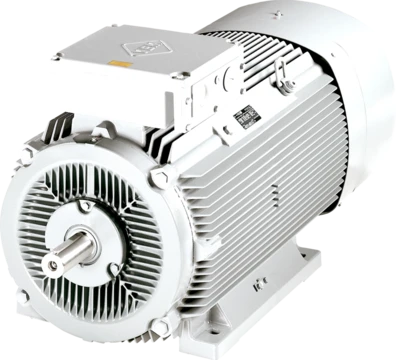
Brushless DC electric motor
An electronically commutated synchronous motor using DC power.

A brushless DC electric motor (BLDC) is a type of synchronous motor that runs on direct current (DC) power. Instead of using mechanical brushes, it relies on an electronic controller to send DC current pulses to the motor's windings. These pulses create magnetic fields that appear to rotate in space, and the rotor, fitted with permanent magnets, follows these fields. The controller manages both the speed and torque of the motor by adjusting the phase and timing of the current pulses. This design improves upon the older mechanical commutator (brush) system found in many conventional motors.
The basic construction of a brushless motor system often resembles that of a permanent magnet synchronous motor (PMSM), but it can also take the form of a switched reluctance motor or an induction (asynchronous) motor. These motors may use neodymium magnets and come in several configurations: outrunners (where the rotor surrounds the stator), inrunners (where the stator surrounds the rotor), or axial designs (where the rotor and stator are flat discs facing each other).
Compared to brushed motors, brushless motors offer several benefits: a higher power-to-weight ratio, the ability to run at high speeds, nearly instant control of speed and torque, excellent efficiency, and low maintenance needs. They are used in many devices, including computer peripherals (like disk drives and printers), handheld power tools, and vehicles ranging from model aircraft to automobiles. In modern washing machines, brushless DC motors have made it possible to replace rubber belts and gearboxes with a direct-drive system.
**Background**
Brushed DC motors were invented in the 20th century and are still widely used. Brushless DC motors became possible thanks to the development of solid-state electronics in the 1960s.
An electric motor generates torque by keeping the magnetic fields of the rotor (the rotating part) and the stator (the stationary part) out of alignment. One or both sets of magnets are electromagnets, made from a coil of wire wound around an iron core. When DC current flows through the wire, it creates a magnetic field that powers the motor. The misalignment between the rotor's and stator's fields produces a torque that tries to bring them into alignment.
- Advantages
- high power-to-weight ratio, high speed, nearly instantaneous control of speed and torque, high efficiency, low maintenance
- Applications
- computer peripherals (disk drives, printers), hand-held power tools, vehicles from model aircraft to automobiles, modern washing machines (direct-drive design)
- Limitation
- maximum power limited almost exclusively by heat; too much heat weakens magnets and damages winding insulation
- Efficiency benefit
- more efficient than brushed motors primarily due to absence of brushes, reducing mechanical energy loss from friction; enhanced efficiency greatest in no-load and low-load regions
Lore & Background
Brushless DC motors were made possible by the development of solid-state electronics in the 1960s. Their construction is typically similar to a permanent magnet synchronous motor (PMSM), but can also be a switched reluctance motor or an induction (asynchronous) motor. They may use neodymium magnets and be outrunners (stator surrounded by rotor), inrunners (rotor surrounded by stator), or axial (rotor and stator flat and parallel).
In brushless DC motors, an electronic controller replaces the brush commutator contacts. An electronic sensor detects the angle of the rotor and controls semiconductor switches such as transistors that switch current through the windings, either reversing the direction of the current or turning it off at the correct angle so the electromagnets create torque in one direction. The elimination of the sliding contact allows brushless motors to have less friction and longer life; their working life is limited only by the lifetime of their bearings.
Controller implementations may use Hall-effect sensors or a rotary encoder to directly measure rotor position, or measure back-EMF in undriven coils to infer rotor position (sensorless controllers). Commutation can be implemented in software using a microcontroller, or using analog or digital circuits. This allows for speed limiting, microstepping operation for slow and fine motion control, and holding torque when stationary.
Reader's Guide
The brushless DC motor represents a significant evolution from brushed DC motors, addressing key drawbacks of the brush commutator system. The brush commutator had disadvantages including friction causing power losses, brush wear creating dust and requiring replacement, electrical resistance causing brush drop energy loss, and sparks causing fire hazards and electromagnetic interference. Brushless motors overcome these by eliminating sliding contacts, resulting in higher efficiency, lower susceptibility to mechanical wear, reduced noise, longer lifetime, elimination of ionizing sparks, and reduced electromagnetic interference. With no windings on the rotor, they are not subjected to centrifugal forces, and windings supported by the housing can be cooled by conduction, allowing the motor's internals to be entirely enclosed and protected from dirt. These benefits come at the cost of potentially less rugged, more complex, and more expensive control electronics. Brushless motors are used in environments requiring maintenance-free operation, high speeds, and operation where sparking is hazardous or could affect electronically sensitive equipment. In modern washing machines, they have allowed replacement of rubber belts and gearboxes by a direct-drive design.
Did You Know?
- The working life of a brushless motor is limited only by the lifetime of its bearings.
- Some brushless motor controllers measure back-EMF in undriven coils to infer rotor position, eliminating the need for separate Hall-effect sensors.
- Brushless motors can hold finite torque at zero RPM, similar to stepper motors.
Frequently Asked Questions
Who is Brushless DC electric motor?
BLDC is a synchronous motor powered by a DC supply that spins without any physical brushes. An electronic controller feeds timed current pulses into the stator windings, generating a rotating magnetic field that a permanent-magnet rotor simply chases around.
What are Brushless DC electric motor's powers and role?
It packs a very high power-to-weight ratio, offers near-instantaneous speed and torque control, and needs minimal upkeep because there are no brushes to wear away. You'll find it driving hard-disk spindles, handheld power tools, model aircraft, and direct-drive washing machines alike.
Why is Brushless DC electric motor important?
It replaced the older brushed-commutator design across countless applications because it runs more efficiently, spins faster, and demands far less maintenance. That combination made it the default choice for precision, high-speed, and compact systems in both consumer and industrial technology.
How does Brushless DC electric motor control its speed and torque?
The electronic controller adjusts the phase and timing of the DC pulses delivered to each winding, which changes the speed of the rotating field the rotor follows. By tweaking that timing in real time, the motor can accelerate or brake almost instantly without any mechanical switching.
More in Electric Motors 1-24
Spotted an error? Know more?
Reader corrections go straight into our review queue. Suggest an edit · How this site is sourced