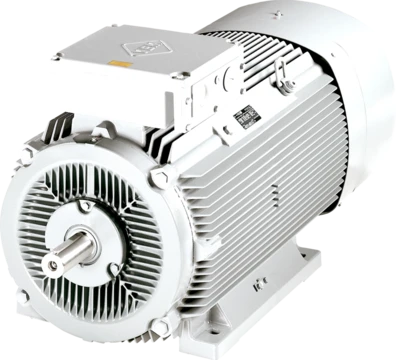
Electric motor test stand
Test stand for reproducible testing of electric motors.

An electric motor test stand (or bench) is a setup designed for repeatable testing of electric motors. Beyond its mechanical structure, it includes measurement instruments, sensors, control software, and the bus systems that manage and monitor the motor under test. Common types include developmental, endurance, end-of-line (EoL), and hardware-in-the-loop (HiL) test stands.
Testing typically aims to find specific points on a motor's characteristic curve or map the entire curve. Additional tests examine electromagnetic behavior, such as generative measurements, cogging torque, and discharge measurements.
In classic testing, a load machine, clutch, and torque transducer are used. An external load stresses the motor, allowing direct mechanical measurement of characteristics and calculation of derived values. Input current and voltage give absorbed power, while rpm and torque yield mechanical power output, enabling efficiency calculation. This method works with various motor types without changing the test algorithm, and further tests are easy to add after adaptation. However, mechanical modifications are needed for each motor or shaft change, incorrect test parameterization can introduce systematic errors, and adapting test objects to the stand is time-consuming.
Parameter identification uses the test object's own inertia to dynamically run through the characteristic curve. This method requires no mechanical coupling or torque/speed measurements—only terminal voltage and current are measured, with parameters determined via mathematical models. Advantages include a simple design, fast testing, no need to adapt for different motor types, and no measurement of mechanical quantities. The main disadvantage is the need for model adaptation across different motor types.
For drone brushless motors, often used in UAS propulsion, testing helps optimize flight time or lift capacity. Tests include endurance, flight replays, reliability, and pass/fail quality control. Tyto Robotics Inc. is the primary manufacturer of test stands specialized for UAS propulsion.
Noise analysis uses a suitable excitation function so that all noise-producing forces can be analyzed by sensors. Common noise sources are rolling bearings, commutators, and electric forces.
- Types of test stands
- developmental, endurance, end-of-line (EoL), hardware-in-the-loop (HiL)
- Testing purposes
- determine characteristic curve points or entire characteristic curves; characterize electromagnetic behavior
- Electromagnetic tests
- generative measurements, measurements of cogging torque, discharge measurements
- Classic testing components
- load machine, clutch, torque transducer
- Parameter identification method measurem
- terminal voltage and current values only
- Cogging torque measurement methods
- measurement at slow speed, measurement with closed-loop position control
Lore & Background
Testing of electric motors is generally done to determine characteristic curve points or entire characteristic curves, with additional testing to characterize electromagnetic behavior such as generative measurements, measurements of cogging torque, and discharge measurements. Classic testing involves a load machine, clutch, and torque transducer, where an externally applied load strains the motor, allowing direct mechanical acquisition of simple characteristics and calculation of derived variables. From input current and voltage, absorbed power is recorded; from rpm and torque, mechanical power output and efficiency are determined.
Reader's Guide
The electric motor test stand is significant for enabling reproducible testing across various motor types. Classic testing offers advantages such as testing different motors without changing the test algorithm and easy implementation of further tests after adaptation. However, it requires mechanical modifications for each motor or shaft change, risks systematic errors if tests are incorrectly parameterized, and involves time-consuming adaptation before testing. The parameter identification method uses the test object's own inertia to dynamically run through the characteristic curve without mechanical coupling or torque/speed measurements, relying only on terminal voltage and current values via mathematical models. This method provides a simple design, fast test methods, and no need for adaptation across motor types, but requires model adaptation for different motor types. Other testing includes drone brushless motor testing for UAS propulsion, noise analysis using suitable excitation functions, regenerative testing to diagnose electromagnetic behavior via induced voltage, and measuring cogging torque with an active load machine driving the currentless test object.
Did You Know?
- The test stand includes bus systems used to control and monitor the test objects.
- Classic testing uses a load machine, clutch, and torque transducer to strain the motor.
- The parameter identification method tests motors without mechanical coupling and without torque and speed measurements.
- Cogging torque can be measured at slow speed or with closed-loop position control.
More in Electric Motors 1-24
Spotted an error? Know more?
Reader corrections go straight into our review queue. Suggest an edit · How this site is sourced