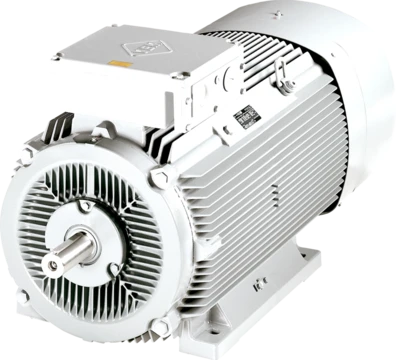
Dual-rotor motor
A motor with two rotors in one housing for improved performance.

A dual-rotor motor contains two rotors inside a single housing. This design can boost power volume density and efficiency while lowering cogging torque. In one configuration, a standard stator surrounds a squirrel-cage rotor attached to the output shaft. That rotor spins at a speed slightly below the stator’s rotating field. Inside this squirrel-cage rotor sits a freely rotating permanent magnet rotor, which locks onto the stator’s rotating field and reinforces it. Because the stator’s field lags behind, inducing current in the squirrel-cage rotor, this type qualifies as an induction motor. Another arrangement places the stator between two rotors: one on the inside and one on the outside. A patent drawing (labeled FIG. 8) shows such a unit with eight permanent magnets on the inner rotor’s outer surface and eight on the outer rotor’s inner surface. Manufacturers are developing both axial and radial flux versions. In one axial flux design, the rotor is a disk that sits between two symmetric rotor disks.
- Rotors
- 2
- Arrangements
- stator on the outside; stator between rotors
- Inner rotor magnets
- 8
- Outer rotor magnets
- 8
- Flux configurations
- axial and radial
Lore & Background
In one arrangement, the motor has an ordinary stator. A squirrel-cage rotor connected to the output shaft rotates within the stator at slightly less than the rotating field from the stator. Within the squirrel-cage rotor is a freely rotating permanent magnet rotor, which is locked in with the rotating field from the stator. The effect of the inner rotor is to reinforce the field from the stator. Because the stator slips behind the rotating magnetic field inducing a current in the rotor, this type of motor meets the definition of an induction motor. In another arrangement, one rotor is inside the stator with a second rotor on the outside of the stator. The photo labelled FIG. 8 is from a patent application. It shows two rotors assembled into a single unit, with eight permanent magnets attached to the outer surface of the inner rotor, and eight to the inner surface of the outer rotor. Vendors are working on both axial and radial flux configurations. In one axial flux design, the rotor is a disk that sits between two symmetric rotor disks.
Reader's Guide
The dual-rotor motor is notable for its ability to increase power volume density, efficiency, and reduce cogging torque compared to conventional single-rotor motors. The source article describes two distinct arrangements: one with a stator on the outside and an inner permanent magnet rotor reinforcing the field of an induction-type squirrel-cage rotor, and another with a stator between two rotors, each carrying eight permanent magnets. The latter arrangement is depicted in a patent application figure. Vendors are actively developing both axial and radial flux configurations, with one axial flux design featuring a disk-shaped rotor between two symmetric rotor disks. The significance lies in the potential for more compact and efficient motor designs, though the article does not specify any commercial adoption or performance benchmarks. The dual-rotor concept remains an area of ongoing development, with no dates, companies, or individuals named in the source.
Did You Know?
- A dual-rotor motor has two rotors within the same motor housing.
- In one arrangement, a squirrel-cage rotor rotates within the stator, and a permanent magnet rotor rotates freely inside it.
- Another arrangement places one rotor inside the stator and a second rotor on the outside of the stator.
- The photo labelled FIG. 8 shows eight permanent magnets on the inner rotor and eight on the outer rotor.
More in Electric Motors 1-24
Spotted an error? Know more?
Reader corrections go straight into our review queue. Suggest an edit · How this site is sourced