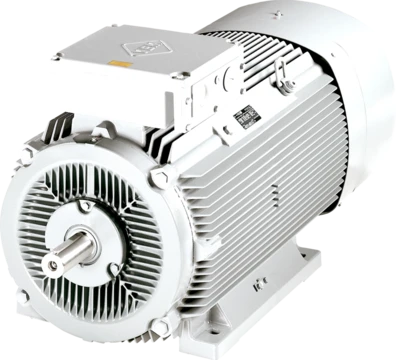
Doubly fed electric machine
Doubly fed machines allow variable speed with reduced converter cost.

A doubly fed electric machine—also called a doubly fed induction generator or slip-ring generator—is a type of electric motor or generator in which both the field magnet windings and the armature windings connect independently to external equipment. By supplying adjustable-frequency AC power to the field windings, the magnetic field can be made to rotate, which allows the machine’s speed to vary. This feature is especially useful for wind turbines and variable-speed pumped-storage hydropower plants, and it also gives DFIG-based wind turbines the ability to control both active and reactive power.
The machine’s origins trace back to wound-rotor induction motors with multiphase windings on both rotor and stator, invented by Nikola Tesla in 1888. In early versions, the rotor winding set was connected to resistors via multiphase slip rings for starting, but the slip power was lost as heat. To improve efficiency in variable-speed operation, the Krämer drive recovered slip power by connecting the rotor to an AC and DC machine set that fed a DC machine on the same shaft, returning the power as mechanical energy. However, this required oversized machines to handle extra circulating power. The Scherbius drive corrected this by feeding slip power back to the AC grid using motor-generator sets.
The rotating machinery for rotor supply was heavy and costly. The static Scherbius drive improved on this by connecting the rotor to a rectifier-inverter set, first using mercury-arc devices and later semiconductor diodes and thyristors. Because the rectifier was uncontrolled, power could only flow out of the rotor, limiting operation to sub-synchronous speeds as a motor. Another approach used a cycloconverter between the rotor and the AC grid, allowing power flow in both directions and enabling both sub- and oversynchronous speeds. Large cycloconverter-controlled doubly fed machines have powered single-phase generators for Europe’s 16⅔ Hz railway grid and have also driven turbines in pumped-storage plants. Today, frequency changers for applications up to tens of megawatts use two back-to-back IGBT inverters. Several brushless designs have been developed to eliminate slip rings, which require maintenance.
- Inventor
- Nikola Tesla
- Invention year
- 1888
- Typical speed range
- ±30% around synchronous speed
- Converter power fraction
- 25–30%
- Crowbar recovery time
- 20–60 ms
Lore & Background
The doubly fed electric machine has its origins in wound rotor induction motors with multiphase winding sets on the rotor and stator, invented by Nikola Tesla in 1888. Initially, the rotor winding set was connected to resistors via multiphase slip rings for starting, but the slip power was lost in the resistors. To improve efficiency, the Krämer drive was developed, where the rotor was connected to an AC and DC machine set that fed a DC machine connected to the shaft, returning slip power as mechanical power. However, this required overdimensioned machines. The Scherbius drive corrected this by feeding slip power back to the AC grid using motor-generator sets. Later, the static Scherbius drive used a rectifier-inverter set with mercury-arc devices, then semiconductor diodes and thyristors, but power flow was only out of the rotor. A cycloconverter concept allowed bidirectional power flow, enabling both sub- and oversynchronous speeds, and was used for single-phase generators feeding 16+2⁄3 Hz railway grids in Europe and for pumped storage plants. Today, frequency changers for applications up to tens of megawatts use two back-to-back connected IGBT inverters. Brushless concepts have also been developed to eliminate slip rings.
Reader's Guide
The doubly fed induction generator (DFIG) is widely used in wind turbines. Its stator windings connect directly to the grid, while rotor windings connect to a converter via slip rings and a back-to-back voltage source converter, allowing rotor frequency to differ from grid frequency. This enables independent control of active and reactive power fed to the grid from the stator, regardless of generator speed. The control principle used is either two-axis current vector control or direct torque control (DTC), with DTC showing better stability, especially when high reactive currents are required. The rotor is typically wound with 2 to 3 times the number of turns of the stator, resulting in higher rotor voltages and lower currents. In the typical ±30% operational speed range around synchronous speed, the converter's rated current is lower, reducing cost. However, controlled operation outside this range is impossible due to higher rotor voltages, and grid disturbances can magnify voltage transients. A protection circuit called a crowbar short-circuits the rotor windings through a small resistance when excessive currents or voltages are detected. An active crowbar can remove the short in a controlled way, allowing the rotor-side converter to restart after 20–60 ms if remaining voltage stays above 15% of nominal. This enables reactive current generation during voltage dips, aiding grid recovery. For zero-voltage ride-through, it is common to wait until the dip ends. The DFIG offers advantages over conventional induction machines: it can import and export reactive power, supporting grid stability during low-voltage ride-through; it allows the turbine to remain synchronized while speed varies, improving wind resource utilization; and the converter cost is low because only 25–30% of mechanical power passes through the converter, with the rest fed directly from the stator.
Did You Know?
- The doubly fed electric machine was invented by Nikola Tesla in 1888 as a wound rotor induction motor.
- An active crowbar can restart the rotor-side converter 20–60 ms after a grid disturbance if remaining voltage stays above 15% of nominal.
- Only 25–30% of mechanical power is fed to the grid through the converter; the rest goes directly from the stator.
More in Electric Motors 1-24
Spotted an error? Know more?
Reader corrections go straight into our review queue. Suggest an edit · How this site is sourced