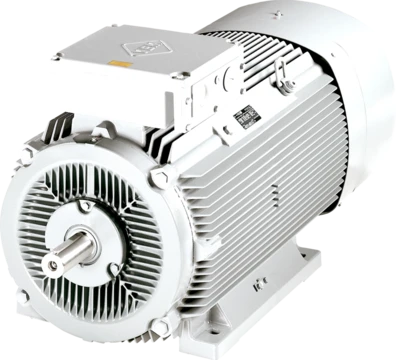
DC motor
DC motors convert direct current into mechanical force via magnetic fields.

A DC motor is an electric motor that turns direct current (DC) into mechanical force. Most common designs work through magnetic fields generated by electric currents flowing through coils. Almost every DC motor includes a system—either electromechanical or electronic—that periodically reverses the current direction in part of the motor. These motors were the first type to see widespread use because they could run on the existing DC lighting networks.
Inside a simple DC motor, a stationary set of magnets (the stator) surrounds a rotating armature. The armature has insulated wire wound around a soft iron core, which concentrates the magnetic field. The windings often have multiple turns, and in larger motors there may be several parallel current paths. The ends of the wire connect to a commutator, which energizes each armature coil in sequence and links the spinning coils to the external power supply through brushes. (Brushless DC motors use electronics to switch the DC current to each coil on and off, eliminating brushes.) The strength of the electromagnetic field depends on the total current sent to the coil, the coil’s size, and what it is wrapped around. By turning coils on and off in a specific order, a rotating magnetic field is created. This field interacts with the stator’s magnetic fields (from permanent magnets or electromagnets) to produce torque on the armature, making it spin. In some designs, the stator uses electromagnets for greater control. At high power levels, forced air cooling is almost always used.
Different arrangements of stator and armature fields, along with how they are connected, give different speed and torque characteristics. Speed can be controlled by changing the voltage applied to the armature, or by adding variable resistance in the armature or field circuit. Modern DC motors often use power electronics that “chop” the DC current into on-off cycles, creating an effective lower voltage. The series-wound type produces its highest torque at low speed, making it common in traction applications like electric locomotives and trams. DC motors can run directly from rechargeable batteries, powering early electric vehicles, today’s hybrid and electric cars, and many cordless tools. They are still used in everything from toys and disk drives to large steel rolling mills and paper machines.
- First widely used motor type
- True
- Speed control methods
- variable supply voltage or changing field winding current
- Common brush material
- graphite or carbon, sometimes with added copper
- Cooling method for high power
- forced air
- Typical application examples
- tools, toys, appliances, electric vehicles, elevators, hoists, steel rolling mills
Lore & Background
The introduction of DC motors and an electrical grid system to run machinery starting in the 1870s started a new second Industrial Revolution. DC motors can operate directly from rechargeable batteries, providing the motive power for the first electric vehicles and today's hybrid cars and electric cars as well as driving a host of cordless tools. A simple DC motor has a stationary set of magnets in the stator and an armature with one or more windings of insulated wire wrapped around a soft iron core that concentrates the magnetic field. The commutator allows each armature coil to be energized in turn and connects the rotating coils with the external power supply through brushes. Brushless DC motors have electronics that switch the DC current to each coil on and off and have no brushes.
Since the series-wound DC motor develops its highest torque at low speed, it is often used in traction applications such as electric locomotives and trams. Large DC motors with separately excited fields were generally used with winder drives for mine hoists, for high torque as well as smooth speed control using thyristor drives. These are now replaced with large AC motors with variable frequency drives. The advent of power electronics has made replacement of DC motors with AC motors possible in many applications.
Reader's Guide
DC motors were the first form of motors to be widely used, powered by existing direct-current lighting distribution systems. Their speed can be controlled over a wide range by varying supply voltage or field winding current. Small DC motors are used in tools, toys, and appliances, while larger ones are used in electric vehicle propulsion, elevators, hoists, and steel rolling mills. The universal motor, a lightweight brushed motor, can operate on both direct current and alternating current. Brushed DC motors offer low initial cost, high reliability, and simple speed control, but require regular maintenance of brushes and commutator. Brushless DC motors eliminate brushes, offering long life, little maintenance, and high efficiency, but have higher initial cost and more complicated controllers. If external mechanical power is applied, a DC motor acts as a generator, enabling regenerative braking in hybrid and electric cars to recharge batteries or return electricity to the grid. The introduction of DC motors and an electrical grid system in the 1870s started a new second Industrial Revolution.
More in Electric Motors 1-24
Spotted an error? Know more?
Reader corrections go straight into our review queue. Suggest an edit · How this site is sourced