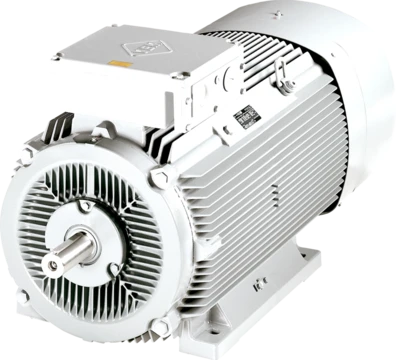
Dahlander pole changing motor
A two-speed induction motor using pole-changing connections.

A Dahlander motor, also known as a pole changing motor or dual- or two-speed motor, is a type of multispeed three-phase induction motor. Its speed is varied by altering the number of poles through changes in the wiring connections inside the motor. It is notable for providing two discrete speeds at a 2:1 ratio with less power loss than other speed control systems like variable frequency drives.
- Inventor
- Robert Dahlander (1870–1935)
- Invention year
- 1897
- Patent co inventor
- Karl Arvid Lindström
- Speed ratio
- 2:1
- Pole ratio
- 1:2
- External connections
- 6
Lore & Background
Robert Dahlander, a Swedish engineer working for ASEA, discovered that switching the poles in a motor led to a reduction in speed. In 1897 he invented an electrical configuration to switch between poles, for which he was granted a patent along with his co-worker Karl Arvid Lindström. The new connection was named the 'Dahlander connection,' and a motor having such a configuration is commonly referred to as a 'pole changing motor' or a 'Dahlander motor.'
The Dahlander motor is based on a 'consequent pole' construction: the total number of virtual poles expressed by the stator field is a combination of those with a winding directly around that pole and the flux through the rest of the stator armature, giving rise to consequent poles in between them. With the Dahlander arrangement, switching to the double wye connection reverses the direction of current flow in half of the windings, causing a halving of the number of poles expressed.
Normally, the electrical configuration of windings is varied from a delta connection (Δ) to a double star connection (YY) for constant torque applications, such as crane hoists. Star connections (Y) varied to double star connections (YY) are used for quadratic torque applications, such as pumps. The motor may have fixed or variable torque depending on the stator winding.
Reader's Guide
The Dahlander motor's significance lies in its ability to provide two discrete speeds with less power loss compared to other speed control systems like variable frequency drives, as most power is used to drive the motor and no electrical pulse switching is done. The system is simpler and easier to use than other speed control methods. However, it has the disadvantage of fast mechanical wear and tear due to changing speeds in such a drastic ratio, and it produces high harmonic distortion during pole shifting as the angular distance between the power generated increases when poles are decreased. Its legacy is as a practical solution for applications requiring two speed controls, such as pumps, fans, crushers, milling applications, and cranes, where one speed is used for material movement and the other for positioning. Although its use involves wye-delta switching, this should not be confused with wye-delta starting commonly used with large three-phase induction motors.
Did You Know?
- The Dahlander motor is named after its inventor Robert Dahlander (1870–1935).
- It has six external connections to its stator windings.
- The speed can be varied at a 2:1 ratio by altering the number of poles at a 1:2 ratio.
- Delta to double star connections are used for constant torque applications like crane hoists.
More in Electric Motors 1-24
Spotted an error? Know more?
Reader corrections go straight into our review queue. Suggest an edit · How this site is sourced