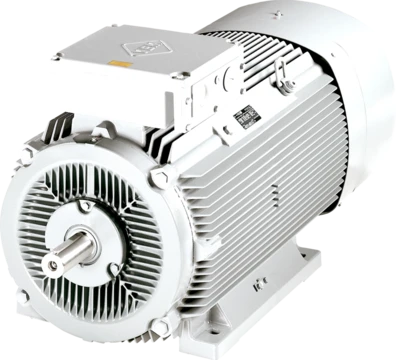
Commutator (electric)
Rotary switch reversing current in DC motors and generators.

A commutator is a rotating electrical switch found in some electric motors and generators. Its job is to flip the direction of current flow between the spinning rotor and the stationary external circuit. The commutator is a cylinder made up of several metal contact bars attached to the machine's rotating armature. Soft, conductive brushes—often made of carbon—press against these bars, sliding from one segment to the next as the rotor turns. The wire coils on the armature connect directly to the commutator segments.
These devices are used in direct current (DC) machines, including dynamos (DC generators), many DC motors, and universal motors. In a motor, the commutator sends electric current into the windings. By reversing the current in the rotating coils every half turn, it creates a steady twisting force, or torque. In a generator, the commutator collects the current produced in the windings and flips its direction each half turn, acting as a mechanical rectifier that turns the alternating current from the coils into direct current for the external load circuit. The first DC commutator-type machine—the dynamo—was built by Hippolyte Pixii in 1832, following a suggestion from André-Marie Ampère.
Commutators are not very efficient and need regular upkeep, like replacing brushes. As a result, machines with commutators are becoming less common, replaced by alternating current (AC) machines and, more recently, by brushless DC motors that use semiconductor switches.
**Principle of operation**
A commutator has a set of contact bars fixed to the machine's rotating shaft, linked to the armature windings. As the shaft spins, the commutator reverses the current direction in a winding. For a single winding, after the shaft completes a half turn, the winding is reconnected so current flows through it in the opposite direction from before. In a motor, the armature current makes the fixed magnetic field push on the winding, creating torque that turns it. In a generator, the mechanical torque applied to the shaft keeps the armature winding moving through a stationary magnetic field, which induces a current in the winding. In both cases, the commutator periodically reverses the current direction in the winding so that current in the external circuit flows only one way.
**Simplest practical commutator**
Practical commutators have at least three contact segments.
- First commutator machine
- dynamo built by Hippolyte Pixii in 1832
- Based on suggestion by
- André-Marie Ampère
- Brush material modern
- carbon, sometimes with copper powder
- Minimum segments practical
- three
- Typical insulation material early large
- mica
Lore & Background
The first direct current commutator-type machine, the dynamo, was built by Hippolyte Pixii in 1832, based on a suggestion by André-Marie Ampère. Early machines used brushes made from strands of copper wire, but these hard metal brushes tended to scratch and groove the smooth commutator segments, eventually requiring resurfacing. Fine copper wire mesh or gauze provided better surface contact with less segment wear, but were more expensive. Modern rotating machines with commutators almost exclusively use carbon brushes, which may have copper powder mixed in to improve conductivity. Metallic copper brushes can still be found in toy or very small motors and some intermittently operating motors such as automotive starter motors.
Reader's Guide
Commutators are relatively inefficient and require periodic maintenance such as brush replacement. Consequently, commutated machines are declining in use, being replaced by alternating current (AC) machines and, in recent years, by brushless DC motors which use semiconductor switches. The commutator's principle of operation involves reversing the flow of current in a winding as the shaft rotates, enabling a steady torque in motors and converting alternating current to direct current in generators. Practical commutators have at least three contact segments to prevent a 'dead' spot. Friction between segments and brushes causes wear; carbon brushes wear faster and are designed for easy replacement. On large industrial machines, commutators may be resurfaced or individual segments replaced, while smaller motors are typically discarded. High-performance applications may require specific 'spin seasoning' processes to guarantee stability and prevent premature brush wear.
Did You Know?
- Modern commutators almost exclusively use carbon brushes, sometimes mixed with copper powder for improved conductivity.
- Large industrial commutators can be 'refilled' by replacing individual copper and mica segments, while smaller motors are discarded when they fail.
More in Electric Motors 1-24
Spotted an error? Know more?
Reader corrections go straight into our review queue. Suggest an edit · How this site is sourced