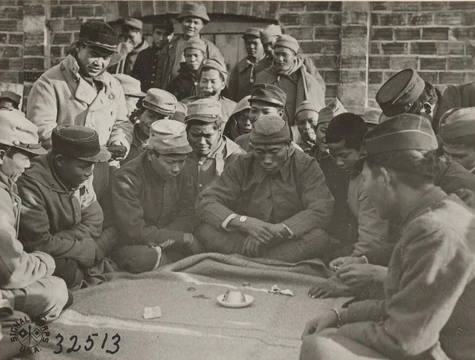
Hoo Hey How
Chinese dice game with fish, prawn, and crab symbols.

Hoo Hey How (Chinese: 魚蝦蟹; pinyin: yú xiā xiè; literally "Fish-Prawn-Crab") is a Chinese dice game using three identical six-sided dice. It shares roots with Vietnam's Bầu cua cá cọp, Cambodia's Klah Klok, and resembles Crown and Anchor in the West Indies and the American game chuck-a-luck.
A player and a banker face off on a canvas or felt mat printed with six symbols. The player bets on one or more symbols, then rolls the three dice. If a bet matches a symbol showing on any die, the banker returns the stake on that symbol and pays out according to how many dice show it: even money for one die, 2:1 for two, and 3:1 for three. If the symbol doesn't appear, the player loses that bet.
Based on calculations for Crown and Anchor, the chance a player loses their bet (no dice matching their symbol) is 57.9%. The odds of winning are 34.7% for one die, 6.9% for two, and 0.5% for all three. For every 100 yuan wagered, the player can expect to lose 7.87 yuan to the banker. In a casino, the house acts as banker; among friends, the banker role rotates.
Quick Facts
- P
- yúxiāxiè
- Poj
- hû-hê-hōe
- L
- fish-shrimp-crab
- Vie
- Bầu cua cá cọp
- Ki
- kʰlaː ˈkʰloːk
Facts from the source article.
Lore & Background
Hoo Hey How is played with three identical six-sided dice. The player places bets on one or more symbols from a mat marked with six symbols, then throws the dice. If a bet matches a symbol on one or more dice, the banker returns the stake and pays out according to the number of dice showing that symbol: even money for one, 2:1 for two, and 3:1 for three. If the symbol does not appear, the player loses the bet.
Reader's Guide
Hoo Hey How is a traditional Chinese dice game that shares mechanics with several regional variants, including Vietnam's Bầu cua cá cọp, Cambodia's Klah Klok, the West Indian Crown and Anchor, and the American game chuck-a-luck. The game's probability structure is well-documented: the chance of a player losing their bet is 57.9%, while winning odds are 34.7% for one die, 6.9% for two, and 0.5% for three. For every 100 yuan wagered, a player is expected to lose 7.87 yuan to the banker. In casino settings, the house acts as banker; among friends, the role rotates. This game illustrates the mathematical edge inherent in many dice-based gambling games, where the banker's advantage is built into the payout structure.
Did You Know?
- The game is related to Bầu cua cá cọp in Vietnam and Klah Klok in Cambodia.
- When played at a casino, the house acts as banker; when played with friends, the role rotates.
More in Dice games 1-24
Spotted an error? Know more?
Reader corrections go straight into our review queue. Suggest an edit · How this site is sourced