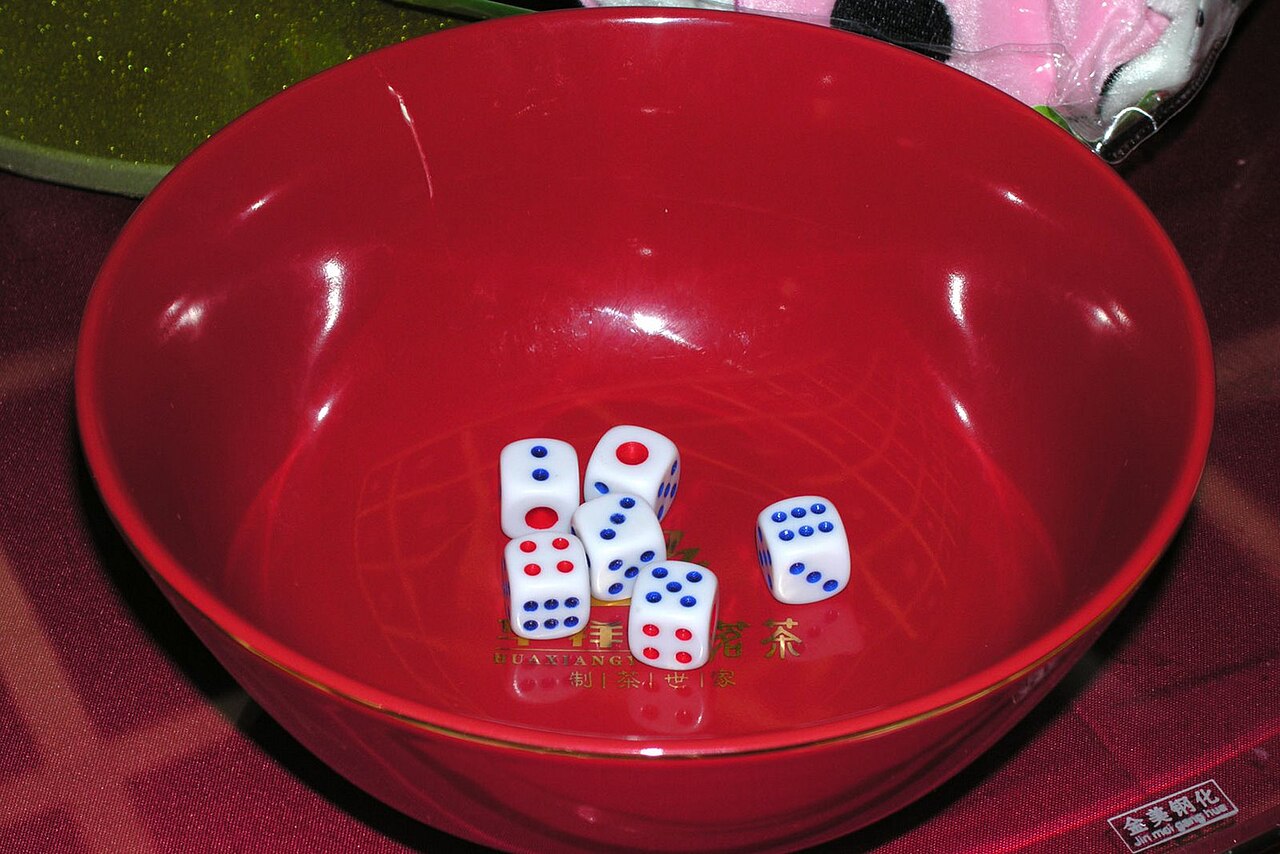
Bo Bing (game)
Chinese dice game played during the Mid-Autumn Festival.

Xmhaoyu · CC BY 3.0
Bo Bing is a Chinese dice game from Southern Fujian traditionally played during the Mid-Autumn Festival, also known as the Mooncake Festival. It is a national-level intangible cultural heritage of China as of 2008 and is also widely played among the Chinese Filipino community in the Philippines, where it is known as the Mooncake Festival Dice Game or Pua Tiong Chiu.
Quick Facts
- Other Names
- Po̍ah-piáⁿ / Po̍ah-chiōng-gôan-piáⁿ / Poa̍h-tiong-chhiu
- Years
- 17th century - present
- Genre
- Dice game
- Players
- 2+
- Random Chance
- High
- Materials
- Six dice, a bowl
Facts from the source article.
Lore & Background
The game dates back to the 1600s, when it is said to have been invented by Chinese general Koxinga of the Southern Ming. Zheng was stationed with his troops in Amoy during the Mid-Autumn Festival of 1660, and the game was an attempt to boost the morale of his homesick troops. The game became popular in Amoy (now Xiamen) and is considered a folk game.
The Hokkien Chinese name Po̍ah-piáⁿ translates as 'gambling for cakes', and the game traditionally has 63 different sized mooncakes as prizes: 32 of the smallest cake, half as many of the next largest, and so on ending with a single large champion cake. These days in mainland China, the game's instructions are often printed on mooncake packaging, although the game is also played with prizes of daily necessities, household appliances or money. In the Philippines, prizes often include money, daily necessities, household appliances, toys, school supplies, junk food, snacks, hobby items, and sometimes mooncakes.
The game requires six dice and a wide mouthed bowl. The first player is assigned by the eldest or most senior player rolling two dice and counting clockwise until the sum is achieved. Players throw the six dice into the bowl and win prizes based on dice combinations. Special rules include the ultimate throw (six fours) allowing the player to take all mooncakes from 6th to 1st place, and chasing of big prizes by other players.
Reader's Guide
Bo Bing is significant as a folk game that has endured for over 400 years, originating as a morale-boosting activity for troops during a military campaign. Its recognition as a national-level intangible cultural heritage of China in 2008 underscores its cultural importance. The game reflects the integration of gambling, celebration, and community bonding during the Mid-Autumn Festival. Its spread to the Philippines among the Chinese Filipino community shows its adaptability and enduring appeal across diasporas. The game's structure, with 63 mooncakes of descending sizes, creates a competitive yet communal experience. Modern adaptations, including prizes of daily necessities and money, show its evolution while maintaining traditional elements. The rituals associated with the game, such as wearing a champion hat and the winner purchasing next year's mooncakes, reinforce social ties and shared fortune. Bo Bing remains a living tradition that bridges historical roots with contemporary practice.
Did You Know?
- Bo Bing was invented in the 1600s by Chinese general Koxinga (Zheng Chenggong) to boost troop morale during the Mid-Autumn Festival.
- The game traditionally uses 63 mooncakes as prizes, with sizes ranging from 32 smallest cakes to one large champion cake.
- In the Philippines, the game is known as the Mooncake Festival Dice Game or Pua Tiong Chiu among the Chinese Filipino community.
- An ultimate throw of six fours allows the player to take all mooncakes from 6th to 1st place, even those already awarded.
The Die as Central Random Engine
Dice games occupy a distinctive niche in the tabletop landscape by placing one or more dice at the very heart of their mechanics. Rather than serving as a minor supplement to other components, the die functions as the sole or central element around which the entire experience is built. In most cases, this component operates as a random device, introducing an element of chance that shapes every turn and decision a player makes. This reliance on randomized outcomes sets dice games apart from purely strategic or deterministic systems, creating a tension between skill and luck that defines the genre's appeal. Whether a title falls into the traditional, proprietary, or collectible subcategory, the fundamental principle remains the same: the rolling of a die is the engine that drives the game forward, making each playthrough a fresh negotiation with probability.
The Collectible Dice Game Movement
Inspired by the enormous popularity of collectible card games, publishers began exploring a parallel model built around dice. A number of collectible dice games were released during this period, each attempting to replicate the expansion-driven, set-collecting experience that had made trading cards a cultural phenomenon. The results, however, proved short-lived in the mainstream market. Most of these titles are now long out of print, their production runs ended and their shelf presence largely gone. Yet the genre has not vanished entirely. A small but dedicated following continues to sustain interest in many of these products, keeping them alive through secondary markets and enthusiast communities. This lingering devotion suggests that the core appeal of collecting and building a dice-based set still resonates with a niche audience, even as the broader commercial wave has receded.
Notable Titles and Their Lineage
The catalog of published collectible dice games spans more than a decade and includes a variety of themes and design approaches. Among the earliest entries is Dicemaster: Cities of Doom, released in 1996, which helped establish the format in the mid-to-late nineties. Other titles from this era include Battle Dice, Cookie Fu, Demon Dice, Diceland, and Dragon Dice, each bringing its own flavor to the dice-collecting concept. The genre saw a notable revival in 2012 with Dice Masters, a system originally designed as a companion for the game Quarriors! before expanding to encompass additional titles. Additionally, licensed properties found their way into the format, as seen with the Star Trek: The Next Generation Collectible Dice Game. Together, these titles illustrate both the creative range publishers attempted and the eventual consolidation of the genre into a smaller, more specialized corner of the hobby.
Dice Games in the Wider Tabletop Family
Dice games do not exist in isolation but sit within a broader ecosystem of tabletop pastimes that share structural DNA. The categorization places them alongside traditional and proprietary subcategories, suggesting a spectrum from folk origins to modern commercial products. Cross-references to domino games, card games organized by card count, and cross-and-circle games highlight how closely related these family members are in terms of components and play patterns. A domino tile and a die both reduce outcomes to a small set of numerical possibilities; a card game's deck and a dice game's pool of dice both function as the source of random variation. This interconnectedness means that players drawn to one form of tabletop randomness often find natural entry points into another, and the design principles that make a dice game engaging frequently echo across the entire family of chance-based table games.
Gallery
Frequently Asked Questions
What is Bo Bing (game)?
Bo Bing is a traditional Chinese dice game that originated in Southern Fujian province. It is most closely associated with the Mid-Autumn Festival, where families gather to roll dice as a form of celebration and good-fortune ritual.
Who is credited with inventing Bo Bing (game)?
The game is traditionally attributed to General Koxinga, also known as Zheng Chenggong, the Ming-dynasty loyalist and military leader. According to folk tradition, he popularized the dice game among his troops and communities in the Fujian region.
Is Bo Bing (game) recognized as a cultural heritage?
Yes. In 2008, the Chinese government designated Bo Bing as a national-level intangible cultural heritage. This recognition underscores the game's long-standing role in Fujianese folk traditions and festival customs.
Is Bo Bing (game) played outside of China?
Absolutely. The game has a strong presence in the Philippines, where the Chinese Filipino community plays it during the Mooncake Festival. There it is commonly called the Mooncake Festival Dice Game or Pua Tiong Chiu.
Why is Bo Bing (game) culturally important?
Bo Bing serves as a living link to centuries-old Fujianese customs, binding family gatherings and festival celebrations to a shared ritual of dice-rolling. Its survival across generations—and its spread to diaspora communities like the Chinese Filipinos—makes it a symbol of cultural continuity.
More in Dice games 1-24
Spotted an error? Know more?
Reader corrections go straight into our review queue. Suggest an edit · How this site is sourced