Beetle (game)
A dice-drawing game where luck builds a beetle.

Lorc · CC BY 3.0
Beetle is a British party game where players build a beetle by drawing its body parts, guided by dice rolls. It relies entirely on luck, not skill, and is also known as Cootie or Bugs. The game can be played with just paper, a pen, and a die, or with a commercial set that may include custom scorepads and dice, or snap-together plastic pieces.
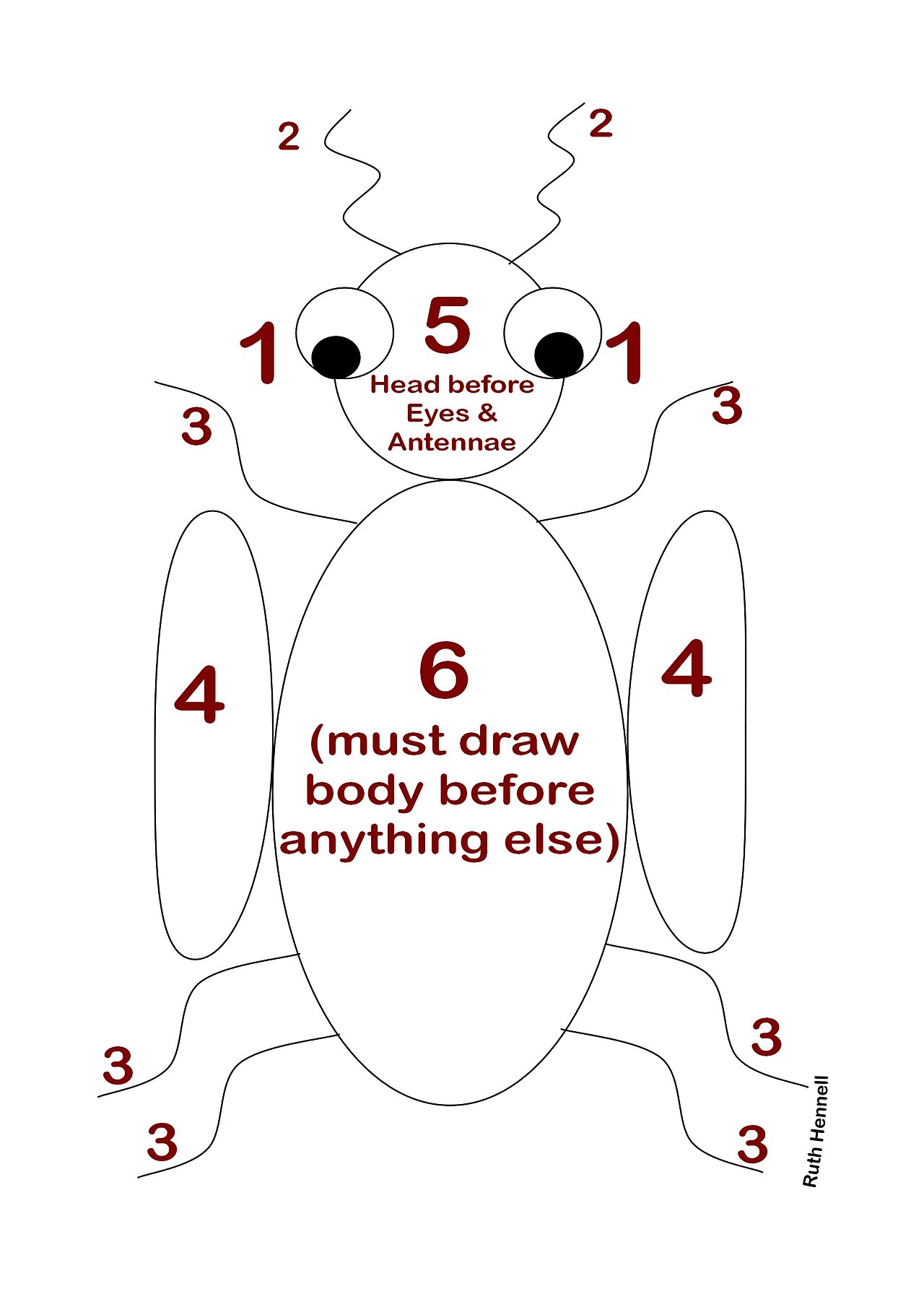
In the standard version, each die roll corresponds to a specific part: a six gives the body (one needed), a five gives the head (one), a four gives wings (two), a three gives a leg (six), a two gives an antenna (two), and a one gives an eye (two). Players can agree on different rules for which number matches which part. The body must be rolled first before any other part can be drawn. Once the body is in place, the head, legs, or wings can be added, but the head must come before the antennae and eyes. The first player to complete all parts wins.
Commercial versions include Cootie and Milton Bradley’s Beetle, where beetles are built as plastic models. In these, there are minor rule changes—for example, the beetles have no wings.
A beetle drive is a social event where many rounds are played. Players sit in groups of four, sharing one die. When someone finishes their beetle, they shout “Beetle!” and all groups stop. The winner of each group (the player with the most complete beetle) moves one table clockwise, while the loser (the least complete) moves anticlockwise, or stays put. The overall winner is usually the player who has drawn the most complete beetles or the most parts total. Beetle drives were especially popular as church fundraisers, particularly among Non-conformist churches, and the tradition continues today. In the North East of England, these events often include a “pie and pea” supper.
- Type
- Party game
- Origin
- British
- Also known as
- Cootie, Bugs
- Equipment
- Pen, paper, die; or commercial sets with custom scorepads, dice, or snap-together pieces
- Win condition
- First player to draw all requisite parts
Lore & Background
Beetle is played by rolling a die to determine which part of a beetle to draw. Traditional rolls assign the body to a six, head to a five, wings to a four, legs to a three, antennae to a two, and eyes to a one. The body must be drawn first, and the head must precede antennae and eyes. The first player to complete all parts wins.
The game has been commercialized as Cootie and as Beetle by Milton Bradley, with plastic model beetles and minor rule differences such as omitting wings. Beetle drives are social events where multiple rounds are played in groups of four with a communal die. When a player completes a beetle, they shout 'Beetle!' stopping all groups.
In a beetle drive, winners move clockwise to the next table and losers move anticlockwise, or sit still. The ultimate winner is determined either by the most complete beetles or the most parts drawn overall. Beetle drives were popular as church fund-raising events, especially among Non-conformist churches, and are often accompanied by a 'pie and pea' supper, particularly in the North East of England.
Reader's Guide
Beetle holds significance as a simple, luck-based party game that has endured through commercial adaptations and social gatherings. Its reliance entirely on dice rolls makes it accessible to all ages and skill levels, contributing to its popularity at church fund-raising events and beetle drives. The game's structure—requiring a specific order of drawing parts—adds a layer of strategy to pure chance. Commercial versions like Cootie and Milton Bradley's Beetle have broadened its reach, while the tradition of beetle drives, often paired with a 'pie and pea' supper, has kept the game alive in community settings, particularly in the North East of England. The game's legacy lies in its simplicity and social function, fostering group interaction and friendly competition without requiring any skill.
Did You Know?
- The game is sometimes called Cootie or Bugs.
- It is necessary to roll the correct number for the body before any other part may be drawn.
- Beetle drives were very popular as church fund-raising events, especially amongst Non-conformist churches.
The Dice as Engine of Chance
Dice games occupy a distinctive niche in the broader board game landscape by placing one or more dice at the very center of their mechanics. Rather than serving as a minor supplementary element, the dice function as the sole or primary random device that drives every meaningful decision a player makes. This design philosophy means that the outcome of each turn hinges on the tumble of a small object, creating a pure relationship between player strategy and probabilistic chance. The simplicity of this core loop—roll, interpret, act—has allowed dice games to persist across cultures and centuries without requiring elaborate rulebooks or complex component sets. The randomness is not an add-on; it is the engine itself, and every rule, every scoring condition, and every strategic choice exists in service of managing or exploiting that randomness. This makes the dice not merely a component but the defining identity of the entire game category.
Traditional Roots and Proprietary Branches
The history of dice games splits naturally into two broad streams. On one hand sit the traditional dice games—those passed down through oral and folk traditions, often with minimal components and rules explainable in a single sentence. These games rely on the universal human fascination with chance and have appeared in virtually every civilization that has carved or cast small objects for randomization. On the other hand, the proprietary stream represents the modern commercial publishing world, where individual designers and companies craft branded dice games with specific rule systems, thematic packaging, and retail distribution. While the traditional variety tends to be anonymous and regionally rooted, proprietary titles carry the name of a designer or publisher and are marketed as discrete products. Both streams share the same fundamental dependency on dice as the central randomizer, yet they differ enormously in cultural context, production scale, and how they reach players. Together they illustrate how a single mechanical idea can sustain both the oldest and newest expressions of tabletop play.
The Collectible Dice Game Phenomenon
In the wake of the enormous commercial success of collectible card games, publishers and designers saw an opportunity to transplant that same model onto the dice-game format. The result was a wave of collectible dice games in which players assembled pools of specially printed dice, each carrying unique abilities, values, or thematic content, much like the individual cards in a trading-card system. Titles such as Battle Dice, Cookie Fu, Demon Dice, Diceland, Dragon Dice, and the Star Trek: The Next Generation Collectible Dice Game all followed this template. Dicemaster: Cities of Doom, published in 1996, and Dice Masters, a 2012 system originally designed to support the Quarriors! game before expanding into its own broader franchise, represent two different eras of this collectible approach. The underlying appeal was the same: the tactile thrill of collecting, the strategic depth of building a personalized set, and the social ritual of trading and comparing one's collection against another player's.
A Niche That Endures
Despite the initial enthusiasm that surrounded the collectible dice game boom, the commercial reality proved far less forgiving than the card-game market. The vast majority of these titles are now long out of print, their production runs exhausted and their publishers having moved on to other product lines. Yet the disappearance from shelves did not extinguish the community entirely. A small but dedicated following continues to seek out, trade, and play these games well after their official lifespans have ended. Enthusiasts maintain knowledge of the rules, the set compositions, and the strategic interactions between individual dice, preserving a living culture around products that no longer have corporate backing. This quiet persistence mirrors the broader pattern seen in many tabletop niches: a commercial wave recedes, but the players who formed genuine attachments to the mechanics keep the tradition alive through word of mouth and the occasional rediscovery. The dice themselves, small and durable, outlast the cardboard boxes and rulebooks that once framed them.
Gallery



More in Dice games 1-24
Spotted an error? Know more?
Reader corrections go straight into our review queue. Suggest an edit · How this site is sourced