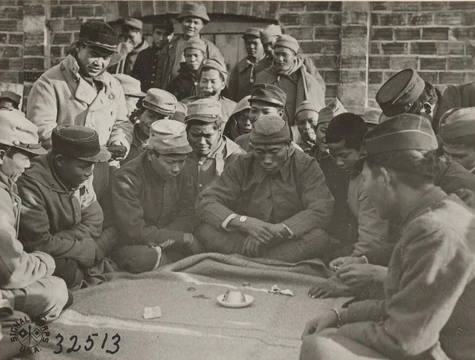
Bầu cua cá cọp
Vietnamese dice game played at New Year with animal pictures.

User:Krestavilis · Public domain
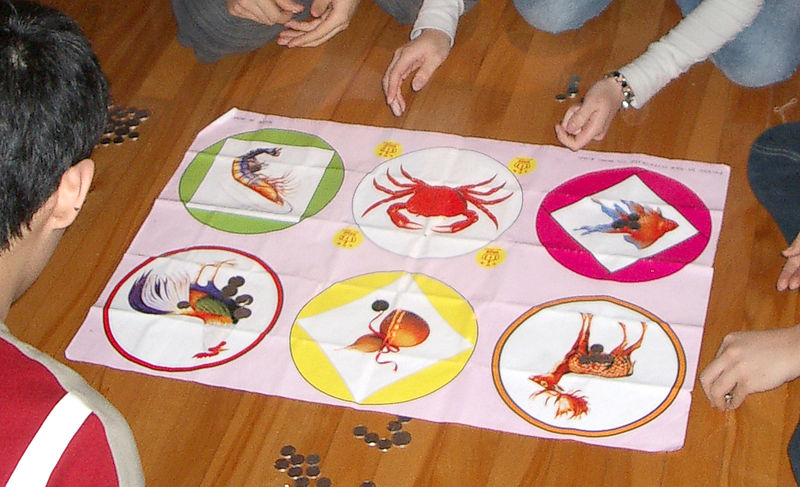
Bầu cua cá cọp, also called Bầu cua tôm cá or Lắc bầu cua, is a Vietnamese gambling game played with three dice. It is especially popular during Tết, the Vietnamese New Year. Unlike standard dice, each side of these dice is marked with a picture: a fish, a prawn, a crab, a cock, a calabash, and a stag (or a tiger). Players place bets on a board showing the same six images, wagering on which ones will appear when the dice are rolled. If one die matches a player’s bet, they win an amount equal to their wager. If two dice match, they win double their bet; if all three match, they win triple. For example, betting 3 đồng on fish and rolling one fish, one crab, and one stag would return the original 3 đồng plus an additional 3 đồng. Any money not won stays in a central pool managed by the dealer, who also rolls the dice. This game is related to Hoo Hey How (Fish-Prawn-Crab) in China, Klah Klok or Kla Klouk in Cambodia, and shares similarities with the dice games Crown and Anchor (adopted by British sailors) and chuck-a-luck in America, though these games have independent origins.
- Type
- Gambling game
- Origin
- Vietnam
- Dice
- Three dice with six pictures
- Pictures
- Fish, prawn, crab, cock, calabash, stag (or tiger)
- Played at
- Vietnamese New Year
- Related games
- Hoo Hey How (China), Klah Klok/Kla Klouk (Cambodia), Crown and Anchor (British), chuck-a-luck (America)
Lore & Background
Bầu cua cá cọp is a traditional Vietnamese gambling game that uses three dice, each side bearing one of six pictures: a fish, a prawn, a crab, a cock, a calabash, and a stag (or a tiger). Players place wagers on a board displaying these six images, betting on which pictures will appear when the dice are rolled. The game is especially popular during the Vietnamese New Year celebrations.
Reader's Guide
The game's significance lies in its cultural role as a festive pastime during Vietnamese New Year, and its status as the Vietnamese original version of similar dice games found across Asia and adopted by Western sailors. The rules are straightforward: if one die matches a bet, the bettor receives the same amount as their bet; two matches yield double; three matches triple. The bettor keeps their original stake if they win. Any money not rewarded goes into a central pool managed by the dealer, who rolls the dice. This game is essentially the Vietnamese original of Hoo Hey How (Fish-Prawn-Crab) played in China, Klah Klok/Kla Klouk in Cambodia, and the dice games Crown and Anchor adopted by British sailors and chuck-a-luck played in America. Its legacy is as a simple, culturally embedded gambling game that has parallels in many other traditions.
Did You Know?
- The dice sides show pictures of a fish, prawn, crab, cock, calabash, and stag (or tiger) instead of pips.
- If a player bets 3 đồng on fish and the dice show one fish, one crab, and one stag, they receive 3 đồng and keep their original 3 đồng bet.
- The game is related to Hoo Hey How (China), Klah Klok/Kla Klouk (Cambodia), Crown and Anchor (British), and chuck-a-luck (America), though each has its own independent origins.
- Any money not rewarded for a round is kept in a central pool managed by the dealer.
Origins and Cultural Significance
Bầu cua cá cọp, literally translating to 'gourd crab fish tiger,' stands as a distinctly Vietnamese dice game with deep roots in the country's festive traditions. The game carries alternative names such as Bầu cua tôm cá and Lắc bầu cua, reflecting regional or colloquial variations in how players refer to it. Most notably, it is strongly associated with the Vietnamese New Year, when families and communities gather and the game becomes a centerpiece of celebration. Its presence during this period underscores how the game functions not merely as a form of entertainment or gambling but as a cultural ritual embedded in one of the most important moments of the Vietnamese calendar. The very naming of the game—referencing everyday creatures and objects familiar to Vietnamese life—signals its homegrown character. Rather than being an imported pastime, it is presented as the Vietnamese original from which several other regional variants later emerged, giving it a foundational place in the broader Southeast Asian and even global dice-game tradition.
The Dice and Their Imagery
What immediately distinguishes Bầu cua cá cọp from standard Western dice games is the design of its three dice. Rather than the familiar arrangement of one to six pips, each face of the dice bears a distinct pictorial symbol. The six images are a fish, a prawn, a crab, a cock, a calabash, and a stag or tiger. These choices draw on creatures and objects that would be instantly recognizable to players in a Vietnamese setting, grounding the game in a local visual vocabulary. The betting board mirrors this imagery, displaying the same six pictures as the possible outcomes onto which players place their wagers. The dealer is the one who physically shakes and rolls the three dice, making the act of rolling a central, almost ceremonial moment in each round. The use of pictures rather than numbers also makes the game accessible to players who may not be literate in numerical notation, broadening its appeal across different age groups and educational backgrounds within a community.
Wagering Mechanics and Payouts
The betting structure of Bầu cua cá cọp is straightforward yet creates a satisfying layer of anticipation. Players stake their wagers on whichever of the six pictured outcomes they believe will appear among the three dice. The payout scales directly with how many of the three dice match the chosen picture: a single matching die returns the bettor an amount equal to their original stake, two matching dice return double the wager, and all three dice landing on the same picture triple the return. For example, a player who places three đồng on the fish and sees the dealer roll one fish, one crab, and one stag would collect three đồng in winnings while also retaining the three đồng originally placed. Crucially, any stakes that do not win in a given round are not lost to individual opponents but instead flow into a central pool overseen by the dealer. This pooled system means the house, rather than other players, stands as the counterparty to every wager, simplifying the social dynamics of the game and concentrating the financial risk in a single managing role.
A Global Family of Dice Games
Bầu cua cá cọp is not an isolated invention but rather the Vietnamese original from which a recognizable family of dice games has branched across cultures and continents. In China, the closely related game known as Hoo Hey How, sometimes called Fish-Prawn-Crab, carries forward the same core concept of pictorial dice and straightforward wagering. Cambodia has its own variant, referred to as Klah Klok or Kla Klouk, which similarly adapts the three-dice, picture-based format to local tastes. The influence extends even further afield: British sailors adopted a version called Crown and Anchor, and in America the game took the form of chuck-a-luck, a staple of saloons and fairgrounds. This widespread diffusion suggests that the Vietnamese game holds a foundational position in a much larger tradition of simple, fast-paced dice gambling. Each regional iteration preserves the essential mechanics—three dice, a set of distinct outcomes, and proportional payouts—while localizing the imagery and cultural context to suit its new audience.
Gallery
Frequently Asked Questions
What is Bầu cua cá cọp?
It is a Vietnamese gambling game in which players roll three specially marked dice and wager on which of six pictured symbols will land face-up. The game is also called Bầu cua tôm cá or Lắc bầu cua and is a fixture of Vietnamese New Year festivities.
What symbols are printed on the Bầu cua cá cọp dice?
Each face of the three dice carries one of six images: a fish, a prawn, a crab, a cock, a calabash, and a stag (sometimes depicted as a tiger). These pictures replace the numbered pips you would find on standard dice.
How are winnings calculated in Bầu cua cá cọp?
If a single die shows the symbol you bet on, you win back an amount equal to your original stake. Two matching dice double your return, and the rare event of all three dice landing on your chosen symbol triples it.
When do Vietnamese people traditionally play Bầu cua cá cọp?
The game is most strongly tied to Tết, the Vietnamese Lunar New Year, when street vendors and family gatherings set up betting boards. Although it can be played year-round, the New Year period is its peak season.
Is Bầu cua cá cọp related to dice games in other cultures?
Yes—the same core mechanic of betting on which of several symbols will appear on rolled dice shows up in China's Hoo Hey How, Cambodia's Klah Klok, Britain's Crown and Anchor, and America's chuck-a-luck. Bầu cua cá cọp is the Vietnamese branch of this widespread game family.
More in Dice games 1-24
Spotted an error? Know more?
Reader corrections go straight into our review queue. Suggest an edit · How this site is sourced