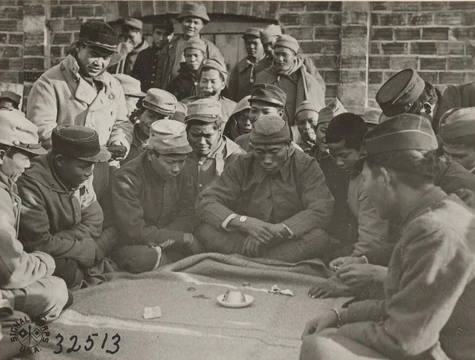
Biscuit (game)
A dice-driven drinking game with a rotating Biscuit.

Harpreet 712 · CC BY-SA 4.0
Biscuit, also known as Bizkit or Biskit, is a drinking game that uses two dice. The game begins with each player rolling the dice once.
- Rolling double ones (1,1) means everyone takes a drink. - Rolling double sixes (6,6) lets the roller invent a new rule that applies for the rest of the game; breaking this rule requires a penalty drink. - Rolling any other doubles (2,2; 3,3; 4,4; 5,5) allows the roller to assign drinks to one or more players equal to the number on one of the dice. - Rolling a total of 3 means the Biscuit player must drink and then ceases to be the Biscuit. The game then has no Biscuit until a 7 is rolled (or another rule names a new Biscuit). - Rolling a total of 7 makes all players put a thumb on their forehead and say "Biscuit." The last player to do so drinks and becomes the new Biscuit. - Rolling a total of 9 means the player to the roller's right drinks. - Rolling a total of 10 means the roller drinks. - Rolling a total of 11 means the player to the roller's left drinks.
After each roll, the dice pass clockwise to the next player.
Quick Facts
- Title
- Biscuit
- Italic Title
- no
- Genre
- Drinking
- Players
- 3+
- Playing Time
- Based on # of players and random chance
Facts from the source article.
Lore & Background
The game begins with each player rolling the dice one time. The first person to roll 7 becomes 'The Biscuit'. That player then rolls the dice, and the result determines the action. Rolling (one, one) makes everyone take a drink. Rolling (six, six) requires the roller to invent a rule that applies for the rest of the game; breaking it requires a penalty drink. Rolling any other doubles allows the roller to give drinks to one or several players equal to the number on one of the dice rolled.
Reader's Guide
A total of 3 is called a 'challenge': the roller chooses a player, who must roll the dice. The results are added, and the first roller must make a higher total. If the first roller wins, the chosen player drinks the difference; if the first roller fails, they drink the difference. A total of 7 prompts all players to put a thumb on their forehead and say 'Biscuit'; the last to do so drinks and becomes the new Biscuit. A total of 9 makes the person to the right of the roller drink; a total of 10 makes the roller drink; a total of 11 makes the person to the left drink. Whenever the number 3 appears on the dice (including as a double three), the Biscuit player must take a drink (two drinks for double three) and then ceases to be the Biscuit; the game then has no Biscuit until 7 is rolled again or another rule nominates a Biscuit. After rolling, dice pass to the next player clockwise.
Did You Know?
- The game is also referred to as Bizkit or Biskit.
- The first player to roll 7 becomes 'The Biscuit'.
The Dice as Engine of Chance
Dice games occupy a distinctive niche in the world of tabletop play. At their core, these games rely on one or more dice serving as the sole or central component, functioning primarily as a random device. This sets them apart from games where dice are merely supplementary tools; here, the roll of the die is the beating heart of the experience. Whether a title falls into the traditional category, the proprietary category, or the collectible category, the unifying thread is that chance, mediated through those small cubic or polyhedral objects, drives the action forward. The simplicity of the mechanism—toss, read, act—has made dice games a persistent and cross-cultural form of play, requiring little beyond the dice themselves and a shared table. In this way, the humble die remains one of the oldest and most reliable engines of uncertainty in human recreation.
The Collectible Dice Game Boom
Inspired by the enormous commercial success of collectible card games, publishers in the late 1990s and beyond attempted to replicate that model using dice as the collectible element. A wave of collectible dice games hit the market, each offering players the ability to build and trade sets of specially designed dice. The concept was straightforward: just as card games let players assemble decks from purchased packs, dice games let players assemble dice sets. Titles like Dice Masters, which launched in 2012 as a system designed for Quarriors! before expanding to support other games, represented a later iteration of this idea. The collectible format added a layer of identity and progression beyond a single session, encouraging players to invest in growing their personal dice collections over time and to seek out rare or desirable pieces from the broader catalog.
A Roster of Diverse Titles
The collectible dice game space produced a varied array of titles, each with its own flavor and mechanical identity. Battle Dice, Cookie Fu, and Demon Dice each carved out their own niche within the genre. Dicemaster: Cities of Doom, published in 1996, represented an earlier entry in the field. Dice Masters arrived much later in 2012, originally conceived as a system for the Quarriors! game before branching out to support additional titles. Diceland and Dragon Dice added further variety to the landscape. Perhaps most notably, the franchise licensing angle was explored with Star Trek: The Next Generation Collectible Dice Game, which brought a well-known television property into the dice-collecting space. Together, these titles illustrate the breadth of themes and design philosophies publishers attempted to capture within the collectible dice format, ranging from fantasy and science fiction to more abstract or humorous concepts.
Nostalgia and Niche Communities
Despite the initial enthusiasm surrounding collectible dice games, the vast majority of titles in this category are now long out of print. The commercial window that once supported these products has closed, and new releases in the collectible dice space are exceedingly rare. Yet the genre has not vanished entirely. A small but dedicated following persists for many of these games, with players who remember the excitement of opening a new dice pack or who still seek out used sets in the secondary market. This quiet endurance speaks to the emotional connection players formed with their dice collections over the years. The community, though modest in size, keeps the memory of games like Cookie Fu or Dragon Dice alive, ensuring that the collectible dice era remains a recognized and fondly recalled chapter in the broader history of tabletop gaming.
Gallery
Frequently Asked Questions
What is Biscuit (the dice game)?
Biscuit is a group drinking game built around a rotating "Biscuit" role that determines who rolls and triggers actions for everyone at the table. It requires only two standard dice and works for any number of players.
How do you become "The Biscuit" in the game?
At the start, every player rolls the two dice once, and the first person to land a 7 claims the Biscuit title. That player then takes over rolling for the round, with the outcome dictating what everyone else does.
What happens when The Biscuit rolls doubles?
Double ones force every player to take a drink, while double sixes let the roller invent a new rule that stays in effect for the rest of the session. Any other pair (2-2 through 5-5) lets the Biscuit assign a number of drinks equal to the die value to one or more players of their choosing.
What equipment and player count does Biscuit require?
All you need is a pair of standard six-sided dice and a group of players willing to take turns rolling. The rules specify no minimum or maximum number of participants, so it scales to any table size.
Why is the number 7 so central to Biscuit?
Rolling a 7 is the key to seizing the Biscuit role during the opening round, making it the most consequential roll of the entire game. It is also listed among the special totals (alongside 3, 9, 10, and 11) that carry unique significance in the game's structure.
More in Dice games 1-24
Spotted an error? Know more?
Reader corrections go straight into our review queue. Suggest an edit · How this site is sourced