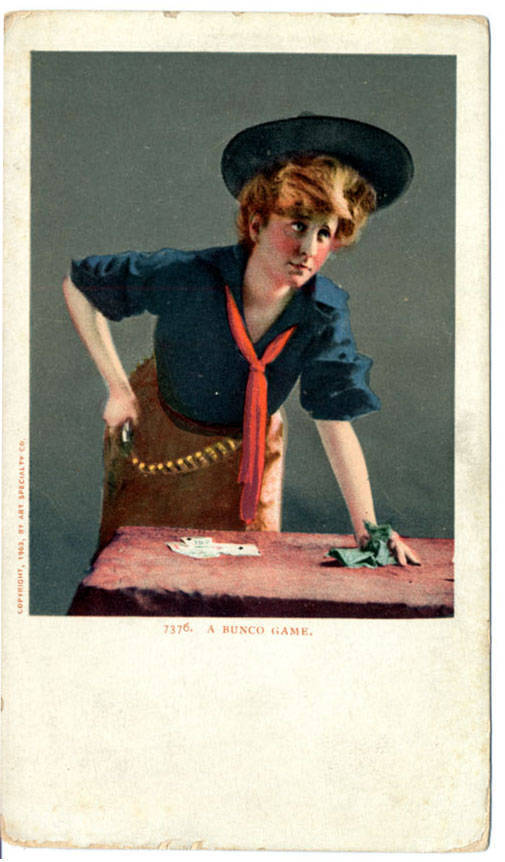
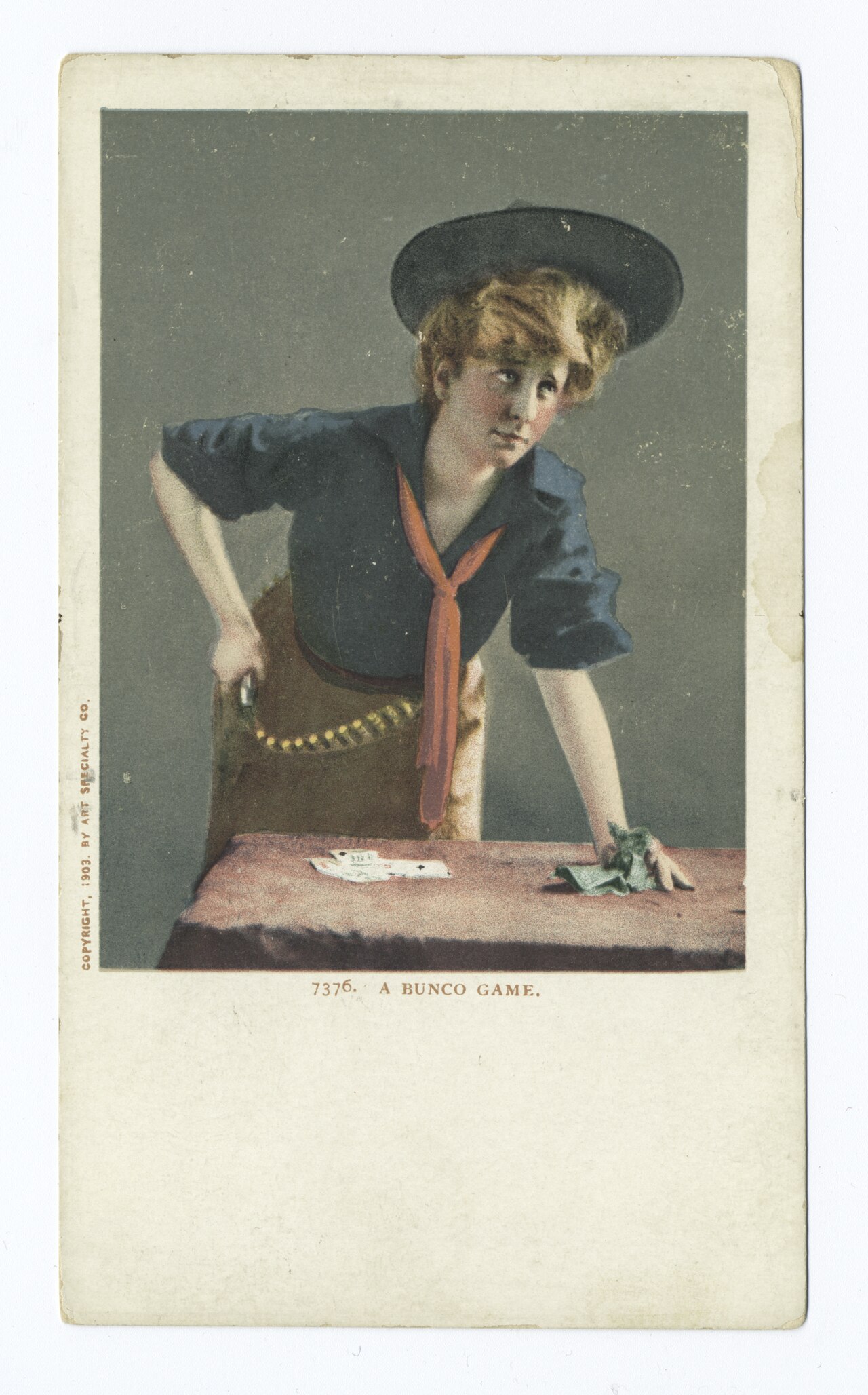
Bunco
A dice game evolving from swindle to social pastime.

Detroit Publishing Company · Public domain
Bunco (also spelled bunko, bonko, or buncko) is a dice game for twelve or more players, who split into groups of four. Players take turns rolling three dice over six rounds, aiming to score points. A "bunco" happens when a player rolls three of a kind that all match the number of the current round, which is set at the start of that round.
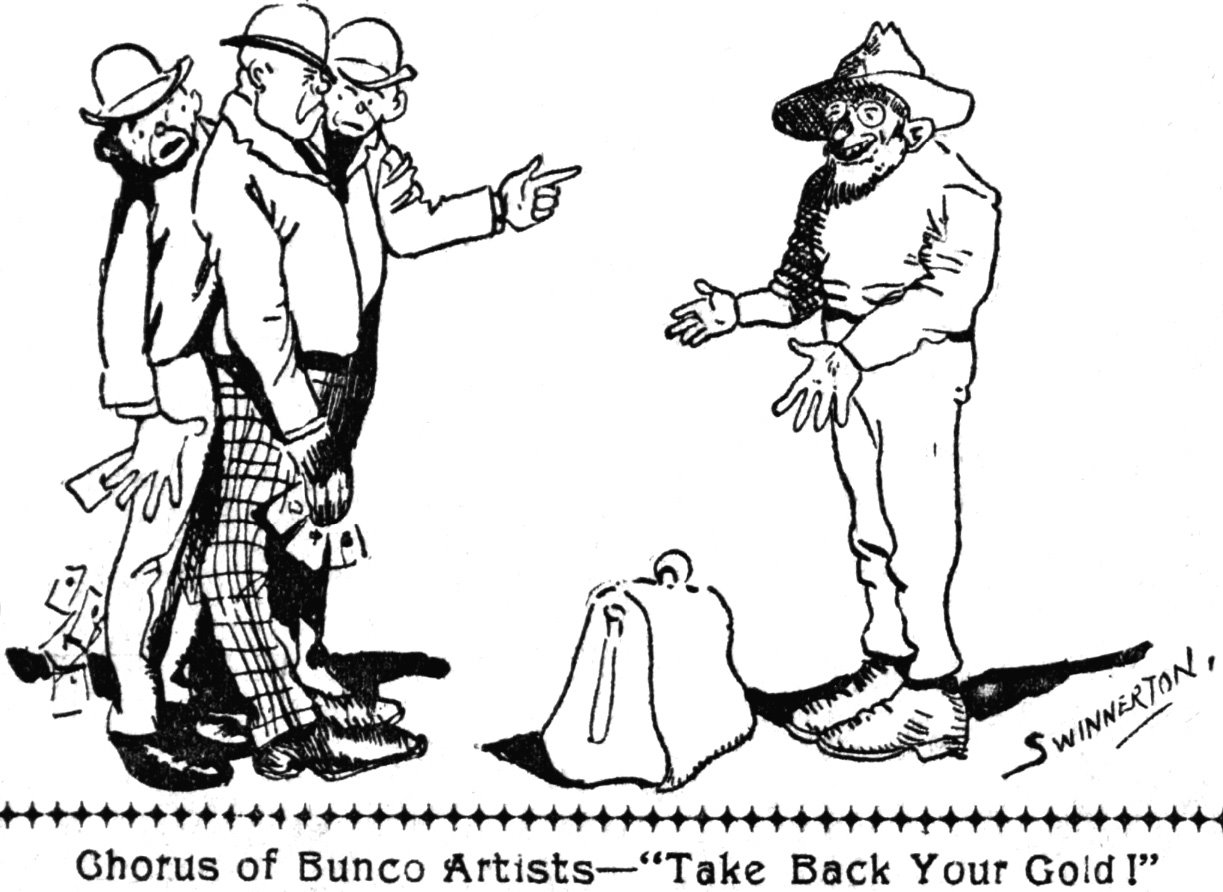
The game's name likely derives from a 19th-century English confidence trick called "bunco" or "bunko," similar to three-card monte. However, the dice game itself evolved later in the United States, not directly from that English con. The earliest documented references to bunco as a dice game in the U.S. are from the late 19th century. The term "bunco" came to label both the gambling halls (bunco parlors) and any swindle. After the Civil War, it turned into a popular parlor game. During Prohibition in the 1920s, bunco returned as a gambling game, often found in speakeasies; police units that raided these places were known as "bunco squads." It saw a revival as a family game in the 1980s. According to the World Bunco Association, the game became popular again in the United States in the early 2000s, with claims that in 2005 over 59 million women had played bunco and over 27 million played regularly. Bunco club members often host in turns, providing snacks, drinks, and tables. Small amounts of money may be involved. The game is sometimes called the "housewife's drinking game."
Each game has six rounds, numbered one through six. Players roll three dice. One point is given for each die that matches the round number, five points if all three dice match each other but not the round number, and 21 points if all three match the round number (a bunco). If a player scores any points, they roll again, adding to their score. If no points are scored, their turn ends and the dice pass to the next player at the table. A round ends when a player reaches 21 points, so rolling a bunco wins the round instantly. The game finishes after all six rounds. The player who wins the most rounds is the overall winner; ties are usually broken by comparing total points.
In larger tournaments, players form teams of two, and multiple tables play at once.
Quick Facts
- Title
- Bunco
- Genre
- Dice rolling
- Players
- 2 or more, usually in teams of two
- Ages
- 4 and up
- Setup Time
- 1–5 minutes
- Playing Time
- 30 minutes to multiple hours
- Random Chance
- High
- Skills
- Counting and simple mathematics
Facts from the source article.
Lore & Background
After the Civil War, bunco evolved into a popular parlor game. During the 1920s and Prohibition, it was re-popularized as a gambling game, often associated with speakeasies. Law-enforcement groups raiding these parlors came to be known as 'bunco squads.' Bunco saw a resurgence in popularity as a family game in the 1980s. According to the World Bunco Association, the game saw a resurgence in popularity in the United States in the early 21st century; in 2006, it was claimed that during the previous year 'over 59 million women have played bunco and over 27 million play regularly.' Members of bunco clubs often take turns hosting, providing snacks, refreshments and the tables to set up the games. Small amounts of money can be involved as well. Bunco is sometimes called the 'housewife's drinking game.'
Reader's Guide
Bunco's significance lies in its transformation from a 19th-century confidence game into a widespread social activity, particularly among women in the United States. Its history reflects broader cultural shifts: from gambling dens and speakeasies during Prohibition to family parlors in the 1980s and organized clubs in the early 21st century. The game's simple rules—rolling three dice across six rounds, scoring points for matches and buncos—make it accessible for large groups. The World Bunco Association reported that in 2006 over 59 million women had played bunco in the previous year, with over 27 million playing regularly. The first bunco World Championship was held in 2006, broadcast on the Oxygen Network and sponsored by Procter & Gamble's Prilosec OTC, benefiting the National Breast Cancer Foundation. The sponsorship ended in 2008. Bunco's legacy includes its role in community building, its association with law enforcement 'bunco squads,' and its enduring appeal as a casual, competitive game.
Did You Know?
- Bunco was originally created as a confidence game similar to three-card monte.
- During Prohibition, law-enforcement groups raiding bunco parlors were known as 'bunco squads.'
- The first bunco World Championship was held in 2006 and broadcast on the Oxygen Network.
- Bunco is sometimes referred to as the 'housewife's drinking game.'
From Street Swindle to Living-Room Staple
Bunco traces its roots to nineteenth-century England, where it emerged as a street-level confidence game in the same family as three-card monte, operating under the name 'eight dice cloth.' In 1855 the game crossed the Atlantic and took hold in San Francisco, where it became a staple of gambling parlors. The word 'bunco' itself became so entrenched in the city's criminal lexicon that it came to mean any kind of swindle, long before it was associated with a friendly dice pastime. Following the American Civil War, the rough edges were sanded off and bunco transformed into a respectable parlor game. The Prohibition era of the 1920s briefly dragged it back into the world of illicit gambling, where it found a natural home alongside speakeasies. Police units tasked with busting these establishments earned the colorful nickname 'bunco squads.' By the 1980s the game had fully shed its criminal associations and re-emerged as a wholesome family activity, setting the stage for the modern social phenomenon it is today.
The Mechanics of a Bunco
At its core, bunco is a game of patient accumulation played with three dice across six sequential rounds. A full game requires at least twelve participants seated in groups of four around a table. Each round is anchored to a specific number from one to six, and every roll is judged against that target. A single die matching the round number earns one point; rolling a triple of any other number nets five points; but landing a perfect match—three dice all showing the round number—produces a 'bunco,' worth a staggering twenty-one points and an immediate victory for that round. The reward for scoring is the right to roll again, allowing a lucky player to snowball their total. When no points are earned, the dice pass to the next player. The overall champion is whoever claims the most round victories, with total points serving as the tiebreaker. This structure makes every turn a small gamble: do you keep rolling and risk losing your streak, or is the round already decided?
The Social Ritual of the Bunco Club
By the early 21st century, bunco had become a massive social institution in the United States. The World Bunco Association reported in 2006 that more than fifty-nine million women had played the game in the preceding year, with over twenty-seven million doing so on a regular basis. The typical bunco gathering is a rotating-host affair: club members take turns providing the venue, laying out tables, and serving snacks and refreshments while the dice clatter. Small stakes—modest amounts of money—sometimes add a layer of friendly competition. The game has even earned the playful moniker 'the housewife's drinking game,' a nod to the casual, social setting in which it thrives. What makes bunco distinctive in the landscape of board and dice games is its emphasis on community over individual mastery. The ritual of hosting, the shared snacks, the laughter over a lucky triple—these elements matter as much as the scoring. It is, in many ways, a game about the table as much as the dice.
Tournaments and the World Championship
Beyond the casual living-room game, bunco has developed a competitive tournament structure that adds a layer of strategic movement. In larger events, players compete in pairs, and multiple tables run simultaneously. The table deemed highest in standing is called the 'head table' or, in some traditions, the 'queen's table.' After each round, the winning pair at any given table advances to the next-highest-ranked table, while the losing pair at the head table drops to the lowest-ranked one. This promotion-and-relegation system keeps every table engaged and creates a constant shuffle of competitors. On the grandest stage, the first bunco World Championship took place in 2006, broadcast on the Oxygen Network. It was sponsored by Procter & Gamble's anti-heartburn product Prilosec OTC, with proceeds benefiting the National Breast Cancer Foundation. P&G maintained its sponsorship for three years before discontinuing its involvement in October 2008, but the championship had already cemented bunco's place as a legitimate competitive pursuit.
Gallery
Frequently Asked Questions
What is Bunco and how do you play it?
Bunco is a social dice game in which twelve or more players split into teams of four. Each player rolls three dice across six rounds, trying to rack up points while the target number shifts with every round.
Where does the name "Bunco" come from?
The title traces back to a 19th-century English street swindle called "bunco" or "bunko," a confidence trick similar to three-card monte. The dice game that borrowed the name developed independently in the United States and was not a direct outgrowth of that English con.
What does it mean to roll a "bunco"?
A bunco occurs when all three dice land on the same number and that number matches the round's target. It is the top-scoring roll of a turn and the event the entire game is named after.
How many players and rounds does a standard game require?
A full game calls for at least twelve participants divided into four-person groups. The session runs six rounds, with the target number changing at the start of each one.
When did Bunco become popular in the United States?
The earliest documented references to the dice game date to the late 1800s in the U.S. It enjoyed a major resurgence as a family-friendly parlor game in the 1980s and has stayed a staple of social club gatherings into the early 21st century.
More in Dice games 1-24
Spotted an error? Know more?
Reader corrections go straight into our review queue. Suggest an edit · How this site is sourced