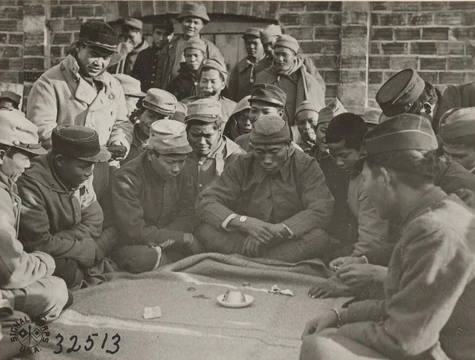
Bozó (dice game)
Brazilian dice game related to Yahtzee, played with five dice.

Bozó, a Brazilian dice game with unknown origins, is especially popular in the states of Mato Grosso and Mato Grosso do Sul. Played with five six-sided dice and a leather cup, it shares close ties with Yahtzee. Two to six players compete, taking turns in a clockwise order. Each turn allows up to three rolls, with the dice shaken in the cup and inverted onto a flat surface; any dice that land stacked must be re-rolled until all lie flat. Players aim to form specific scoring combinations, choosing which to pursue across ten categories. Scores are recorded on a sheet, and the highest total at game’s end wins. Variations allow individual play or teams of two or three.
Scoring rules for combinations can differ regionally or informally. Special rules add nuance: *de boca* awards a 5-point bonus for certain combinations achieved on the first roll. *Baixo*, an optional rule declared after the first roll (usable only on the second or third), counts each die by its opposite face value. *Torar* lets a player forfeit a scoring category instead of assigning a result, after which that category cannot be used again.
Quick Facts
- Title
- Bozó
- Players
- 2–6
- Skills
- strategy · logical reasoning
- Ages
- 8+
- Related
- Yahtzee
Facts from the source article.
Lore & Background
Bozó is a dice game of unknown origin that is popularly played in the Brazilian states of Mato Grosso and Mato Grosso do Sul. Play proceeds in a clockwise direction, and in some variations, players may compete individually or form pairs or trios. At the start of the game, the player places all the dice inside a cup, shakes it, and inverts it onto a flat surface, ensuring that none of the dice escape. Upon lifting the cup, the player must check whether any dice are stacked on top of one another; if this occurs, the dice are re-rolled until all are resting flat on the surface.
Reader's Guide
Bozó is a significant cultural pastime in the Brazilian states of Mato Grosso and Mato Grosso do Sul, where it is popularly played despite its unknown origin. The game's structure—allowing up to three rolls per turn across ten scoring categories—creates strategic depth, as players must decide which combinations to pursue and whether to invoke special rules. The optional rules add complexity: 'De boca' awards a bonus of 5 points for certain combinations achieved on the first roll; 'Baixo' allows counting dice as their opposite face value but can only be declared after the first roll; and 'Torar' lets a player forfeit a scoring category permanently. These variations reflect the informal, regional nature of the game. Bozó's close relation to Yahtzee places it within a broader family of dice games, but its unique cup-shaking method and regional popularity give it a distinct identity in Brazilian gaming culture.
Did You Know?
- The game is typically played by two to six players.
- A combination achieved on the first roll is called 'de boca' and may grant an additional 5 points.
- The 'Baixo' rule allows each die to be counted as its opposite face value.
Historical Roots & Family of Dice Games
Yacht is a public domain dice game whose origins stretch back to at least 1938, making it a contemporary of the three-dice game Crag. It belongs to a broad family of five-dice games that span multiple cultures and languages. In Latin America, players have long enjoyed Generala; in England, Poker Dice occupies a similar niche; Scandinavia gave the world Yatzy; and Cheerio rounds out the list of close relatives. All of these share the fundamental premise of rolling dice to form scoring combinations, yet each carries its own cultural flavor and rule variations. The name "Yacht" has since been borrowed by a number of later dice games that incorporate many features of Yahtzee, making those newer titles closer to Yahtzee than to the original 1938 Yacht. Yahtzee itself is a later development that echoes Yacht in both its name and its core content, yet it diverges in several important rule details. Because Yacht exists in the public domain, no single publisher or designer claims ownership, and the game has circulated freely across borders and decades without a single canonical rulebook to pin down every detail.
Turn Structure & Strategic Choice
A standard game of Yacht unfolds over twelve rounds, and the central tension of each round comes from a single decision: which scoring category to commit to. The player rolls five dice and may re-roll up to three times in total, attempting to shape a combination that fits the chosen category. Once a category has been claimed in a given game, it is permanently removed from the pool, so every subsequent round offers a narrower menu of options. Categories fall into two broad types. Some carry a fixed point value regardless of which dice appear, while others award points based on the actual values showing on the dice. The pinnacle of the scoring table is the Yacht itself—five-of-a-kind—which pays a flat 50 points, the highest possible value in any single category. At the end of all twelve rounds, the player with the greatest total score takes the win. The absence of an official rulebook means that house variants can shift some details, but the twelve-round, three-roll, pick-your-category framework remains the defining skeleton of the game.
The Twelve-Category Scoring Table
Yacht's score sheet lists exactly twelve categories, and a player who selects a category but fails to meet its requirements simply records zero for that round. Among the more intricate rules: a Yacht (five-of-a-kind) cannot be double-counted as a Full House, though it may be scored under Four of a Kind, with the fifth die excluded from the tally. The two straight categories—Big Straight and Small Straight—are both five-dice sequences, and their point values vary by rule set, though a common assignment is 30 points each. Under the most frequently cited scoring scheme, the theoretical maximum a single player can achieve across all twelve categories is 297 points. Notably, there is no three-of-a-kind category, no upper-section bonus, and no Joker or extra-award mechanism. The score sheet lacks the "upper" and "lower" section divisions found in some related games; instead, a single "Total" row at the bottom captures the final sum. Category names also differ from those in later variants: "Ones" rather than "Aces," "Big Straight" rather than "Large Straight," "Yacht" rather than "Yahtzee," and "Choice" rather than "Chance."
How Yacht Diverges from Yahtzee
Although Yahtzee is a later development that borrows heavily from Yacht in both name and structure, the two games differ in several concrete rule details that reshape the strategic landscape. Yacht has no upper-section bonus, no Yahtzee-bonus or Joker rule, and no three-of-a-kind category. Its two straights are both five-dice sequences—Big Straight running two through six and Small Straight running one through five—whereas Yahtzee includes a four-dice small straight. Scoring differences are equally significant. In Yacht, Four of a Kind scores the sum of only those four matching dice, not all five as in Yahtzee. Full House awards the sum of all five dice rather than a flat 25. Straight values can also differ from Yahtzee's standard 40 points. The order of categories on the score sheet may be rearranged, and the sheet itself omits the upper/lower section split, offering only a single Total line. Because Yacht has no official rules, many of these scoring details are left to the variant in play, making each table's version a slightly different game.
Frequently Asked Questions
What is Bozó?
Bozó is a Brazilian dice game of unknown origin that is mechanically very close to Yahtzee. It is played with five standard six-sided dice, a leather cup, and a score sheet, supporting two to six players.
How does a turn work in Bozó?
A player shakes the dice in the cup and inverts them onto a flat surface, getting up to three rolls per turn. Any dice that land stacked must be re-rolled until every die lies flat before the player picks a scoring category to record the result.
How is Bozó different from Yahtzee?
Although both games use five dice, ten scoring categories, and a three-roll structure, Bozó is a distinct Brazilian variant with its own cultural identity. It is especially associated with the states of Mato Grosso and Mato Grosso do Sul rather than the broader international Yahtzee community.
Where is Bozó most commonly played?
The game is particularly popular in the Brazilian states of Mato Grosso and Mato Grosso do Sul. Its exact origins remain unknown, but it has become a well-known local pastime in those regions.
What equipment do you need to play Bozó?
You need five six-sided dice, a leather cup for shaking them, and a score sheet to track points across ten categories. Two to six players take turns in clockwise order, competing for the highest total score.
More in Dice games 1-24
Spotted an error? Know more?
Reader corrections go straight into our review queue. Suggest an edit · How this site is sourced