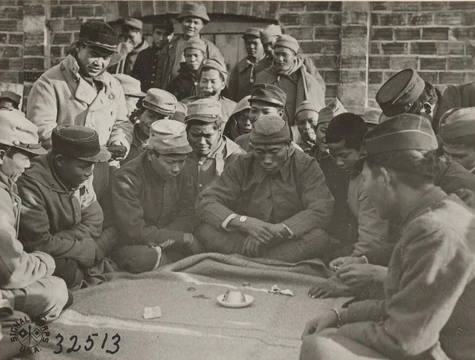
Hazard (game)
Early English dice game that evolved into modern craps.

Hazard is an early English game played with two dice, mentioned in Geoffrey Chaucer's Canterbury Tales in the 14th century. Despite its complicated rules, it was very popular in the 17th and 18th centuries and was often played for money, especially at Crockford's Club in London. In the 19th century, the game craps developed from hazard through a simplification of the rules.
Quick Facts
- Italic Title
- no
- Subject Name
- Hazard
- Players
- 2+
- Setup Time
- < 1 minute
- Random Chance
- High, dice rolling
Facts from the source article.
Lore & Background
Hazard is an early English game played with two dice. It was mentioned in Geoffrey Chaucer's Canterbury Tales in the 14th century. Despite its complicated rules, hazard was very popular in the 17th and 18th centuries and was often played for money. Hazard was especially popular at Crockford's Club in London. In the 19th century, the game craps developed from hazard through a simplification of the rules. Craps is now popular in North America but neither game remains popular within the rest of the world.
The name hazard is borrowed from Old French. The origin of the French word is unclear, but probably derives from Spanish azar ('an unfortunate card or dice roll'), with the final -d by analogy with the common French suffix -ard. The Spanish word has been supposed in turn to come from Arabic, either from the name of a castle in Palestine, or from the word az-zahr (الزهر) meaning 'dice'. However, early evidence for this word in Arabic is lacking, as it is absent from Classical Arabic dictionaries, making the etymology doubtful (although any other source is unknown). Another possibility is Arabic yasara ('he played at dice'). According to William of Tyre, the game was invented by Crusaders during the siege of Hazart (Azaz), but this origin has been called into question.
The game was popular in 17th century England, as described by Charles Cotton in The Compleat Gamester (1674): 'Certainly Hazzard is the most bewitching Game that is plaid on the Dice; for when a man begins to play he knows not when to leave off; and having once accustom'd himself to play at Hazzard he hardly ever after minds anything else.' By that time, the game had already been brought to the Colony of Virginia, as a law barring ministers from playing dice was passed in 1624. The rules including relative odds for side wagers were largely complete by 1790, as published in Hoyle's Games, Improved. It was brought to France some time before 1792, when it was described in the Encyclopédie Méthodique as Krabs, after the English term crabs, referring to the roll combination of 2 or 3. This was corrupted to craps by 1818, as it was named in Bibliothèque Historique, although the rules of that game described at that time were identical to those of hazard.
Reader's Guide
Hazard is historically significant as the direct predecessor of craps, the modern dice game popular in North America. Its rules, though complicated, established the framework for betting on dice outcomes that persists today. The game's influence extends beyond gambling: the word 'hazard' itself entered English meaning 'risk' or 'danger', and the phrase 'at sixes and sevens' may derive from hazard, referring to betting one's entire fortune on a single throw. The expression 'an eye for the main chance' also originates from the game, describing someone habitually looking for opportunities for personal gain. Hazard's mathematical analysis, including the calculation of odds for side wagers based on the relative proportions of main and chance, represents an early application of probability to gaming. The game's popularity at Crockford's Club in London during the 17th and 18th centuries highlights its role in the social history of gambling. Although hazard itself is no longer widely played, its legacy endures through craps and through the language and concepts it contributed to modern culture.
Did You Know?
- Hazard is mentioned in Geoffrey Chaucer's Canterbury Tales from the 14th century.
- The game craps developed from hazard in the 19th century through a simplification of the rules.
- The word 'hazard' in its modern sense of 'risk' or 'danger' comes from this game.
- The phrase 'at sixes and sevens' is sometimes linked to hazard, but its etymology is disputed and not definitively tied to betting one's entire fortune on a single throw.
More in Dice games 1-24
Spotted an error? Know more?
Reader corrections go straight into our review queue. Suggest an edit · How this site is sourced