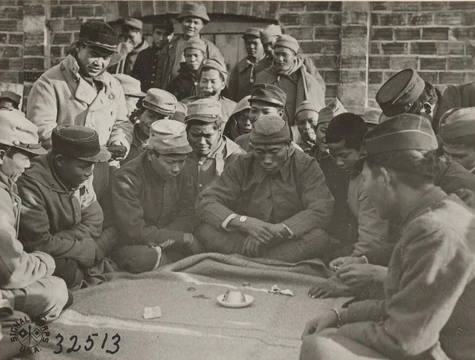
Crown and anchor
A dice game of chance with a banker's edge.

Crown and anchor is a simple dice game traditionally played for gambling purposes by sailors in the Royal Navy as well as those in the British merchant and fishing fleets. It originated in the 18th century and is typically played between two parties, either between two people or a house and a player. The game uses three special dice marked with six symbols: crown, anchor, diamond, spade, club, and heart.
- Origin
- 18th century
- Field
- Dice game
- Known for
- Gambling game played by sailors and at festivals
- Symbols
- crown, anchor, diamond, spade, club, heart
- House edge
- about 7.87 pence per pound wagered
Lore & Background
The game is played on a canvas or felt mat marked with the six symbols. A player places bets on one or more symbols and then throws the three dice. If a symbol appears on one or more dice, the banker returns the stake and pays out even money for one die, 2:1 for two, and 3:1 for three. If the symbol does not appear, the player loses the bet. The expected return for a £1 wager is about –£0.0787, meaning the banker has an edge.
Reader's Guide
Crown and anchor remains popular in the Channel Islands and Bermuda, where it is strictly controlled and may be played legally only on certain occasions, such as agricultural shows, Liberation Day celebrations, or Bermuda's annual Cup Match cricket game. Variations exist in Nepal (Langur Burja), Flanders (Anker en Zon), France (Ancre, Pique, et Soleil), China (Hoo Hey How), and Vietnam (Bầu cua cá cọp). The game appears in numerous cultural works, including the detective series Foyle's War, Terry Pratchett's Dodger, Thomas Pynchon's Gravity's Rainbow, and Ronald Hugh Morrieson's Came a Hot Friday. It is also mentioned in Dorothy L. Sayers' Busman's Honeymoon, the film Passport to Pimlico, Spike Milligan's war memoirs, David Jones's In Parenthesis, and The Wheel of Time book series.
Did You Know?
- The game originated in the 18th century.
- A similar version called Langur Burja is played in Nepal.
More in Dice games 1-24
Spotted an error? Know more?
Reader corrections go straight into our review queue. Suggest an edit · How this site is sourced