Craps
A dice game derived from Hazard, popularized in America.

Craps is a dice game where players bet on the outcome of a pair of dice. They can wager against each other in informal "street craps," which needs little equipment, or against a bank in "casino craps." Players often use slang for bets and actions.
The game evolved in the United States from a simplified version of the European game Hazard (also spelled Hazzard or Hasard). Hazard’s origins are unclear, possibly dating to the Crusades, and were detailed by Edmond Hoyle in Hoyle's Games, Improved (1775). In aristocratic London, "crabs" referred to dice totals of two and three, which are instant losses on the first roll in Hazard, no matter the shooter’s chosen main number. The name "craps" comes from a corruption of "crabs" to "creps" and then "craps."
Some accounts say Hazard was brought from London to New Orleans around 1805 by Bernard Xavier Philippe de Marigny de Mandeville, a young gambler from a wealthy Louisiana family. Hazard lets the shooter pick any number from five to nine as their main. A 1933 pamphlet claimed Marigny simplified the game by always making the main seven—the mathematically best choice with the lowest disadvantage for the shooter. However, more recent research suggests Marigny played an unmodified version of Hazard. Instead, John Scarne credits anonymous Black American inventors with streamlining Hazard, speeding up the game and adding various wagers.
Whoever simplified it, the game was first called "Pass," from the French word "pas" (meaning "pace" or "step"). It was popularized by the underclass in the early 1800s. Field hands taught friends and deckhands, who carried it up the Mississippi River, though riverboat gamblers never embraced it. Marigny named a street Rue de Craps in his New Orleans subdivision. Craps saw a revival there in the late 1830s but wasn’t played in gaming houses until the 1890s. Budd Theobald credits Pullman car attendants and railroad passengers for spreading the game, which became widespread across America by the 1910s, when Foster's Complete Hoyle (1914) called it "the gambling game of [the country]."
The craps numbers 2, 3, and 12 come from Hazard. If the main is seven, the dice sum of twelve joins the "crabs" as a losing number on the first roll. This rule carried over into Pass.
Quick Facts
- Title
- Craps
- Other Names
- Seven-Eleven
- Genre
- Dice game
- Random Chance
- High
Facts from the source article.
Lore & Background
Craps developed in the United States from a simplification of the western European game of Hazard. The origins of Hazard are obscure and may date to the Crusades; a detailed description of Hazard was provided by Edmond Hoyle in Hoyle's Games, Improved (1775). In aristocratic London, crabs was the epithet for the sum combinations of two and three for two rolled dice, which in Hazard are instant-losing numbers for the first dice roll, regardless of the shooter's selected main number. The name craps is derived from the corruption of this term crabs to creps and then craps.
Reader's Guide
Craps is significant as a major gambling game that evolved from the European game Hazard into a distinctly American form. Its development involved multiple contributors: Bernard Xavier Philippe de Marigny de Mandeville, who may have brought Hazard to New Orleans around 1805; anonymous Black American inventors, whom John Scarne credits with simplifying the game; and John H. Winn, who around 1907 introduced the "Don't Pass" bet layout that incentivized casinos to use fair dice. The game spread through cultural exchange, notably via field hands, deckhands on the Mississippi, and attendants and railroad passengers on Pullman cars. By the 1910s, it was described as "the gambling game of [the country]" in Foster's Complete Hoyle (1914). Craps exploded in popularity during World War II, when it was played by service members, and became the dominant casino game in postwar Las Vegas and the Caribbean. After 1960, it spread to Europe, Australia, Macau, and after 2004 to online casinos. The game's legacy includes both street craps, played informally with cash, and bank craps, played in casinos with chips and a structured table staffed by up to four employees.
Did You Know?
- The name 'craps' is derived from the corruption of the term 'crabs' (or 'Krabs') to 'creps' and then 'craps'.
- John H. Winn introduced a layout featuring a space to wager on 'Don't Pass' in addition to 'Pass' around 1907.
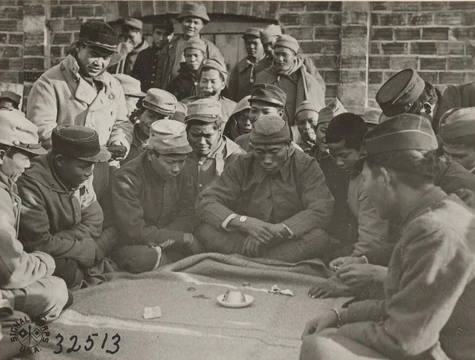
- Craps exploded in popularity during World War II, when it was often played by service members using a blanket as a shooting surface.
More in Dice games 1-24
Spotted an error? Know more?
Reader corrections go straight into our review queue. Suggest an edit · How this site is sourced