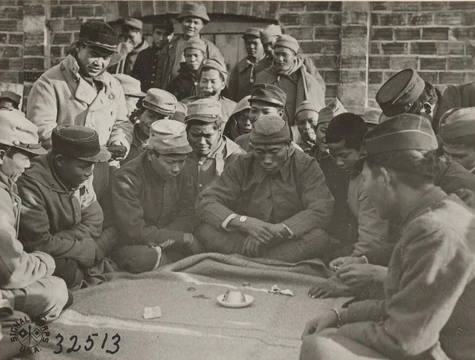
Choboichi
A Japanese gambling game played with one covered die.

Choboichi (チョボイチ, also written as チョボ一, ちょぼいち, or 樗蒲一) is a Japanese gambling game that uses a single die hidden under a cup. The dealer, called the *dōtori* (筒取), shakes a standard six-sided die in a cup or rice bowl, then turns it upside down to conceal the result. Bettors, known as *hariko* (張子), place their money on one of six spaces on a game board, predicting the die’s value. The dealer then lifts the cup to reveal the number.
The dealer may be a fixed person or rotate among players. The cup itself is called the *tsubo* (壺) or *tsubozara* (壺皿). Winning bets are typically paid at four-to-one odds—for example, a ¥10 bet returns ¥40—while the dealer keeps all losing wagers. The payout multiplier can range from 2:1 to 5:1.
To illustrate the house edge: if a player bets ¥600 total, placing ¥100 on each of the six spaces, one space wins. With a 4:1 multiplier, the player receives ¥400 for that win but loses ¥500 on the other five spaces, resulting in a net loss of ¥100. This ¥100 is 1/6 (16.7%) of the initial ¥600. Formally, the house edge is calculated as (5/6) – (1/6 × M), where M is the multiplier. This edge ranges from 50% (at M=2) to 0% (at M=5), with the common 4:1 payout giving a 16.7% edge.
Variations exist using up to five dice, but those games—such as Chō-han (two dice) and Cee-lo (three dice)—have different rules.
By the 18th century, choboichi was so popular that a stretch of gambling sheds one *ri* long (about 3.75 km or 2.33 miles) was dedicated entirely to it.
In Japanese culture, at least two *rakugo* stories feature choboichi as a central element: *One for Show* and *Tanuki Dice* (狸賽).
- Field
- Gambling game
- Nationality
- Japan
- Known for
- Simple dice gambling with one covered die and a house edge
Lore & Background
In choboichi, the dealer is known as the dōtori (筒取), while the bettors are the hariko (張子); the dealer is the one who holds the cup, known as the tsubo (壺) or tsubozara (壺皿). The role of the dealer may either be fixed to one person or rotate amongst the players. Players wager by placing money on one of six spaces on the game board. Winning wagers are paid out typically at four-to-one (e.g., a player who places a $10 bet on a winning space would be paid $40) while the dealer keeps the losing bets. The winning payout may vary between 2:1 and 5:1.
The house edge varies from 50% (for a multiplier of 2) to 0% (for a multiplier of 5), with the most common multiplier of 4 resulting in a house edge of 16.7%. There are multiple variations using up to five dice, although multiple-dice games generally have different rules, including Chō-han (2 dice) and Cee-lo (3 dice). At least two rakugo stories use choboichi as a central element: One for Show and "Tanuki Dice" (狸賽, Tanuki Sai).
Reader's Guide
Choboichi is significant as a traditional Japanese gambling game that illustrates simple probability and house edge mechanics. Its popularity in the 18th century was so great that a dedicated strip of gambling sheds stretched one ri (3.75 km) in length. The game's structure—a single die, a covered cup, and a board with six spaces—makes it easy to understand and play. The house edge calculation, based on the winning multiplier, ranges from 50% (at 2:1 payout) to 0% (at 5:1 payout), with the typical 4:1 payout yielding a 16.7% edge. This mathematical transparency makes choboichi a useful example in discussions of gambling odds. Its cultural legacy includes appearances in rakugo storytelling, specifically in the pieces 'One for Show' and 'Tanuki Dice,' preserving the game in Japanese performing arts. The game's terminology—dōtori for dealer, hariko for bettors, and tsubo for the cup—reflects a specialized gambling vocabulary. While simple, choboichi's variations using multiple dice connect it to other Japanese dice games like Chō-han and Cee-lo, showing its place in a broader gambling tradition.
Did You Know?
- The dealer in choboichi is called the dōtori (筒取), and the cup is called the tsubo (壺) or tsubozara (壺皿).
- Winning wagers are typically paid out at four-to-one, but the payout may vary between 2:1 and 5:1.
- The house edge with a multiplier of 4 is 16.7%.
- At least two rakugo stories feature choboichi: 'One for Show' and 'Tanuki Dice' (狸賽).
More in Dice games 1-24
Spotted an error? Know more?
Reader corrections go straight into our review queue. Suggest an edit · How this site is sourced