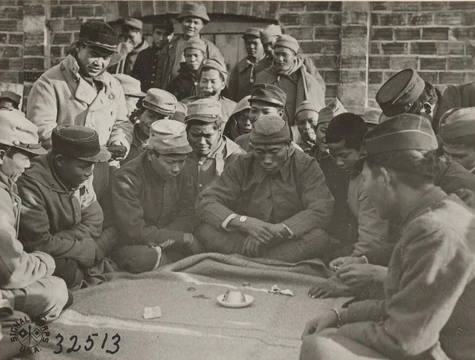
Chō-han
Traditional Japanese dice game of even or odd.

Chō-Han, also known as Chō-Han Bakuchi, is a traditional Japanese dice game. The game involves two standard six-sided dice, which a dealer shakes inside a bamboo cup or bowl before overturning it onto the floor. Players then bet on whether the sum of the two dice will be *chō* (even) or *han* (odd). Once bets are placed, the dealer lifts the cup to reveal the dice, and winners collect their money.
In some variations, the dealer acts as the house and keeps all losing bets. More commonly, players bet against each other, requiring an equal number of bets on odd and even; the house then takes a set percentage of the winning bets. Of the 36 possible dice combinations, six are doubles (all even sums), while the remaining 30 pairings of different numbers yield 12 odd sums and 18 even sums.
The game was a staple among the *bakuto*, itinerant gamblers of old Japan, and continues to be played by the modern yakuza. In a traditional setting, players sit on a tatami floor, and the dealer sits in the formal *seiza* position. To prevent accusations of cheating, the dealer is often shirtless, exposing elaborate tattoos. Female dealers follow the same rule but wear *sarashi* (a chest wrap) for modesty.
Chō-Han appears frequently in Japanese films, particularly *chambara* (sword-fighting) and yakuza movies. It is also featured as a playable minigame in many entries of the *Ryū ga Gotoku* (Yakuza) video game series.
Quick Facts
- Subtitle
- Dice game using two dice
- Other Names
- Chō-Han · 丁半 / Even-odd
- Aka
- Chō-Han
- Random Chance
- complete
- Materials
- 2× six-sided dice
Facts from the source article.
Lore & Background
Chō-Han appears in many Japanese films, especially chambara and yakuza movies, and is a playable minigame in many of the Ryū ga Gotoku (Yakuza) series of video games.
Reader's Guide
Chō-Han holds significance as a traditional Japanese gambling game deeply embedded in the culture of the bakuto and yakuza. Its simple premise—betting on whether the sum of two dice is even or odd—belies its role as a social and ritualistic activity. The dealer's shirtless posture, exposing tattoos, and the formal seiza seating underscore the game's connection to yakuza identity and anti-cheating measures. The game's mathematical odds, with 18 odd sums and 12 even sums among the 30 non-double pairings, plus six even doubles, create a built-in house advantage when the dealer acts as the bank. Its legacy extends beyond gambling halls into popular culture, featuring prominently in Japanese cinema and video games, particularly the Yakuza series, which has introduced the game to a global audience. This enduring presence in media ensures that Chō-Han remains a recognizable symbol of traditional Japanese underworld gambling, preserving its historical and cultural relevance.
Did You Know?
- The game uses two standard six-sided dice shaken in a bamboo cup or bowl.
- Of the 36 possible outcomes, there are six distinct doubles that result in an even outcome.
More in Dice games 1-24
Spotted an error? Know more?
Reader corrections go straight into our review queue. Suggest an edit · How this site is sourced