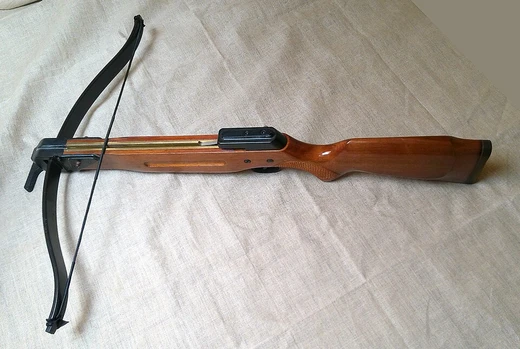
Leonardo's crossbow
Renaissance crossbow designs blending mechanical innovation with military intent.

Shubol3D · CC BY-SA 4.0
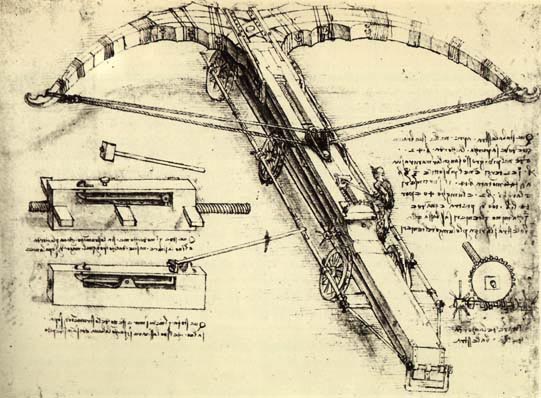
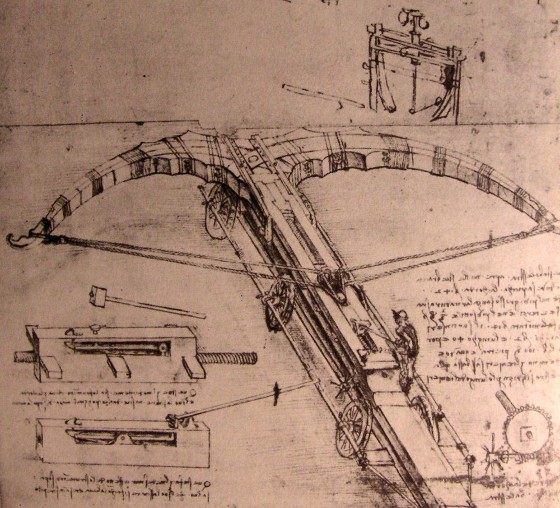
Leonardo's crossbow designs are a series of shooting weapon schematics by Leonardo da Vinci found in the Codex Atlanticus. One version is a self-spanning infantry weapon called the rapid-fire crossbow (balestra veloce in Italian); the other is the giant crossbow (balestra gigante in Italian), intended as a mounted siege weapon. The designs are notable for incorporating advanced mechanical and mathematical concepts that improved efficiency and precision.
- Manuscript
- Codex Atlanticus
- Rapid-fire crossbow sheets
- 143r, 153r, 155r
- Giant crossbow sheet
- 149a
- Period of drafting
- generally believed between 1483 and the early 1490s
- Place of completion
- Milan
- Patron associated with giant crossbow
- Ludovico Sforza
- Giant crossbow dimensions
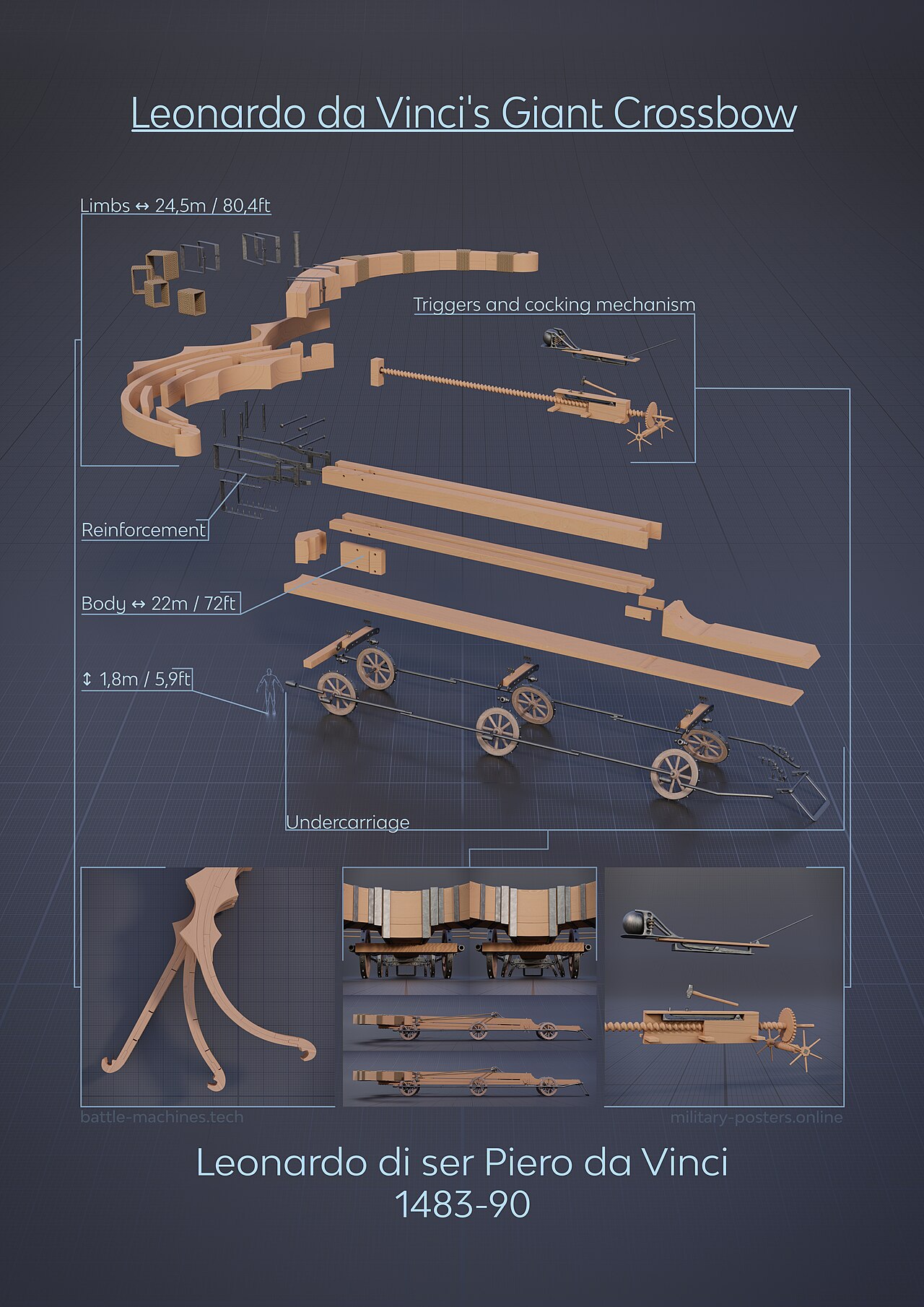
- 27 yards across, made of 39 separate parts
Lore & Background
The creation of the giant crossbow design is linked to Ludovico Sforza, an Italian prince who wanted to expand his military and territory in the Milan region. Leonardo responded to Sforza's desire to update a contemporary military engineering treatise by writing a letter that included innovative machine designs, among them the giant crossbow. While there is no exact date for the illustrations, they are generally believed to have been drafted between 1483 and the early 1490s, and many scholars agree Leonardo completed them in Milan, though debate exists as to why he originally went there.
The rapid-fire crossbow's tiller was split into two stacked wooden pieces held together by a hinge and spring-loaded latch. Inside, interconnected folding levers attached the lower half to a sliding plank that contained the rolling nut and spring-loaded sear. Pressing a switch released the latch, allowing the user to fold the bottom half down, which pushed the sliding plank forward until the drawstring was caught by the rolling nut. After loading a bolt and pulling the trigger, the sear's spring released the nut to propel the bolt. This design removed the need for external spanning tools.
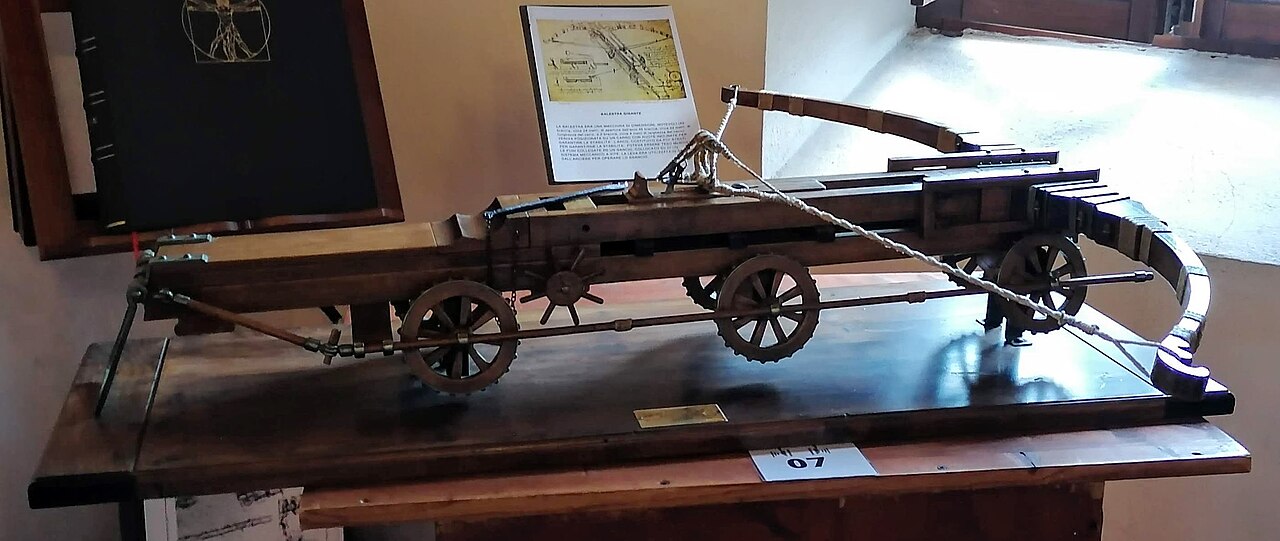
The giant crossbow was intended to fire rocks and bombs as an intimidation-based weapon. It was made of thin wood on six wheels, 27 yards across, with 39 separate parts. While some believe Leonardo designed it for his own amusement, the context suggests it was meant to be a dangerous weapon appealing to Sforza. Inspiration likely came from Leonardo witnessing constant warfare between Italian city-states during the 15th century.
Reader's Guide
Leonardo's crossbow designs represent a significant step in the application of geometrical mathematics to machine design. The mathematics he used, though containing some inaccuracies by modern geometric knowledge, marked him as the first modern engineer to attempt applying the laws of motion to machine design. His proportional techniques were applied to every aspect of the crossbow designs. The rapid-fire crossbow's self-spanning mechanism was a notable innovation, eliminating the need for external spanning tools and simplifying the arming process. A working replica built in 2015 demonstrated precision shooting and a fast internal spanning mechanism, features not found in most modern handheld crossbows. The giant crossbow was never constructed by Leonardo, but a 1:1 scale working model was built and shown in a 2003 documentary. The designs remain important for their mechanical ingenuity and their place in the context of Renaissance military engineering.
Did You Know?
- The rapid-fire crossbow is called balestra veloce in Italian.
- The giant crossbow design is found on sheet 149a of the Codex Atlanticus.
- A working replica of the rapid-fire crossbow was demonstrated at the Castello Sforzesco in Milan on 24 June 2015.
The Sforza Commission and Milanese Ambition
The origins of Leonardo's crossbow schematics are inseparable from the political turbulence of fifteenth-century Italy. The Italian peninsula was perpetually mired in conflict among its city-states, and Ludovico Sforza, the ruling prince of the Milan region, sought to strengthen both his armed forces and his territorial holdings. A key part of that ambition was modernizing the military engineering knowledge of the era, specifically updating the contemporary treatise authored by Roberto Valturio. Leonardo responded to Sforza's needs with a letter that showcased a suite of innovative machine concepts, the giant crossbow among them, while simultaneously underscoring his own engineering credentials—a calculated move, given that Sforza was actively recruiting military engineers at the time. Scholars generally place the drafting of these illustrations between 1483 and the early 1490s, with the work completed in Milan. Yet the reason Leonardo first set foot in the city remains contested: some argue he arrived seeking painting commissions and only afterward learned of Sforza's military ambitions, while others contend his initial purpose was to secure employment with the duke directly.
Mathematics, Aerodynamics, and Independent Innovation
Although the crossbow as a weapon category predates Leonardo by centuries, his schematics introduced refinements that set his work apart. By specifying a narrower shaft paired with a tapered bolt, his designs improved the aerodynamic profile of the projectile and reduced drag, yielding both greater operational efficiency and sharper accuracy. Crucially, these aerodynamic insights appear to have been developed entirely on his own, without borrowing from any known external source. The mathematical framework underpinning the designs was remarkably sophisticated for its era. Even where some of his geometric assumptions diverge from what modern physics would confirm, scholars recognize Leonardo as the first engineer in the modern tradition to try bringing the geometrical mathematics governing motion into the design of machines. Equally notable is his consistent use of proportional techniques throughout every element of the crossbow's construction, from the overall frame to the smallest mechanical component, reflecting a holistic engineering philosophy that treated the weapon as a unified geometric system rather than a mere collection of parts.
The Self-Spanning Mechanism of the Balestra Veloce
The rapid-fire crossbow, or balestra veloce, represents Leonardo's most mechanically intricate design. Its tiller is divided into two stacked wooden sections joined at the front by a hinge and secured at the rear by a spring-loaded latch. Nestled between these halves is a pair of interconnected folding levers that link the lower section to a sliding plank resting atop the upper section, positioned between two metal prods. At the rear of that plank sit a rolling nut and a spring-loaded sear, while the lower tiller half houses the trigger. To arm the weapon, the operator presses a side switch to release the latch, folds the bottom half downward, and the levers drive the sliding plank forward until the rolling nut catches the drawstring, held in place by the sear's spring tension. Folding the lower half back up re-engages the latch. Once a bolt is loaded and aimed, pulling the trigger compresses the sear spring and frees the drawstring to launch the projectile. This entirely internal spanning system eliminated the need for the bulky external tools that traditional arbalists had to carry.
From Codex Pages to Working Replicas
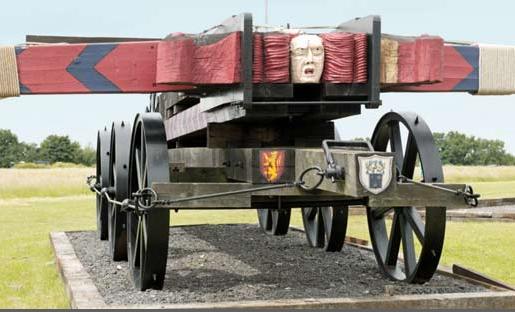
Leonardo's crossbow designs remained paper concepts for over five centuries until modern engineers brought them to life. For the rapid-fire crossbow, a prototype was first assembled in 2013, followed by the debut of a fully functional model on 24 June 2015 at the Castello Sforzesco in Milan. That demonstration was the fruit of research by Edoardo Zanon of the Leonardo3 study center, who investigated the processing and assembly techniques available in Leonardo's own era to ensure historical fidelity. The resulting replica achieves precision shooting and features a rapid internal spanning mechanism that, remarkably, is absent from most contemporary handheld crossbows. The model now resides in the Leonardo3 – The World of Leonardo museum on Piazza della Scala in Milan. The giant crossbow, by contrast, was never built by Leonardo himself in any form, whether as a scaled model or a full siege weapon. However, a full-scale one-to-one working replica was later constructed and featured in the ITN documentary Leonardo's Dream Machines, which first aired on Channel 4 in February 2003.
Gallery
Frequently Asked Questions
What is Leonardo's crossbow?
Leonardo's crossbow refers to a set of weapon schematics drawn by Leonardo da Vinci that appear in his Codex Atlanticus manuscript. The designs encompass both a self-loading infantry crossbow and a massive siege-mounted variant, representing some of the earliest known applications of mechanical engineering to ranged weaponry.
What are the two versions of Leonardo's crossbow?
The rapid-fire crossbow (balestra veloce) was a self-spanning infantry weapon designed for quick successive shots, while the giant crossbow (balestra gigante) was a much larger siege weapon meant to be mounted and used against fortifications.
Where in the Codex Atlanticus are Leonardo's crossbow designs located?
The rapid-fire crossbow appears on folios 143r, 153r, and 155r, while the giant crossbow is drawn on folio 149a. These pages contain the mechanical diagrams and annotations that describe each weapon's operation.
When and where did Leonardo create his crossbow designs?
The schematics are generally dated to the period between 1483 and the early 1490s and were completed in Milan. The giant crossbow in particular was associated with the patronage of Duke Ludovico Sforza, who governed Milan at the time.
Why is Leonardo's crossbow considered significant?
The designs stand out because they apply advanced mechanical principles—such as self-spanning mechanisms and mathematical calculations for precision—to practical military applications. They represent a rare Renaissance example of engineering innovation directly serving warfare, bridging theoretical mechanics and battlefield utility.
More in Crossbows 1-20
Spotted an error? Know more?
Reader corrections go straight into our review queue. Suggest an edit · How this site is sourced