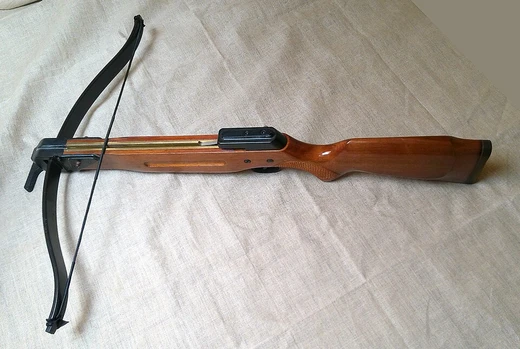
Laws on crossbows
Crossbow laws vary widely, often equating them to firearms.

The crossbow often has a complicated legal status due to its potential use for lethal purposes and its similarities with both firearms and other archery weapons. For legal purposes, it is often categorized as a firearm by various legal jurisdictions, even though it is not considered a firearm from a technical perspective, as no combustion is required to propel the projectile. Laws concerning crossbows vary widely by country, with some nations imposing no specific regulation and others requiring permits, background checks, or licenses similar to those for firearms.
- Minimum age for possession (australia)
- 18
- Minimum age for possession (czech republ
- 18
- Minimum age for possession (netherlands)
- 18
- Minimum age for possession (united kingd
- 18
- Draw weight threshold for regulation (cz
- 150 N
- Draw weight threshold for regulation (ho
- 6 kg
- Muzzle velocity threshold for firearm cl
- 152.4 m/s
Lore & Background
The legal treatment of crossbows reflects their dual nature as both a traditional archery tool and a potentially lethal weapon. In many jurisdictions, crossbows are classified alongside firearms for regulatory purposes, despite lacking any combustion mechanism. This has led to a patchwork of laws: some countries, like Bulgaria, have no specific regulation but prohibit their use for hunting and fishing, while others, such as Japan, require licenses and restrict possession to licensed ranges and specific purposes. In Canada, crossbows are generally not classified as firearms unless they have a barrel and launch projectiles at a velocity exceeding 152.4 m/s, though one-handed or very short crossbows are prohibited. The United Kingdom requires no license for ownership but bans sale and possession by those under 18, with additional restrictions on use in public while intoxicated.
Reader's Guide
The significance of crossbow laws lies in their variation and the legal ambiguity they create. In some nations, crossbows are treated as equivalent to firearms, requiring licenses and background checks, while in others they are unregulated or subject only to age restrictions. This inconsistency can affect hunters, sport shooters, and collectors, as well as law enforcement. For example, in Australia, pistol crossbows are strictly controlled due to their concealability, and Western Australia has moved to prohibit ownership entirely except for existing participants. In Germany, crossbows are legally equated with firearms but require no license for acquisition or possession, and minors may use them under adult supervision. The legal status of crossbows continues to evolve, as seen in the United Kingdom, where a 2021 incident prompted a review of the law, and the Crime and Policing Act 2026 introduced a ban on the sale of new crossbows and hunting arrows.
Did You Know?
- In Canada, crossbows measuring less than 500 mm in length are prohibited.
- In Hong Kong, crossbows with a draw weight of more than 6 kg are defined as firearms.
- In the Netherlands, crossbows must be transported in a way requiring at least three actions before the weapon is ready for use.
- In Sweden, any weapon that stores energy and produces more than 10 J at the muzzle is illegal without a license.
The Legal Paradox — A Weapon That Isn't
The crossbow occupies a strange legal limbo. In many jurisdictions, it is grouped alongside firearms for regulatory purposes, even though it shares no combustion mechanism with a gun. Germany explicitly notes that crossbows do not "shoot" under its legal definition because they lack expanding gases or similar propulsion. Canada's Criminal Code draws a line at 152.4 m/s muzzle velocity for barrelled weapons, meaning standard crossbows fall outside the firearm category entirely. Yet Ireland classifies crossbows as firearms requiring a licence, and Hong Kong treats any crossbow exceeding 6 kg draw weight as a firearm under its Firearms and Ammunition Ordinance. This disconnect between technical reality and legal categorization creates a patchwork where the same object is a regulated weapon in one country and an unregulated sporting implement in another, all while no specific combustion or gas-expansion mechanism is involved in its operation.
A Global Spectrum — From Prohibition to Permissiveness
Crossbow regulation spans an extraordinary range of strictness. At the most restrictive end, Denmark prohibits the creation, import, or possession of crossbows without a licence and does not recognise them as legal hunting weapons. Japan, since 2022, bans most civilian ownership outright, restricting use to firing ranges, shooting sports, and veterinary anaesthesia. Western Australia went so far as to make crossbow possession illegal after a July 2011 deadline, grandfathering only those already participating in the sport. At the opposite extreme, Bulgaria imposes no specific crossbow regulation at all, and Finland requires no licence for possession. The Czech Republic carves out a middle path: crossbows under 150 newtons of drawing force face no regulation whatsoever, while those above that threshold become Class D weapons subject to age and location restrictions. This diversity means a crossbow that is perfectly legal in one nation may be a criminal possession in a neighbouring one.
Hunting, Fishing, and the Sporting Crossbow
The question of whether a crossbow may be used to take an animal is one of the most commonly addressed issues in crossbow law. In Bulgaria, Finland, Germany, and Denmark, crossbow use for hunting is explicitly prohibited, and Germany and Bulgaria also ban crossbow fishing. Canada delegates hunting regulation to its provinces, so the legality of crossbow hunting shifts from one provincial border to the next. Australia permits crossbow ownership for sporting purposes, though Western Australia's 2011 law froze participation to those already in the sport, barring new entrants. Japan allows crossbow use in shooting sports and at firing ranges but channels it through licensed storage in lockers. The Czech Republic restricts use of higher-draw crossbows to licensed ranges and marked, supervised locations. In every case, the sporting or recreational context is where legal crossbow use is most clearly defined, while the hunting context is where it most often disappears.
Age Gates, Licences, and the Rules of the Road
Across the jurisdictions that do regulate crossbows, a consistent set of administrative controls emerges. Age is the most common threshold: Australia, Canada, the Czech Republic, the Netherlands, and Japan all set 18 as the minimum age for possession or ownership. Several countries layer on licensing requirements that mirror firearms regulation. Ireland demands a licence to own a crossbow, a requirement introduced by the 1990 Firearms and Offensive Weapons Act after earlier drafts had exempted low-draw-weight models. Hong Kong requires a police-issued licence for crossbows above 6 kg draw weight. Japan obliges owners to store crossbows in lockers or equivalent secure facilities and bars possession by anyone under 18, anyone with a criminal record, or anyone identified as a drug addict. The Netherlands adds a transport rule: the weapon must be packaged so that at least three separate actions are needed before it is ready to fire. These layered requirements—age, licence, storage, transport—create a regulatory architecture that, in practice, treats the crossbow much like a handgun, even though no gunpowder is involved.
Frequently Asked Questions
Why do many countries treat crossbows the same as firearms legally?
Even though a crossbow fires its bolt using stored mechanical tension rather than combustion, most legal frameworks still slot it into the firearm category. This means owners in regulated jurisdictions face the same permits, background checks, or licensing requirements they would for a gun.
What is the minimum age to possess a crossbow in Australia, the Czech Republic, the Netherlands, and the UK?
All four of those countries set the minimum ownership age at 18. Below that age, possessing a crossbow is not permitted under their respective regulations.
Do crossbow laws look the same in every country?
No—regulation ranges from virtually no specific rules at all to full firearm-style licensing and background checks. The level of restriction a crossbow owner faces depends almost entirely on which jurisdiction they live in.
At what draw weight does the Czech Republic begin regulating a crossbow?
The Czech threshold is 150 newtons of draw weight. Crossbows exceeding that figure fall under the country's regulated-weapon rules.
Is a crossbow actually a firearm by definition?
Technically, no, because propelling the bolt requires no combustion or explosive charge. However, for the purposes of most legal codes, the distinction is irrelevant and the weapon is grouped with firearms anyway.
More in Crossbows 1-20
Spotted an error? Know more?
Reader corrections go straight into our review queue. Suggest an edit · How this site is sourced