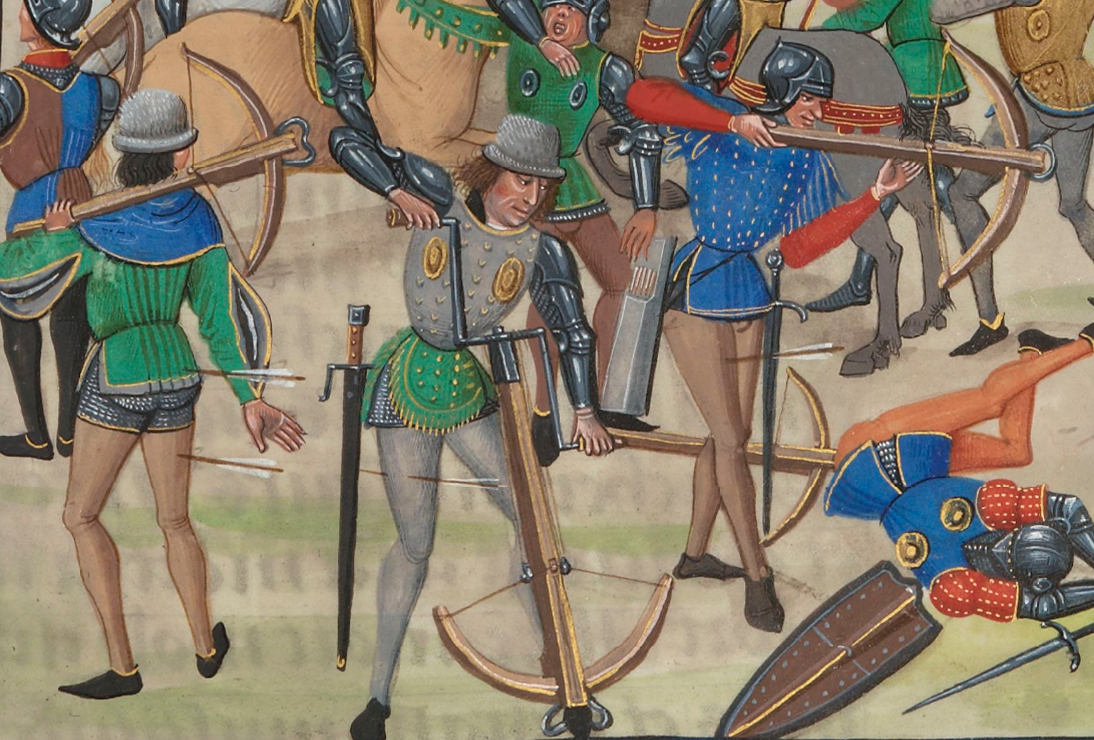
Genoese crossbowmen
Respected medieval mercenary corps armed with the Genoese crossbow.

Loyset Liédet · Public domain
The Genoese crossbowmen were a medieval military corps that served both the Republic of Genoa and, as mercenaries, other Italian and European powers. They fought on land and at sea, with notable naval actions at Meloria and Curzola. Their members trained and organized in Genoa, but also came from across Liguria, parts of Montferrat, towns in the Po Plain such as Pavia, Piacenza, and Parma, and from Corsica. Company commanders were typically drawn from Genoa’s noble families. Their main weapon was the crossbow, made locally by the Balistrai Corporation. Each crossbowman also carried a dagger, a light metal helmet, a gorget, a hauberk, and a large pavise shield used while reloading. A standard team included one crossbowman and two assistants—one holding the pavise, the other spanning a second bow to double the rate of fire. The corps first gained prominence during the First Crusade under commander Guglielmo Embriaco at the siege of Jerusalem, and again at the Battle of Jaffa in 1192 during the Third Crusade. They remained highly respected into the 16th century, even after black-powder weapons appeared. Their effectiveness led to harsh reprisals: Emperor Frederick II, after a defeat at the siege of Parma caused by a Genoese sally, ordered captured crossbowmen to have their fingers cut off. At the Battle of Crécy in August 1346, about 5,000 Genoese crossbowmen under Ottone Doria and Carlo Grimaldi fought for the French. The French advance had left their wagons with pavises and extra ammunition behind, preventing the crossbowmen from deploying in their usual protected teams. Around 4 PM, a rainstorm struck. English longbowmen kept their bowstrings dry under waterproof caps, but crossbows could not be unstrung without tools, and their wet strings stretched. When the crossbowmen attacked about an hour later, their weapons were largely useless. Unprotected by pavises and under heavy longbow fire, Doria ordered a retreat. French knights behind them, commanded by Charles II, Count of Alençon, saw this as cowardice and cut them down. Most of the crossbowmen, including Doria, were killed. The English won the battle with very few losses.
- Notable commanders
- Guglielmo Embriaco, Ottone Doria, Carlo Grimaldi
- Main armament
- Crossbow made in Genoa by the Balistrai Corporation
- Equipment
- Dagger, light metal helmet, gorget, hauberk, large shield (pavise)
- Team composition
- One crossbowman and two assistants (one supporting the pavise, one spanning a second bow)
- Key battle
- Battle of Crécy (August 1346)
- Number at crécy
- Upwards of 5,000
- Origin of members
- Genoa, other parts of Liguria, Montferrat, towns of the Plain of the Po (including Pavia, Piacenza, Parma), and Corsica
Lore & Background
The Genoese crossbowmen were trained and organized in Genoa, though members also came from other parts of Liguria, Montferrat, certain towns of the Plain of the Po (including Pavia, Piacenza and Parma), and Corsica. Commanders of the companies usually came from the noble families of the city. Their main armament was the crossbow, made in Genoa by the Balistrai Corporation. In addition, the mercenaries were equipped with a dagger, a light metal helmet, a gorget, a hauberk, and a large shield called a pavese (pavise), which was used while reloading the crossbow. The usual team consisted of a crossbowman and two assistants: one supporting the pavise, the other responsible for spanning a second bow, thus doubling the rate of fire.
The corps came to prominence during the First Crusade, when the Genoese commander Guglielmo Embriaco used them in the course of the siege of Jerusalem, and again at the Battle of Jaffa in 1192 during the Third Crusade. The heavy losses created by Genoese crossbows led medieval monarchs to extreme measures. Emperor Frederick II, after the defeat at the siege of Parma triggered by a Genoese sally, ordered that captured crossbowmen have their fingers cut off.
During the Battle of Crécy in August 1346, upwards of 5,000 Genoese crossbowmen, led by Ottone Doria and Carlo Grimaldi, were employed by the French in the first line against the English. The precipitous nature of the French advance to Crécy had meant that the wagons containing the pavises and extra ammunition had been left behind, leaving the crossbowmen unable to deploy in their usual well-protected teams. A sudden rainstorm arose; the English longbowmen removed their bowstrings and stored them under their water-resistant leather caps to keep them dry, while crossbows cannot be unstrung and restrung without tools. The strings of the crossbows became stretched upon being drenched by rain. When the rain-soaked and stretched crossbow strings were used roughly an hour later during the initial attack, the crossbows were largely rendered useless. Unprotected by their usual pavises, the Genoese came under heavy fire from English longbowmen, and their commander Ottone Doria ordered a retreat. The French knights commanded by Charles II, Count of Alençon behind them saw this as cowardice and cut them down as they retreated. Most of the crossbowmen were killed, including their commander.
Reader's Guide
The Genoese crossbowmen represent a significant example of a specialized medieval mercenary corps that maintained its reputation for centuries. Their effectiveness is demonstrated by the extreme measures taken against them, such as Emperor Frederick II ordering captured crossbowmen to have their fingers cut off after the siege of Parma. The corps remained one of the most respected military units until the 16th century, well after the introduction of black-powder weapons, indicating the enduring value of their skills and organization.
The Battle of Crécy illustrates both the strengths and vulnerabilities of the Genoese crossbowmen. When properly deployed with their pavises and team-based reloading system, they could maintain a high rate of fire while protected. However, the loss of their pavises and ammunition wagons, combined with the rain that stretched their crossbow strings, left them exposed to English longbow fire. The subsequent retreat and slaughter by French knights highlights the complex dynamics between mercenary forces and their employers. The battle also demonstrates the tactical limitations of crossbows compared to longbows in certain weather conditions, as crossbows could not be unstrung to protect their strings from rain.
The corps' legacy includes their role in both land and naval battles, such as Meloria and Curzola, and their service in the Crusades. Their organization, with teams of one crossbowman and two assistants, allowed for a sustained rate of fire that made them formidable in siege and field warfare.
Did You Know?
- The Genoese crossbowmen used a team of one crossbowman and two assistants to double the rate of fire.
- At the Battle of Crécy, the crossbow strings became stretched after being drenched by rain, rendering the weapons largely useless.
- Emperor Frederick II ordered that captured Genoese crossbowmen have their fingers cut off after the siege of Parma.
- The Genoese crossbowmen fought in naval battles including Meloria and Curzola.
Origins & Geographic Reach
The Genoese crossbowmen were a medieval fighting force that served dual purposes: defending the Republic of Genoa and selling their skills as mercenaries to other Italian and European rulers. Although every company was ultimately trained, drilled, and structured within the walls of Genoa, the manpower pool stretched far beyond the city. Recruits came from other stretches of Liguria, from the regions of Montferrat, from towns across the Plain of the Po including Pavia, Piacenza, and Parma, and even from Corsica. This wide-net recruitment was unified under a single organizational center in Genoa, where the corps took its final shape. Command of each company was reserved for members of the city's noble families, giving the unit an aristocratic leadership layer atop a broadly drawn enlisted base. The result was a professional fighting body that belonged to one republic in name and structure while drawing its human capital from a swath of northern Italy and the western Mediterranean.
Equipment & the Three-Man Team
The crossbow was the corps' signature weapon, and it was produced locally in Genoa by a specialized guild called the Balistrai Corporation. Each mercenary also carried a dagger, wore a light metal helmet, a gorget, and a hauberk, and was issued a large rectangular shield known as a pavise. That pavise was not a passive piece of armor; it was the linchpin of the unit's tactical doctrine. The standard operating cell paired one crossbowman with two assistants. One assistant braced the pavise to shield the shooter during the exposed reloading window, while the other kept a second crossbow spanned and ready to fire. This three-man arrangement effectively doubled the volume of bolts the team could deliver, creating a sustained arc of fire that a lone crossbowman could never sustain. The system proved lethal on both land and at sea, as the devastating naval engagements at Meloria and Curzola demonstrated.
Rise to Prominence & Enduring Fear
The corps first seized the attention of medieval warfare during the First Crusade, when Genoese commander Guglielmo Embriaco deployed crossbowmen during the siege of Jerusalem. They reappeared at the Battle of Jaffa in 1192 during the Third Crusade, reinforcing their reputation as a force that could break sieges and hold ground. What truly set them apart was their extraordinary longevity: they remained one of the most respected military units in Europe well into the 16th century, long after gunpowder weapons had begun reshaping the battlefield. Their lethality provoked extreme reactions from rulers. After suffering a defeat at the siege of Parma — a loss triggered by a Genoese sally — Emperor Frederick II decreed that captured crossbowmen have their fingers cut off, a brutal measure aimed at destroying the specific skill that made them so dangerous. The fact that a Holy Roman Emperor felt compelled to maim prisoners rather than simply execute them speaks to the deep fear these men inspired across the medieval world.
The Catastrophe at Crécy
In August 1346, the Genoese crossbowmen suffered their most infamous and final great defeat. Upwards of 5,000 of them, led by Ottone Doria and Carlo Grimaldi, were placed in the French first line at the Battle of Crécy against the English. The French advance was so hasty that the wagons carrying their pavises and spare ammunition were abandoned, stripping the crossbowmen of their essential protective and logistical support. Around four in the afternoon, a sudden rainstorm swept over the field. English longbowmen simply unstrung their bows and tucked the strings under water-resistant leather caps. Crossbows, by contrast, could not be unstrung and restrung without tools; the rain stretched their strings until they were rendered largely useless. When the Genoese launched their attack roughly an hour later, their weapons failed. Unprotected by pavises and facing devastating English longbow fire, Doria ordered a retreat. French knights under Charles II, Count of Alençon, interpreted this as cowardice and slaughtered the retreating crossbowmen, killing most of them, including their commander. The English won the battle with minimal losses.
Gallery
Frequently Asked Questions
What were the Genoese crossbowmen?
They were a professional mercenary unit of medieval crossbow operators who served the Republic of Genoa and were hired out to other Italian and European states. They fought on both land and sea, with recruitment drawing from Genoa proper, the wider Ligurian coast, parts of Montferrat, Po Plain cities like Pavia and Parma, and Corsica.
What equipment did a Genoese crossbowman carry into battle?
Each man was issued a crossbow locally produced by the Balistrai Corporation, a dagger, a light metal helmet, a gorget, a hauberk, and a large pavise shield. The crossbow served as the primary weapon while the pavise gave the shooter body cover during volleys.
How were Genoese crossbowmen organized in the field?
They operated in three-man squads: one crossbowman, one assistant dedicated to bracing the pavise, and a second assistant tasked with spanning a backup bow. Company-level command was normally held by members of Genoa's noble families.
What was the most famous engagement involving Genoese crossbowmen?
Their best-known deployment came at the Battle of Crécy in August 1346, where upwards of 5,000 of them took the field. They also saw significant naval action at the battles of Meloria and Curzola.
Who were some of the most respected Genoese crossbowmen commanders?
Guglielmo Embriaco, Ottone Doria, and Carlo Grimaldi are among the most frequently cited leaders of the corps. These commanders typically came from Genoa's aristocratic families and directed the unit in both land campaigns and naval operations.
More in Crossbows 1-20
Spotted an error? Know more?
Reader corrections go straight into our review queue. Suggest an edit · How this site is sourced