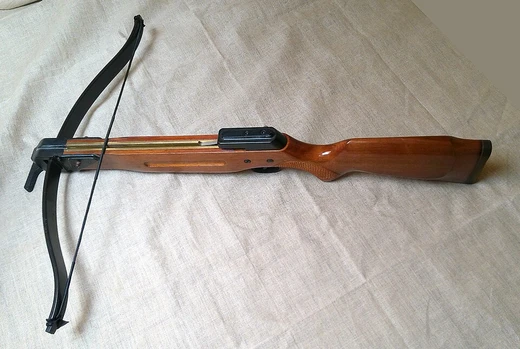
Gastraphetes
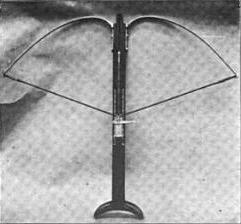
Ancient Greek hand-held crossbow, forerunner of the catapult.

Hartmann Linge · Public domain
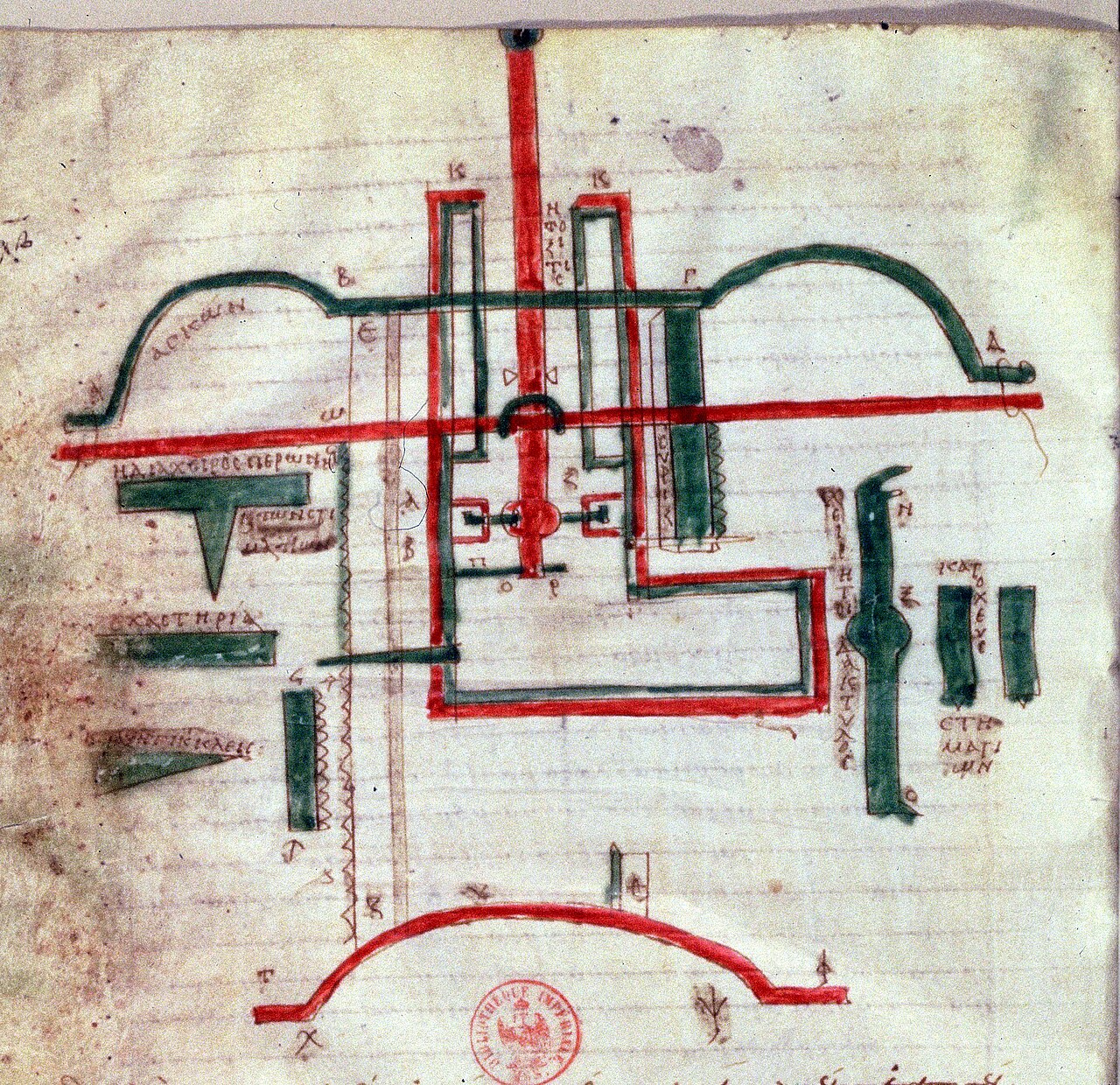
The gastraphetes, known as the belly bow or belly shooter, was a handheld crossbow employed by the Ancient Greeks. The 1st-century author Heron of Alexandria described it in his work *Belopoeica*, relying on an earlier account from the engineer Ctesibius, who lived around 285–222 BC. Heron considered the gastraphetes the predecessor of the catapult, indicating its invention occurred at some unknown point before roughly 420 BC.
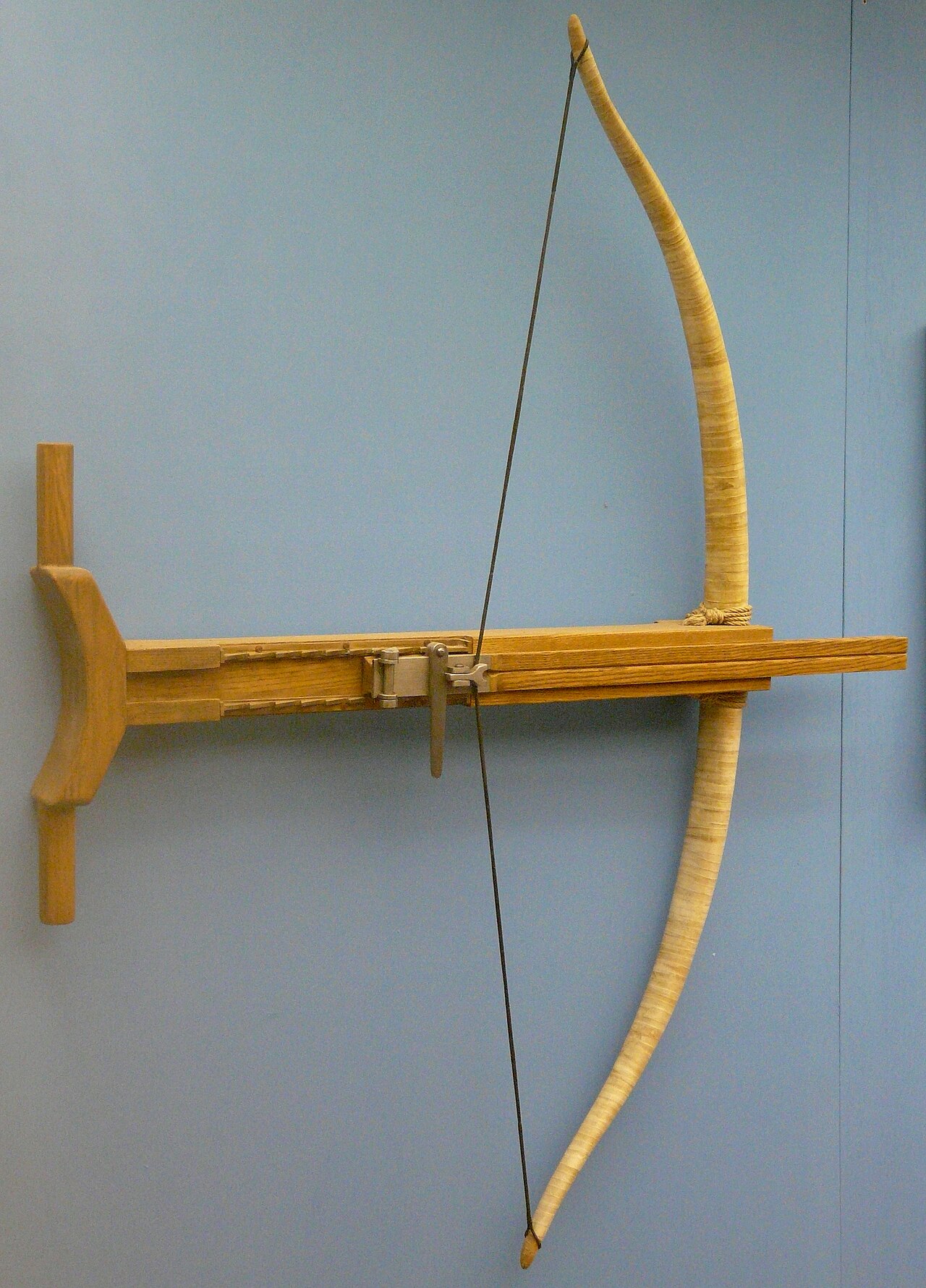
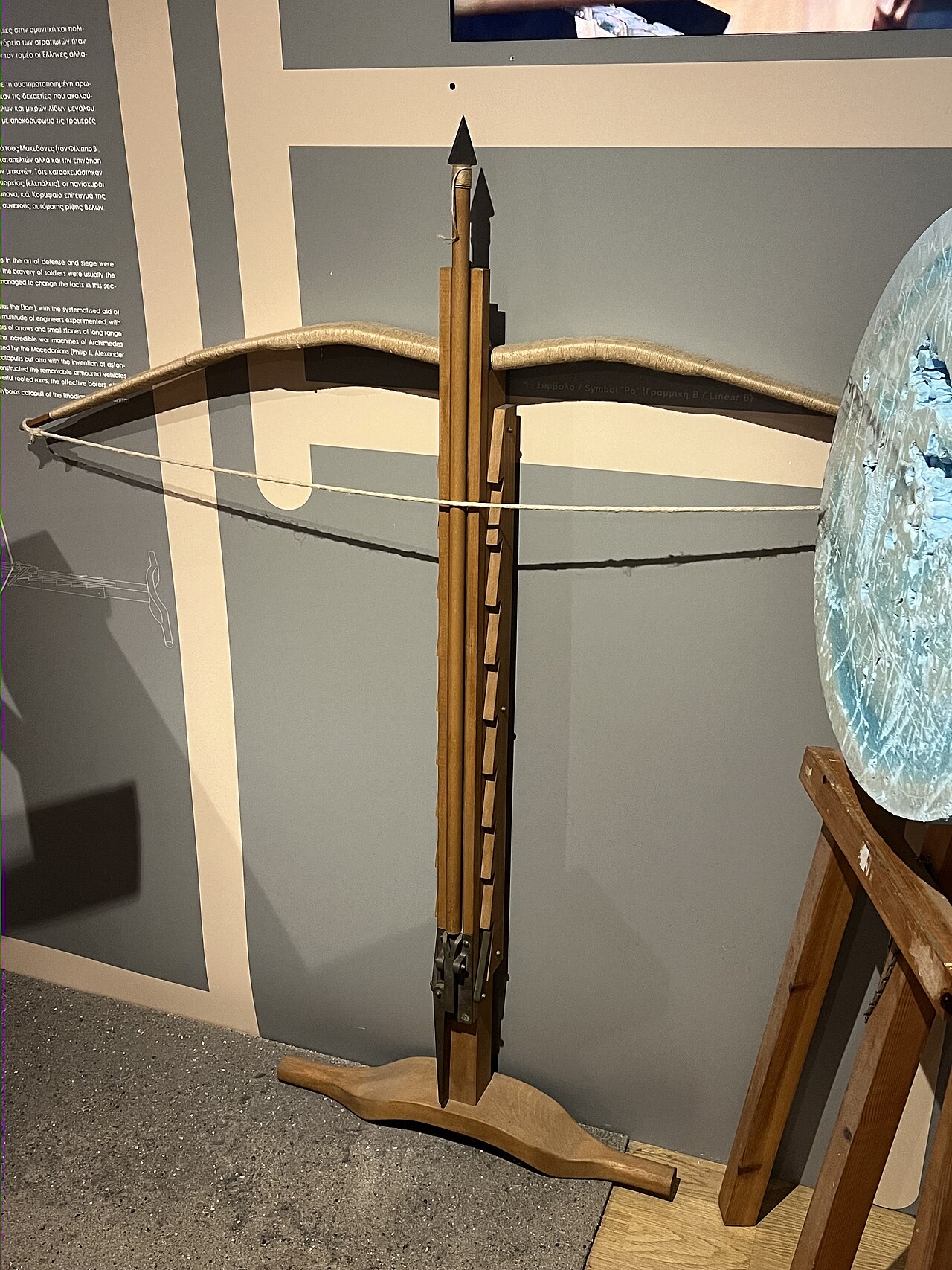
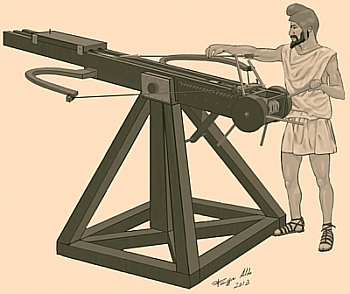
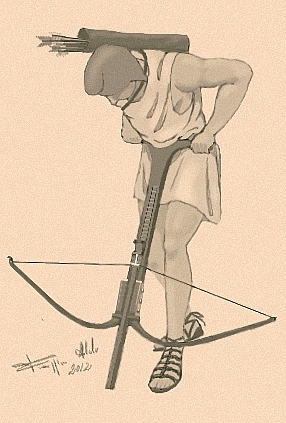
Unlike later Roman and medieval crossbows, spanning this weapon involved pushing down a slider mechanism rather than pulling the string upward. A detailed description and drawing survive in Heron’s text, which credits the 3rd-century BC engineer Ctesibius. The weapon used a composite bow and was cocked by resting the belly in a concave area at the rear of the stock and pressing downward, allowing the user to summon more energy than a hand-bow. No archaeological finds or pictorial evidence exist, but the description is detailed enough for modern reconstructions. Some authors suggest the gastraphetes may have included a prop. A larger version, the oxybeles, was used in siege warfare, and later the early ballista supplanted these, eventually developing into smaller versions that replaced the gastraphetes.
Regarding its date, a long-held view by scholar E. W. Marsden placed its invention in 399 BC by Greek craftsmen working for the tyrant Dionysius I of Syracuse. However, recent scholarship notes that the historian Diodorus Siculus did not mention the gastraphetes but referred to the invention of the “katapeltikon,” a mechanical arrow-firing catapult. Since Heron states that stand-mounted artillery like the katapeltikon was inspired by the earlier handheld gastraphetes, the introduction of handheld crossbows into Greek warfare must have occurred at some unknown time before 399 BC. The terminus ante quem may be more precisely set before 421 BC, as another Greek author, Biton, credits two advanced forms of the gastraphetes to a certain Zopyros, likely a Pythagorean engineer from Taranto, Italy. Zopyros may have designed his stand-mounted bow-machines during the sieges of Cumae and Miletus between 421 BC and 401 BC, marking the date by which the archetypical gastraphetes must have already been known.
- Also known as
- belly bow, belly shooter
- Type
- hand-held crossbow
- Cocking method
- resting the belly in a concavity at the rear of the stock and pressing it down
- Invention date
- some unknown time before c. 420 BC
- Described by
- Heron of Alexandria (1st century) in Belopoeica, drawing on Ctesibius (fl. 285–222 BC)
Lore & Background
The gastraphetes was powered by a composite bow. Unlike later Roman and medieval crossbows, spanning the weapon was not done by pulling up the string but by pushing down a slider mechanism. It was cocked by resting the belly in a concavity at the rear of the stock and pressing it down, allowing considerably more energy to be summoned than by using only one arm of the archer as in a hand-bow. There are no attestations through pictures or archaeological finds, but Heron's description is detailed enough to allow modern reconstructions. According to some authors, the dimensions of the gastraphetes may have involved a prop.
A larger version of the gastraphetes were the oxybeles used in siege warfare. Early ballista later supplanted these, which later developed into smaller versions supplanting the gastraphetes. The terminus ante quem may be more precisely defined as before 421 BC, since another Greek author, Biton, credits two advanced forms of the gastraphetes to a certain Zopyros, probably a Pythagorean engineer from Taranto, Italy. He may have designed his stand-mounted bow-machines on the occasion of the sieges of Cumae and Miletus between 421 BC and 401 BC, marking the date by which the archetypical gastraphetes must have already been known.
Reader's Guide
The gastraphetes is significant as the earliest known hand-held crossbow in the ancient Greek world and as the direct forerunner of later mechanical artillery. Heron explicitly identifies it as the inspiration for the stand-mounted katapeltikon, a mechanical arrow-firing catapult. This lineage establishes the gastraphetes as a crucial step in the development of siege warfare technology. The weapon's design—using a composite bow and a slider mechanism cocked by the body's weight—demonstrates an early understanding of mechanical advantage. Its legacy extends to later Roman and medieval crossbows, though the exact relationship is debated. The gastraphetes also appears in the context of other ancient mechanical hand-held weapons such as the arcuballista and manuballista, though scholarly disagreement persists about whether these were flexion bows or torsion powered. The detailed description by Heron, despite the lack of archaeological finds, has allowed modern reconstructions that confirm the weapon's practicality.
Did You Know?
- The gastraphetes was cocked by pressing the belly into a concavity at the rear of the stock.
- Heron of Alexandria identified the gastraphetes as the forerunner of the later catapult.
- The terminus ante quem for the gastraphetes may be before 421 BC, based on the work of Zopyros.
The Belly-Press Mechanism
The gastraphetes, a name that translates roughly as "belly-releaser," was a hand-held crossbow employed by the Ancient Greeks. What set it apart from later Roman and medieval crossbows was its unique cocking method: rather than drawing a string upward, the operator pressed his own abdomen into a concave depression at the rear of the stock, using the full weight and strength of his torso to drive a slider mechanism downward. This body-powered action allowed the weapon to store considerably more energy than a hand-bow, where only a single arm's strength was available. The bow itself was composite, meaning it was built from layered materials to handle the increased tension. No surviving images or archaeological specimens exist, yet the written description preserved by Heron of Alexandria is sufficiently detailed that modern engineers have been able to construct working reconstructions. Some scholars have suggested the weapon's dimensions may have required a prop or support to manage its size and weight during operation.
Origins and the Dating Debate
Pinpointing when the gastraphetes first appeared in Greek warfare has been a matter of scholarly contention for decades. For a long time, the dominant position, articulated by E. W. Marsden, held that the weapon was invented in 399 BC by a group of craftsmen gathered by the tyrant Dionysius I of Syracuse. However, more recent analysis has challenged this reading. The historian Diodorus Siculus, often cited as the source for that 399 BC date, actually appears to have been describing the invention of the katapeltikon, a mechanical arrow-firing catapult, rather than the gastraphetes itself. Since Heron explicitly states that stand-mounted mechanical artillery like the katapeltikon was inspired by the earlier hand-held gastraphetes, the handheld crossbow must predate 399 BC. A potentially earlier terminus comes from the 2nd-century BC author Biton, whose credibility has been reassessed favorably in recent scholarship. Biton credits two advanced variants of the gastraphetes to an engineer named Zopyros, likely a Pythagorean from Taranto in southern Italy, who may have designed stand-mounted bow-machines during the sieges of Cumae and Miletus between 421 BC and 401 BC. This pushes the known existence of the archetypical gastraphetes to before 421 BC.
From Hand-Held Weapon to Siege Artillery
The gastraphetes occupied a pivotal position in the evolutionary chain of ancient Greek military technology. Heron of Alexandria, writing in the first century AD, explicitly identified it as the forerunner of the later catapult, placing its invention at some unknown point before roughly 420 BC. The weapon's design principles did not remain confined to the individual soldier's hands. Larger, stand-mounted versions known as oxybeles were deployed in siege warfare, projecting heavier projectiles against fortified positions. These oxybeles were eventually superseded by the early ballista, a torsion-powered siege engine that represented a significant technological leap. In a further twist of military evolution, the ballista lineage then produced smaller, more portable iterations that in turn displaced the original gastraphetes from the battlefield. This progression, from a body-powered handheld crossbow through massive siege engines and back to compact portable weapons, illustrates how Greek engineers iteratively refined the fundamental concept of storing and releasing mechanical energy to hurl arrows. The entire trajectory, documented through Heron's Belopoeica and its reliance on the earlier work of Ctesibius, the renowned 3rd-century BC engineer, traces a continuous thread of innovation spanning centuries.
Ancient Crossbows Beyond the Gastraphetes
The gastraphetes was not the only mechanical hand-held weapon known to the ancient Mediterranean world, and the precise terminology used by Greek and Roman authors remains a subject of ongoing scholarly debate. Writers such as Vegetius, active in the fourth century AD, repeatedly reference arrow-firing weapons by names including arcuballista, manuballista, and cheiroballistra. While most scholars agree that at least one of these terms designates a handheld mechanical weapon, there is genuine disagreement over whether these were flexion bows like the gastraphetes or torsion-powered devices resembling the famous 2005 Xanten find. The Roman military writer Arrian, writing in the second century AD, records cavalry training exercises in which soldiers fired a mechanical handheld weapon from horseback, suggesting such arms had a role in mounted combat. Perhaps the most visually striking evidence comes from sculptural reliefs in Roman Gaul, dating to the second century AD, which depict crossbows in hunting scenes. These reliefs show weapons remarkably close to the medieval crossbow, complete with the characteristic nut lock, and their reflexible shape indicates they were composite bows. Together, these sources paint a picture of a diverse and evolving family of ancient projectile weapons.
Gallery
Frequently Asked Questions
What is the Gastraphetes?
The Gastraphetes, also called the belly bow or belly shooter, was a hand-held crossbow used by the Ancient Greeks. It is widely regarded as the direct forerunner of the catapult.
How do you cock a Gastraphetes?
Rather than pulling the string upward like later Roman or medieval crossbows, the shooter rested their belly in a concave notch at the rear of the stock and pressed downward to drive the slider mechanism. This body-weight method made spanning the weapon far easier than a purely hand-pulled action.
When was the Gastraphetes invented?
The exact date is unknown, but the weapon existed by roughly 420 BC at the latest. The 1st-century writer Heron of Alexandria documented it in his treatise Belopoeica, drawing on the earlier engineering work of Ctesibius (fl. 285–222 BC).
Who first described the Gastraphetes in writing?
The most detailed surviving account comes from Heron of Alexandria in his work Belopoeica, composed in the 1st century AD. Heron based his description on an earlier record by the engineer Ctesibius, who was active around 285–222 BC.
Why is the Gastraphetes important in crossbow history?
It represents the earliest known hand-held crossbow and served as the conceptual bridge to the catapult, which Heron explicitly called its successor. Its belly-pressing cocking mechanism was a fundamentally different approach from the string-pulling method that defined later crossbow designs.
More in Crossbows 1-20
Spotted an error? Know more?
Reader corrections go straight into our review queue. Suggest an edit · How this site is sourced