International Crossbow Shooting Union
Governing body for match crossbow target shooting worldwide.

Mostafameraji · CC BY-SA 4.0
The International Crossbow Shooting Union (IAU), also known as the Internationale Armbrustschützen Union, oversees the sport of match crossbow target shooting worldwide. It was established on June 24, 1956, in Landshut, Germany, and now has its headquarters in Columbier, Switzerland. The IAU organizes World and Continental championships for two match disciplines: 10 meters and 30 meters. World championships are held every two years, with Continental championships taking place in the years between, and additional IAU-Cup and other international events occur annually. As of 2017, the organization included 24 nations, with Charles Méchin serving as its president.
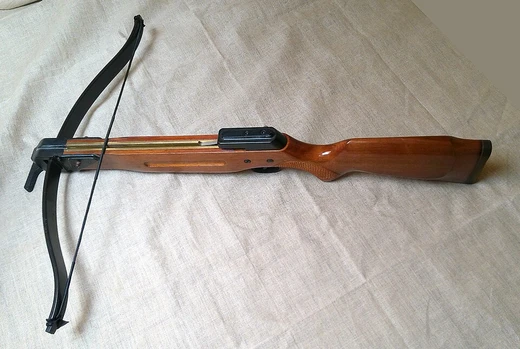
Match crossbow is a target shooting discipline that resembles Olympic rifle shooting more than field crossbow. The bolts used are the same diameter as .177 air rifle pellets and .22 small-bore rifle cartridges. Each bolt has a screw-like blunt tip; the swirling pattern helps shooters extract it from the target board by unscrewing it. A lever—either separate or built into the crossbow—is used to load the bolt, as match crossbows are not hand-drawn. Since the early 1980s, these crossbows have commonly featured an electronic trigger with a dry-fire mechanism and an electronic lighted level. The stock is similar to that of an Olympic air rifle or small-bore rifle, often made from laminated wood.
The 30-meter match is the IAU’s premier discipline, regularly drawing Olympic-class small-bore and air rifle athletes. Shooting occurs on enclosed outdoor ranges with electrically driven target transport systems; existing small-bore ranges can be adapted, or temporary tented ranges with portable targets can be used. Athletes shoot from standing and kneeling positions, firing one bolt per target card and reusing the same bolt. The bolt end is .22 caliber. National federations can enter teams of three competitors (any gender) in Open Class and U-21 Juniors categories. By participating in IAU Cup matches, a nation can earn two additional quota spots, allowing up to five competitors at the next World or Continental championship. The 30-meter competition is mixed. The program includes 60 shots total: 30 standing and 30 kneeling. Team competitions (60 shots) occur on the first day.
Quick Facts
- Abbrev
- ICU
- Jurisdiction
- International
- Founded
- 1956-06-24
Facts from the source article.
Lore & Background
The IAU was established in Landshut, Germany, in 1956 and is headquartered in Columbier, Switzerland. It oversees two primary disciplines: 30 m Match, introduced at the first World Championships in 1979, and 10 m Match, added to the program in 1977. The 30 m event is the premier discipline and regularly includes Olympic-class small bore and air rifle athletes. Shooting takes place on enclosed outdoor ranges with electrically driven target transport systems, and competitors shoot from standing and kneeling positions. The 10 m event is a highly technical indoor discipline shot from the standing position, using targets identical in size to Olympic air rifle targets. The IAU also governs field crossbow, though that discipline is additionally sanctioned by the World Crossbow Shooting Association (WCSA). The first European Match-crossbow Championships were held in 1958 in Ghent, Belgium, and the first European Field-crossbow Championships took place in 1989 in Wolverhampton, England. The first Asian Field-crossbow Championships were held in 1992 in Tainan, Taiwan.
Reader's Guide
The IAU's significance lies in its role as the sole international governing body for match crossbow shooting, a sport that bridges archery and rifle shooting. By standardizing equipment—such as bolts with .177 or .22 diameter ends, electronic triggers, and laminated wood stocks similar to Olympic rifles—the IAU has created a discipline that attracts top air rifle and small bore athletes. The organization's championship structure, with biennial World Championships and intervening Continental Championships, provides a regular competitive calendar. The introduction of the 10 m event in 1977 expanded the sport's reach to new nations. The IAU also manages quota systems for national federations, allowing teams to increase their competitor numbers through IAU Cup matches. The sport's legacy includes the development of specialized crossbow brands such as Winzeler, which pioneered electronic triggers and laminated wood stocks, and Scherrer, which produced the first proper match crossbow in 1951. The IAU's governance extends to field crossbow, though that discipline shares oversight with the WCSA, reflecting a broader crossbow shooting community.
Did You Know?
- The IAU was founded on 24 June 1956 in Landshut, Germany.
- Winzeler pioneered the electronic trigger and laminated wood stock for match crossbows.
- The first World Match-crossbow Championships were held in 1979 in Linz, Austria.
The Architecture of Aim
The defining distinction between a crossbow and a traditional bow lies in the relationship between the shooter and time. An archer wielding a longbow must execute a fluid, continuous motion—drawing the string with arm and back muscles, holding the full draw while aiming, and loosing—all in a single unbroken sequence. Heavy war bows demand considerable physical strength for both the draw and the sustained hold, making accurate, sustained use a matter of long, rigorous practice. The crossbow sidesteps this constraint entirely. Once the string is spanned into the cocked position, a trigger-released locking mechanism maintains the tension indefinitely. The wielder can carry the weapon ready, take as long as needed to acquire a target, and release with a simple pull of the trigger. This mechanical patience also enables coordinated group fire, where one operator shoots a cocked crossbow while teammates reload others. For high-draw-weight models, spanners, levers, pulleys, windlasses, and cranequins assist in overcoming the prod's enormous resistance, making the weapon accessible to less experienced personnel than the English longbow or steppe-nomad bows ever were.
A Language of Parts
Crossbow terminology carries centuries of layered etymology. The person who fires the weapon is variously called a crossbowman, an arbalist, or an arbalister—the last two tracing back to the arbalest, a European crossbow variant in use by the twelfth century. Dictionaries from the nineteenth century reveal shifting conventions: Richardson defined arbalist simply as one who shoots from a bow, while Webster and Johnson reserved the term for the crossbow itself, and Smith applied it to a crossbow maker. The bow-like assembly is called a prod or lath, a word that only entered common usage in the nineteenth century after a mistranslation of the sixteenth-century term rodd. The wooden body carrying the prod is the tiller in medieval parlance or the stock in modern firearms-derived language. Projectiles go by arrow, bolt, quarrel, or the archaic vire. The release assembly—string, sears, trigger lever, and housing—is collectively the lock. This dense vocabulary reflects a craft tradition where every component earned its own name across generations of makers and users.
Two Ancient Births
The crossbow did not emerge from a single lineage. The earliest known examples were crafted in ancient China during the first millennium BCE, where they transformed the role of ranged weaponry in warfare—particularly during the Qin unification campaigns and the subsequent Han dynasty's military operations against northern nomadic confederations and western states. The Greek crossbow, by contrast, was likely an independent invention, though many of its medieval European names ultimately derived from the word ballista, an ancient Greek torsion siege engine that resembled a crossbow in appearance while operating on an entirely different design principle. The Chinese trigger mechanism, typically built from three cast bronze pieces nested inside a hollow bronze housing, represents one of the earliest known examples of a mechanical release system. Its J-shaped string catch doubled as a cocking lever and a primitive rear sight, while the interlocking sear and trigger blade provided mechanical advantage to handle substantial draw weights with a light finger pull. Two civilizations, separated by geography and time, independently solved the same problem of storing elastic energy and releasing it on command.
From Battlefield to Range
Although firearms have long since displaced bows and crossbows as instruments of war, the crossbow endures in modern life as a tool for competitive shooting sports, hunting, and situations where a relatively silent discharge is valued. The sport retains the core mechanical challenges that made the weapon compelling on medieval battlefields. High-draw-weight crossbows still require sophisticated gear-and-pulley systems to span, mechanisms that are inherently slower and more awkward than a simple bow draw. Medieval designs were also hampered by short shot stroke lengths between the string lock and release point, combined with the slower speeds of steel prods and heavy strings despite their massive draw weights. Modern crossbow engineering has largely overcome these efficiency penalties, yet the fundamental trade-off remains: the crossbow trades reload speed for the unmatched advantage of a locked, ready-to-aim position. In a competitive shooting context, that trade-off is precisely what separates the discipline from archery, giving shooters the time to settle, sight, and release with a precision that a drawn longbow simply cannot afford.
Gallery
Frequently Asked Questions
What is the International Crossbow Shooting Union (IAU)?
The IAU, also called the Internationale Armbrustschützen Union, is the worldwide governing body for match crossbow target shooting. It coordinates international competition across 24 member nations.
Where and when was the IAU established?
The organization was founded on June 24, 1956, in Landshut, Germany. Its current headquarters are in Columbier, Switzerland.
What competitions does the IAU organize?
The IAU runs World and Continental championships in two disciplines: 10-meter and 30-meter target shooting. World titles are contested every two years, Continental titles in the intervening years, and IAU-Cup events occur annually.
Who leads the IAU?
As of 2017, Charles Méchin serves as president of the organization. The IAU governs competition for 24 member nations under his leadership.
When and where were the first IAU World Championships held?
The inaugural World Match Championships took place in 1979 in Linz, Austria. The first World Field Championships followed three years later in 1982, hosted in Mikkeli, Finland.
More in Crossbows 1-20
Spotted an error? Know more?
Reader corrections go straight into our review queue. Suggest an edit · How this site is sourced