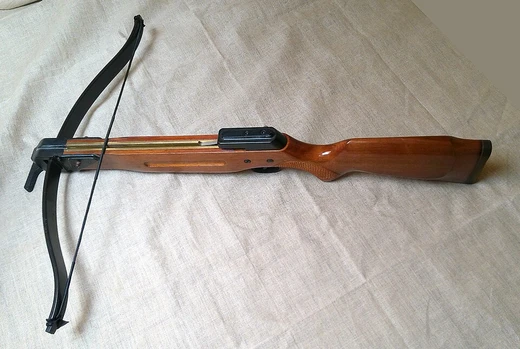
Arbalest
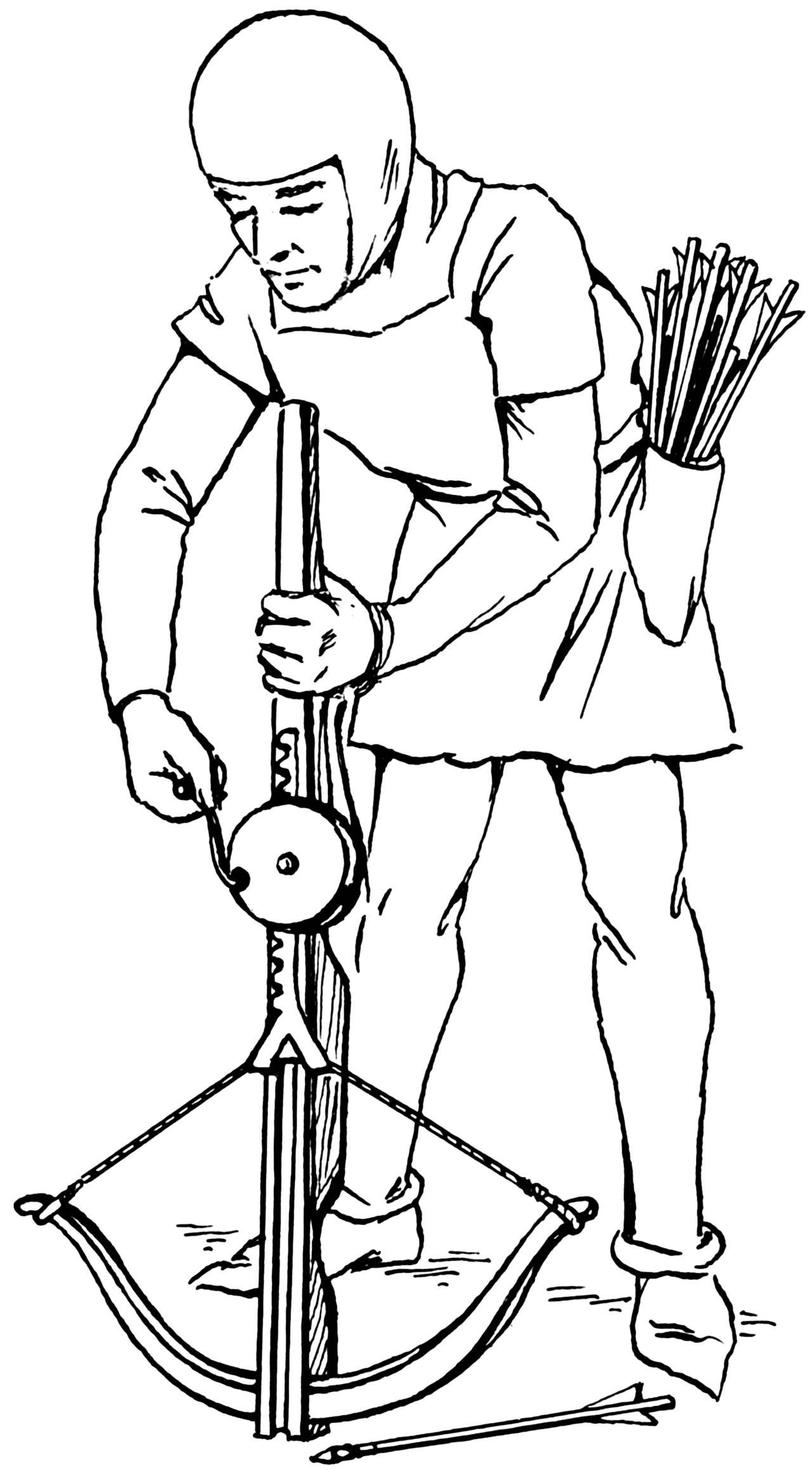
A large steel-prod crossbow used in Europe from the 12th century.

Pearson Scott Foresman · Public domain
The arbalest (also arblast) is a variation of the crossbow that came into use in Europe around the 12th century. It was a large weapon with a steel prod, or bow assembly, and was much larger than earlier crossbows. Because of the greater tensile strength of steel, it had a greater force, though its greater draw weight was offset by a shorter draw length, which limited the total potential energy that could be transferred into the crossbow bolt.
- Type
- Variation of the crossbow
- Period of use
- Around the 12th century in Europe
- Construction
- Large weapon with a steel prod (bow assembly)
- Rate of fire
- Two bolts per minute (skilled arbalestier)
- Alternative names
- Arblast
Lore & Background
The arbalest came into use in Europe around the 12th century. It was a large weapon with a steel prod, or bow assembly, making it much larger than earlier crossbows. The greater tensile strength of steel gave the arbalest greater force, but this was offset by a shorter draw length, which limited the total potential energy that could be transferred into the crossbow bolt. A skilled arbalestier (also called an arbalester) could loose two bolts per minute.
The term 'arbalest' is sometimes used interchangeably with 'crossbow'. It is a Medieval French word originating from the Roman name (from 'bow' + 'missile-throwing engine'), which was then used for crossbows, although originally used for types of artillery. Modern French uses the word , which is linguistically one step further from the stem, due to the disappearance of the s phoneme in the last syllable. This form of the word applies to both crossbows and arbalests, though the latter may be referred to as a heavy crossbow; however, an actual heavy crossbow may not be the same as an arbalest.
Reader's Guide
The arbalest represents a significant development in crossbow technology, notable for its use of a steel prod and its larger size compared to earlier crossbows. Its greater force, derived from the tensile strength of steel, made it a powerful weapon, though the shorter draw length limited the energy transfer to the bolt. The arbalest's rate of fire—two bolts per minute from a skilled arbalestier—indicates its practical use in combat. The term 'arbalest' itself carries a complex linguistic history, originating from a Roman name for artillery before being applied to crossbows, and later becoming interchangeable with 'crossbow' in some contexts. However, the notes record that a heavy crossbow may not be the same as an arbalest, preserving this ambiguity. The arbalest's legacy lies in its role as a medieval European weapon that pushed the limits of crossbow design, balancing increased power with the constraints of draw length and rate of fire.
Did You Know?
- A skilled arbalestier could loose two bolts per minute.
- The term 'arbalest' is a Medieval French word originating from a Roman name for artillery.
- Modern French uses a word that applies to both crossbows and arbalests.
Roots in the Roman Arsenal
The name arbalest carries a lineage stretching back to ancient Rome, where the compound word arcuballista—fusing arcus, meaning bow, with ballista, a term for missile-throwing engines—described a category of artillery rather than the handheld weapon we associate with medieval warfare. This Roman root traveled into Medieval French, where it was repurposed to label the crossbow family of weapons. The arbalest itself emerged as a distinct variation of the crossbow in European hands around the twelfth century, marking a shift in how ranged combat was waged on the continent. Over the centuries the word continued to evolve: in modern French the form has shifted to arbalète, a change linguists attribute to the gradual disappearance of the s phoneme in the final syllable. This phonetic drift illustrates how a single military term can migrate across languages and eras, shedding its original artillery connotations while retaining a connection to the bow-and-projectile tradition that first inspired it.
Steel, Draw Weight, and the Physics of Force
The arbalest distinguished itself from earlier crossbow designs primarily through its construction. Its prod—the bow assembly that stored and released energy—was fashioned from steel, a material whose tensile strength far exceeded that of materials used in prior crossbow iterations. Combined with an overall larger frame, this steel prod allowed the weapon to generate a significantly greater force than its predecessors. However, the engineering trade-off was real: the increased draw weight was counterbalanced by a shorter draw length. Because potential energy depends on both the force applied and the distance over which it acts, this reduced travel distance capped the total energy that could ultimately be transferred into the crossbow bolt. The result was a weapon that delivered a harder strike per unit of draw yet could not simply scale its power indefinitely. This interplay of material choice, geometry, and mechanical limitation defined the arbalest's performance envelope for the centuries it remained in service.
The Arbalestier and the Rhythm of Battle
In the hands of a trained operator, the arbalest was a weapon of disciplined rhythm. The specialist who wielded it was known as an arbalestier, and the pace at which such a skilled marksman could deliver fire was a steady two bolts per minute. This rate of fire represented a meaningful tactical output in twelfth-century European warfare, where the arbalest first found its niche. The weapon's design—its steel prod, its larger frame, its specific draw geometry—shaped not only the energy delivered to each individual bolt but also the physical demands placed on the shooter. Each firing cycle required the operator to manage the weapon's considerable draw weight within a constrained draw length, a process that demanded both strength and practiced technique. The interplay between the arbalest's mechanical characteristics and the operator's skill meant that the two-bolt-per-minute cadence was not merely a speed metric but a measure of the weapon's overall usability in sustained combat. For the arbalestier, mastery of this rhythm was the difference between a tool and a decisive instrument of war.
A Name That Blurs the Line
One of the most persistent sources of confusion surrounding the arbalest is its relationship to the broader category of crossbow. In common usage the term arbalest is sometimes employed interchangeably with crossbow, as though the two were simply different names for the same object. Yet the historical record suggests a more nuanced distinction. The arbalest is specifically a variation of the crossbow, one characterized by its steel prod and larger frame. In modern French the word arbalète applies to both crossbows and arbalests alike, further muddying the taxonomy. An arbalest may be described as a heavy crossbow, but the reverse is not necessarily true: an actual heavy crossbow may not qualify as an arbalest in the strict sense. This terminological overlap means that scholars and enthusiasts must carefully contextualize the word, recognizing that a label inherited from Medieval French and ultimately from the Roman arcuballista can point to a range of weapons rather than a single, precisely defined instrument.
Gallery
Frequently Asked Questions
What is an arbalest?
The arbalest is a large crossbow variant that emerged in Europe around the 12th century, distinguished by its steel prod (bow assembly) rather than the wooden limbs of earlier designs. It is also commonly called an arblast.
How does the arbalest differ from earlier crossbows?
Its steel prod gave it significantly greater tensile strength and raw force compared to wooden-prod predecessors. However, the heavier draw weight came with a shorter draw length, which capped the total potential energy that could be loaded into a bolt.
How fast could a skilled arbalestier fire?
A trained operator could manage roughly two bolts per minute, a rate that was modest by later standards but respectable for a weapon of that size and draw weight in the medieval period.
Why was the arbalest considered a powerful weapon for its era?
The switch to a steel prod meant the bow assembly could store and release far more force than the wooden crossbows that came before it, making it a notably harder weapon to defeat in combat.
What period and region is the arbalest associated with?
It came into use in Europe around the 12th century and is classified as a variation of the crossbow rather than a wholly separate weapon category.
More in Crossbows 1-20
Spotted an error? Know more?
Reader corrections go straight into our review queue. Suggest an edit · How this site is sourced