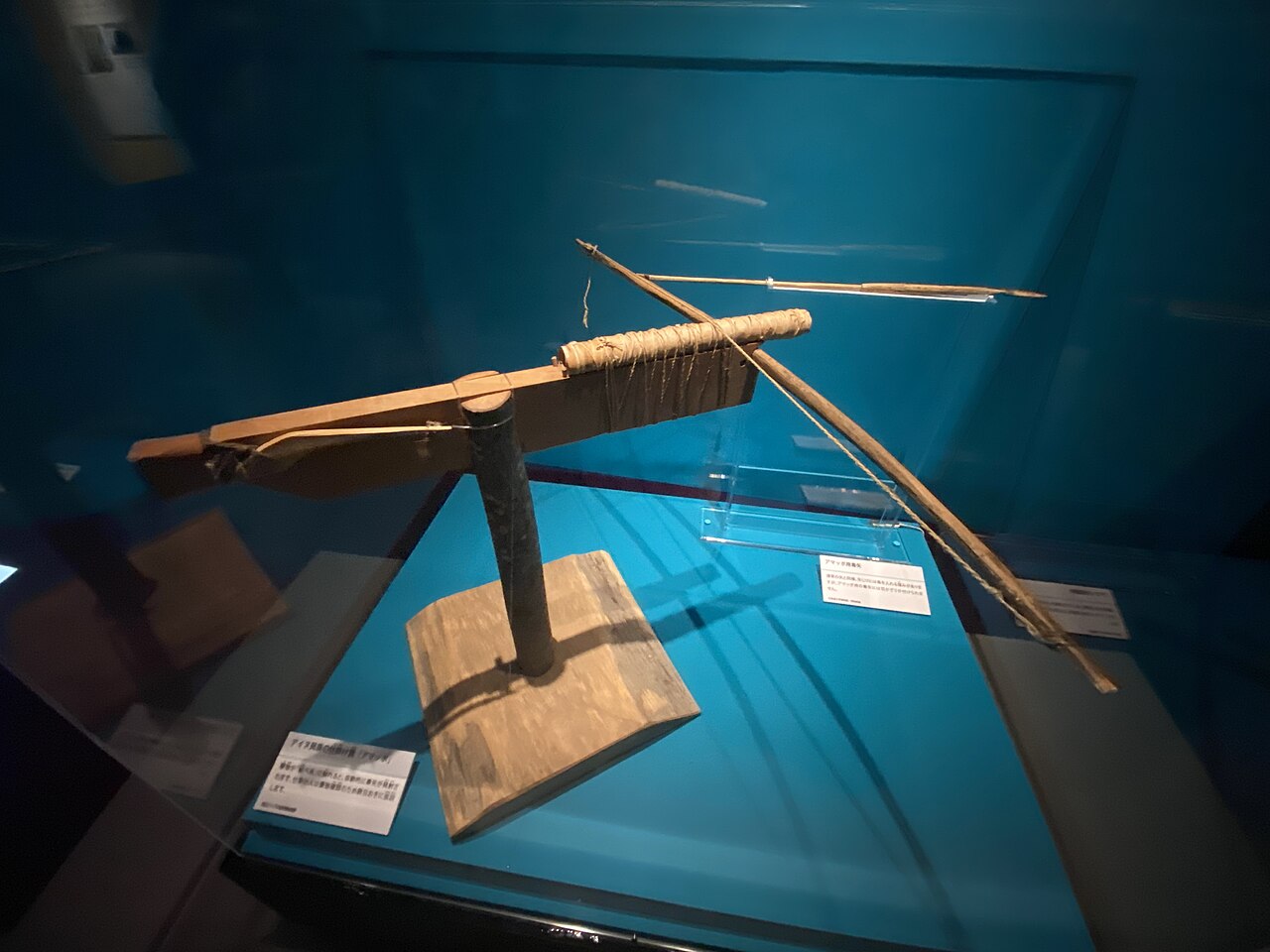
Amappo
Ainu crossbow trap for bear and deer, triggered by tripwire.

Teruteru21 · CC BY-SA 4.0
The amappo was a traditional trap used by the Ainu people of the northern Japanese archipelago and Sakhalin for hunting bear and deer. Mechanically a simple crossbow of elastic yew wood set in a notch at the top of a short post or tree stump, it was triggered by a tripwire strung across a game trail. Similar traps were also used by ethnic Japanese matagi hunters.
- Origin
- Eastern Siberia
- Period of use
- At least since the Neolithic period on the Japanese archipelago
- Primary users
- Ainu people of the northern Japanese archipelago and Sakhalin; also ethnic Japanese matagi hunters
- Target animals
- Bear and deer
- Material
- Elastic yew wood
- Poison
- Surku, derived from aconitum
Lore & Background
The amappo was a spring-loaded crossbow trap mounted on a prepared stump, known as a *nitan*. A tripwire was stretched across a game trail at a height adjusted for the target animal—roughly 10 cm higher for deer than for bear—to improve the chance of striking the heart. When an animal disturbed the wire, a loaded arrow was released. Arrows were wrapped in birchbark to protect them from rain, marked with a family symbol (*itokpa*) to indicate ownership of the kill, and coated with a paste of *surku*, a lethal poison made from aconitum. The poison was prepared by drying aconitum roots and stalks for at least one month, then grinding them in a mortar and pestle set aside for that purpose. The strength of the poison was tested by placing a small amount on the tongue and estimating the resulting pain. If too weak, the prey would escape; if too strong, the meat became inedible and the fur would fall out. However, when hunting animals considered taboo, the greatest possible toxicity was used. According to information obtained from the Ainu of the Saru River and Hidaka Mountains, brown bears poisoned with surku would react violently, then gradually become quiet, stiffen their limbs, foam at the mouth, and die after about two hours—or within one hour if the poison was stronger. The meat of animals killed by surku could be eaten if a fistful of tissue around the arrow wound was removed and discarded, and the remaining meat was cooked thoroughly.
Reader's Guide
The amappo represents a sophisticated hunting technology developed by the Ainu people, combining mechanical engineering with deep knowledge of local ecology and toxicology. Its design—a simple crossbow mounted on a stump with a tripwire release—was adapted from eastern Siberian traditions and refined over millennia on the Japanese archipelago. The use of aconitum-based surku poison required careful preparation and testing, as the balance between efficacy and safety was critical: too weak and the animal escaped, too strong and the meat and pelt were ruined. The trap was used primarily in spring and autumn, when foliage made sighting prey difficult and cold weather slowed carcass decomposition. Safety measures included allowing slack in the tripwire so that a released arrow would pass behind a standing person's thigh, and carving bow-and-arrow symbols into nearby trees as warnings. In the early Meiji era, the Kaitakushi banned the setting of amappo in favor of hunting by firearm, marking the end of its widespread use. The amappo remains a notable example of indigenous hunting technology and cultural adaptation to the northern Japanese environment.
Did You Know?
- The amappo was banned in the early Meiji era by the Kaitakushi in favor of hunting by firearm.
- A tripwire for deer was strung roughly 10 cm higher than that for a bear to improve heart-shot accuracy.
- Arrows were wrapped in birchbark to protect them from rain and marked with a family symbol to indicate ownership.
- The poison surku was tested by placing a small amount on the tongue and estimating its strength by the resulting pain.
Mechanical Design & Arrow Preparation
The amappo functioned as a compact crossbow crafted from elastic yew wood, fitted into a notch at the top of a short post or tree stump called a kútek. A tripwire strung across a game trail acted as the trigger; when a passing animal disturbed the wire, a loaded arrow was released. Each arrow received careful preparation: it was wrapped in birchbark to guard against rain, stamped with an ikashishiroshi—a family symbol identifying the owner of the kill—and coated with surku, a lethal paste made from ground aconitum. This trap style originated in eastern Siberia and was adopted by both the Ainu of northern Japan and Sakhalin, as well as by ethnic Japanese matagi hunters. On the Japanese archipelago, amappo are believed to have been in use since at least the Neolithic period, marking them as among the oldest hunting technologies in the region.
The Surku Poison & Its Delicate Balance
Surku, the lethal paste that gave the amappo its deadly edge, was always based on aconitum. Roots and stalks gathered from the mountains were dried for at least a month before being ground in a dedicated mortar and pestle and mixed with water. Different Ainu villages passed down their own recipes, but the final step was universal: a tiny amount was placed on the tongue, and the resulting pain served as a gauge of potency. Getting the balance right was critical. Too weak, and the prey would survive the arrow and escape. Too strong, and the poison would spread through the entire body, rendering the meat inedible and causing the fur to fall out, destroying the pelt. The sole exception was a wenkamuy, a man-eating animal whose meat and hide were taboo, so hunters deliberately used the maximum possible toxicity. The surgeon Sekiba Fujihiko recorded that a poisoned brown bear would thrash violently, then stiffen its limbs, foam at the mouth, and die within roughly two hours, or about one hour if the formula was especially potent.
Hunting Practice & Safety Measures
Amappo hunting was typically conducted in spring and autumn, seasons when dense foliage made it harder to spot prey visually and cooler temperatures slowed the decomposition of carcasses. The height of the tripwire was carefully calibrated to the target species to maximize the chance of a heart strike; for instance, a wire set for deer would be strung roughly ten centimeters higher than one intended for a bear. Because the trap posed a genuine danger to humans, several precautions were developed. The tripwire was usually left with a degree of slack so that, if a person standing nearby brushed it, the released arrow would pass behind the thigh rather than striking a vital area. Additionally, hunters would carve images of bows and arrows into nearby tree trunks as a visible warning that an amappo was set in the vicinity. These measures reflect a practical concern for the safety of anyone who might pass along the trail.
Historical Context & the Meiji Ban
The amappo's roots stretch back to eastern Siberia, and on the Japanese archipelago it is believed to have been in use since at least the Neolithic period, making it one of the region's most ancient hunting technologies. It was not exclusive to a single group: the Ainu of northern Japan and Sakhalin employed it, and ethnic Japanese matagi hunters used traps of a similar design. For centuries, the amappo represented a self-contained hunting system—requiring no continuous presence, no firearm, and no ammunition—relying instead on the hunter's knowledge of animal behavior, trail placement, and the precise formulation of surku. Its era came to a close in the early Meiji period, when the Kaitakushi banned the setting of amappo in favor of hunting by firearm. This legislative shift marked the end of a tradition that had endured for millennia, replacing a technology rooted in patience and ecological knowledge with the immediacy of gunpowder.
Gallery
Frequently Asked Questions
What is the Amappo?
The Amappo is a traditional spring-loaded crossbow trap built to take down large game such as bear and deer. It consists of a piece of elastic yew wood anchored in a notch at the top of a short post or tree stump.
How does the Amappo trigger?
A tripwire is strung across a game trail, and when an animal brushes against it, the stored tension in the yew wood is released. This drives the bolt into the target with no human present at the moment of firing.
Who historically used the Amappo?
The trap is most closely associated with the Ainu people of northern Japan and Sakhalin, though ethnic Japanese matagi hunters also employed similar designs. It has been in use on the Japanese archipelago at least since the Neolithic period.
What poison was applied to Amappo bolts?
Bolts were typically tipped with surku, a toxin derived from aconitum plants. This ensured that even a non-fatal wound on a large animal like a bear would prove deadly.
Where did the Amappo originate?
The design traces back to Eastern Siberia before spreading to the northern Japanese archipelago. Its simple mechanical construction—a tensioned elastic limb and a tripwire—made it well suited to the dense forest terrain where Ainu and matagi hunters worked.
More in Crossbows 1-20
Spotted an error? Know more?
Reader corrections go straight into our review queue. Suggest an edit · How this site is sourced