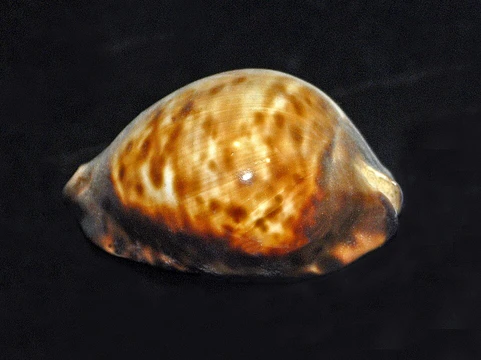
Zoila thersites
A rare cowry with a distinctly arched black or brown shell.

Zoila thersites, called the humpbacked cowry or black cowry, is a marine gastropod mollusk in the cowry family Cypraeidae. This species is endemic to the seas along southern Australia. Its shell, which ranges from 56 to 116 mm in length, is oval with a narrow aperture and a distinctly arched dorsum. The base is pale brown and nearly flat, while the outer and inner lips bear fine teeth. The shell’s surface is smooth and shiny, colored black or pale brown, and densely covered with large, irregular dark brown spots. The animal’s mantle and foot are well developed, with the mantle covering almost the entire shell. It lays egg capsules containing a single fertilized egg; upon hatching, the larva feeds on nurse eggs. These cowries live from the intertidal zone to deep reefs, preferring shallow waters near the intertidal rocky seabed. At dawn or dusk, they prey on sponges, foraminifera, algae, and small crustaceans. The name *Zoila thersites* references a minor character from the second part of Goethe’s tragic play *Faust*, combining the names Zoilus and Thersites.
Quick Facts
- Taxon
- Zoila thersites
Facts from the source article.
Lore & Background
The shell of Zoila thersites can reach a length of 56 to 116 mm. It is oval with a narrow aperture, a distinctly arched dorsum, and a pale brown, almost flat base. Both outer and inner lips bear fine teeth. The surface is smooth and shiny, colored black or pale brown, and more or less densely covered with large irregular dark brown spots. The mantle and foot are very developed, with the mantle covering almost the entire shell. This species lays egg capsules containing a single fertilized egg; upon hatching, the larva feeds on so-called nurse eggs. The name Zoila thersites is a reference to a minor character from the second part of the tragic play Faust by Johann Wolfgang Goethe, and is a neologism made from the words Zoilus and Thersites.
Reader's Guide
Zoila thersites is a notable species within the cowry family due to its distinctive humpbacked form and restricted range. Endemic to Southern Australia, it inhabits shallow waters near intertidal rocky seabeds, emerging at dawn or dusk to prey on sponges, foraminifera, algae, and small crustaceans. Its shell, which can reach over 100 mm, is smooth and shiny with a black or pale brown ground color heavily spotted with dark brown. The species is considered quite rare, and its unusual arched profile sets it apart from many other cowries. The taxonomic history includes two recognized subspecies: Zoila thersites contraria and Zoila thersites thersites. The etymology of its name draws from literary and classical sources, linking it to a character in Goethe's Faust and to the ancient critic Zoilus. This combination of rarity, distinctive morphology, and cultural naming gives the humpbacked cowry a particular interest among malacologists and shell collectors.
Did You Know?
- The name Zoila thersites is a neologism from Zoilus and Thersites, referencing a character in Goethe's Faust.
- It is endemic to Southern Australia and prefers shallow waters near intertidal rocky seabeds.
More in Cowries, Part 2 1-24
Spotted an error? Know more?
Reader corrections go straight into our review queue. Suggest an edit · How this site is sourced