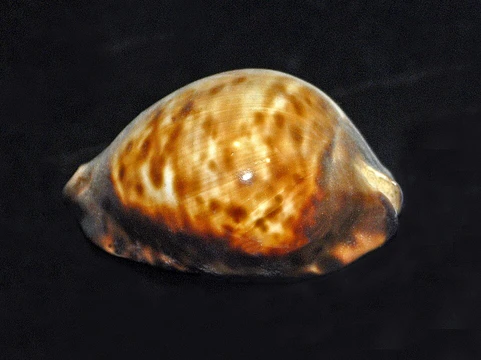
Arestorides argus
A large cowry with eye-like rings on its shell.

The eyed cowrie (Arestorides argus) is a marine gastropod mollusk belonging to the cowry family Cypraeidae. This large sea snail typically reaches about 80 mm in length, with some specimens growing up to 115 mm. Its shell is roughly cylindrical, with a light to medium tan base color. The upper surface is covered in numerous medium-brown rings of varying sizes, which resemble eyes—hence the common name "eyed cowrie" and the species name *argus*, referencing the many-eyed Greek giant Argus Panoptes. The number and size of these rings differ among individuals and especially between subspecies. The shell’s aperture is relatively straight, lined with well-developed teeth, and has two dark-brown blotches on each side; the blotches on the outer lip may be small and faint.
Two subspecies are recognized: *Arestorides argus argus* (Linnaeus, 1758) and *Arestorides argus contracasta* Lorenz, 2012. A third name, *Arestorides argus contrastriata* (Perry, 1811), commonly called the pheasant cowrie, is considered a synonym of *Cypraea contrastriata* Perry, 1811.
This species and its subspecies are found in the Indian and Pacific Oceans. Their range includes waters off Aldabra, the Chagos Archipelago, the Comoros, Kenya, Madagascar, the Mascarene Basin, Mauritius, Mozambique, Réunion, the Seychelles, Somalia, and Tanzania.
Quick Facts
- Taxon
- Arestorides argus
Facts from the source article.
Lore & Background
The shell of Arestorides argus is approximately cylindrical, with a ground color of light to medium tan. Overlying the dorsum are many rings of medium brown and varying sizes, likened to eye spots. This pattern gives rise to the common name eyed cowry and the specific epithet argus, after Argus Panoptes, the many-eyed Greek giant. Some individuals have numerous small rings, while others have fewer, larger rings; the number and size of rings especially varies between subspecies. The aperture is relatively straight, has well-developed teeth, and is flanked by two dark-brown blotches on each side, though the blotches on the outer lip are sometimes small and indistinct. Two subspecies are recognized: Arestorides argus argus and Arestorides argus contracasta. Arestorides argus contrastriata, commonly called the pheasant cowrie, is considered a synonym of Cypraea contrastriata.
Reader's Guide
Arestorides argus is a large cowry species, with specimens averaging 80 mm and measuring up to 115 mm. Its distribution spans the Indian and Pacific Oceans, notably in the seas off Aldabra, Chagos, the Comores, Kenya, Madagascar, the Mascarene Basin, Mauritius, Mozambique, Réunion, the Seychelles, Somalia, and Tanzania. The species is recognized for its distinctive dorsal eye-spot pattern, which has been noted in references such as Verdcourt's work on the cowries of the East African Coast and Burgess's comprehensive study of living cowries. The shell's cylindrical shape and well-developed aperture teeth are characteristic features. The variation in ring size and number between subspecies contributes to its taxonomic interest. The species has been documented in multiple regional faunal surveys, reflecting its wide Indo-Pacific range and its place within the family Cypraeidae.
Did You Know?
- The specific epithet argus refers to Argus Panoptes, the many-eyed Greek giant.
- Specimens average 80 mm and can reach up to 115 mm.
Frequently Asked Questions
What is Arestorides argus?
Arestorides argus is a large marine snail in the cowry family (Cypraeidae), widely known by its common name, the eyed cowrie. It is a sea snail species recognized for its distinctive ringed dorsal pattern.
How big does Arestorides argus get?
Most specimens of this cowry measure around 80 millimeters in length, though exceptionally large individuals can reach roughly 115 millimeters. That places it among the larger members of the Cypraeidae family.
What does Arestorides argus's shell look like?
The shell is roughly cylindrical with a light-to-medium tan base, overlaid with numerous medium-brown rings of varying sizes across the upper surface. The aperture is relatively straight with well-developed teeth, and two dark-brown blotches sit on each side of the opening.
Why is it called the 'eyed cowrie'?
The common name comes from the many ring-shaped markings on the shell's dorsal surface, which visually resemble a cluster of eyes. The species epithet 'argus' nods to Argus Panoptes, the all-seeing giant of Greek myth, reinforcing that same many-eyed impression.
How much does Arestorides argus vary between individuals?
The number, size, and spacing of the brown rings differ noticeably from one specimen to the next. These differences are especially pronounced between recognized subspecies, which can make precise identification tricky for collectors.
More in Cowries, Part 2 1-24
Spotted an error? Know more?
Reader corrections go straight into our review queue. Suggest an edit · How this site is sourced