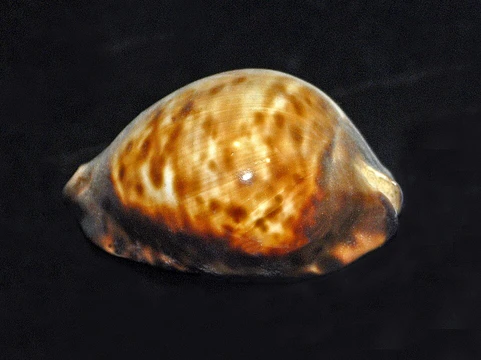
Mauritia depressa
A rare cowry with a flattened base and spotted brown shell.

Mauritia depressa, called the depressed cowry or honey cowry, is a marine gastropod mollusk in the cowry family Cypraeidae. These shells are fairly uncommon. They typically measure 35 to 42 mm long, with a maximum of 61 mm and a minimum of 23 mm. The dorsal color ranges from yellowish brown to dark brown, marked by distinct, nearly round, clear spots. The edges are usually pale bluish or yellowish and dotted with brown. The base is notably flattened and may be white, pale brown, or pale bluish. The teeth lining the aperture are dark brown on both lips.
This species lives in the central Pacific Ocean and the Indian Ocean, including the Chagos Archipelago, Comoros, Kenya, Madagascar, the Mascarene Basin, Mauritius, Réunion, Tanzania, the Laccadive Islands, Timor, the Philippines, and French Polynesia. These cowries inhabit shallow water, mainly in coral reefs or lagoons near wave-swept edges, from the intertidal zone down to 20 meters depth. They typically hide under coral slabs or rocks. They are nocturnal, feeding on algal crests at night.
A subspecies is recognized: Mauritia depressa dispersa (Schilder & Schilder, 1939).
Quick Facts
- Genus
- Mauritia (gastropod)
- Species
- depressa
Facts from the source article.
Lore & Background
The shell of Mauritia depressa reaches an average length of 35 to 42 mm, with a maximum of 61 mm and a minimum of 23 mm. Its dorsal color pattern ranges from yellowish brown to dark brown, marked with distinct, almost circular, clear spots. The edges are typically pale bluish or yellowish and bear several brown dots. The base is definitely flattened and may be white, pale brown, or pale bluish. The teeth along the aperture are dark brown on both lips.
This species occurs in the Central Pacific Ocean and in the Indian Ocean, with records from Chagos, the Comores, Kenya, Madagascar, the Mascarene Basin, Mauritius, Réunion, Tanzania, the Lakkadiven Islands, Timor, the Philippines, and French Polynesia. These cowries mainly live in shallow water, in coral reefs or in lagoons near wave-swept edges, from the intertidal zone to 20 m depth, usually under coral slabs or rocks. They are active at night, when they feed on algal crests.
A recognized subspecies is Mauritia depressa dispersa, described by Schilder & Schilder in 1939.
Reader's Guide
Mauritia depressa holds significance as a distinctive cowry species due to its notably flattened base, which sets it apart from many other cowries. Its common names—depressed cowry and honey cowry—reflect this morphological trait and its warm dorsal coloration. The species is considered quite rare, and its shells are sought after by collectors for their clear, circular spots and the contrast between the dark brown aperture teeth and the pale base. The distribution across the Indian Ocean and Central Pacific, from East Africa to French Polynesia, indicates a broad but patchy range. Its habitat in shallow coral reefs and lagoons, under slabs or rocks, and its nocturnal feeding on algal crests, describe a specialized ecological niche. The existence of the subspecies Mauritia depressa dispersa, named by Schilder & Schilder, adds taxonomic depth. The species is documented in regional faunal works, including studies of East African cowries and FAO guides for the Western Central Pacific, underscoring its relevance to marine biodiversity assessments and shell identification in those regions.
Did You Know?
- The base of Mauritia depressa is definitely flattened.
- Its dorsal color pattern includes distinct, almost circular, clear spots.
- This species is active at night, feeding on algal crests.
Frequently Asked Questions
Who is Mauritia depressa?
Mauritia depressa, often called the depressed cowry or honey cowry, is a marine gastropod mollusk in the cowry family Cypraeidae. It is a fairly uncommon species native to the central Pacific Ocean.
What does Mauritia depressa look like?
The dorsal surface runs from yellowish brown to dark brown and is decorated with distinct, almost circular, clear spots. The edges are typically pale bluish or yellowish with scattered brown dots, while the base is characteristically flattened and may appear white, pale brown, or pale bluish. Both lips of the aperture carry dark brown teeth.
How big is Mauritia depressa?
Most individuals fall in the 35-to-42 mm length range, but the species spans a minimum of 23 mm up to a maximum of 61 mm.
Where does Mauritia depressa live?
This cowry is a marine species restricted to the central Pacific Ocean. It does not occur in freshwater or terrestrial habitats.
Why is Mauritia depressa notable among cowries?
Its strongly flattened base and pattern of clear, nearly round spots on a brown background give it a look that sets it apart from many other Cypraeidae. Because the species is fairly uncommon, finding a well-preserved specimen is a real treat for shell enthusiasts.
More in Cowries, Part 2 1-24
Spotted an error? Know more?
Reader corrections go straight into our review queue. Suggest an edit · How this site is sourced