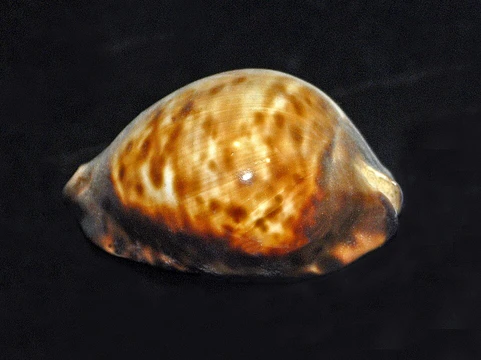
Lyncina leviathan
A tropical cowry with a pink-salmon shell and darker bands.

Lyncina leviathan is a tropical sea snail, specifically a cowry and a marine gastropod mollusk belonging to the family Cypraeidae. Its shell is elongated, smooth, and shiny, with a pink-salmon dorsum crossed by darker bands. The base is whitish, pale pinkish, or pale brown, featuring a long, wide aperture lined with several teeth. Shells average 60 mm in length, ranging from 22 mm to 98 mm. In living individuals, the mantle is brownish, nearly transparent, and well developed, with external antennae and numerous sensory, tree-shaped papillae. This species closely resembles *Lyncina carneola*.
Common across the tropical Indian Ocean (including East Africa and the Red Sea) and the central Pacific Ocean, it is found in waters off Thailand, Australia, Polynesia, and Hawaii. It inhabits rocky intertidal areas and caves in very shallow water, but can also occur at depths up to 40 meters.
Three subspecies are recognized: *Lyncina leviathan leviathan* (the leviathan cowry, endemic to Hawaii), *Lyncina leviathan bouteti* (Boutet's leviathan cowry, found throughout Polynesia), and *Lyncina leviathan titan* (the titanic cowry, found across the Indian and central Pacific Oceans).
Quick Facts
- Taxon
- Lyncina leviathan
Facts from the source article.
Lore & Background
The shells of Lyncina leviathan reach an average length of 60 mm, with a minimum of 22 mm and a maximum of 98 mm. The dorsum surface is pink-salmon, crossed by darker bands, while the base is whitish, pale pinkish, or pale brown. The aperture is long and wide with several teeth. In living specimens, the mantle is brownish, almost transparent, and well developed, with external antennae and several sensorial tree-shaped papillae. This species is superficially similar to Lyncina carneola.
Lyncina leviathan is common throughout the tropical Indian Ocean (East Africa, Red Sea) and the central Pacific Ocean, including the seas along Thailand, Australia, Polynesia, and Hawaii. It inhabits rocky intertidal areas and caves in very shallow water, but can reach depths of up to 40 m.
Three subspecies are recognized: Lyncina leviathan leviathan, endemic to Hawaii; Lyncina leviathan bouteti, found throughout Polynesia; and Lyncina leviathan titan, found throughout the Indian and central Pacific Oceans.
Reader's Guide
Lyncina leviathan holds significance as a widely distributed cowry species across the tropical Indian and central Pacific Oceans, from East Africa and the Red Sea to Thailand, Australia, Polynesia, and Hawaii. Its three recognized subspecies—the nominate leviathan cowry endemic to Hawaii, Boutet's leviathan cowry in Polynesia, and the titanic cowry across the Indian and central Pacific—reflect geographic variation within the species. The species is noted for its elongated, smooth, and shiny shell with a pink-salmon dorsum crossed by darker bands, and a whitish to pale brown base with a long, wide aperture bearing several teeth. In life, the brownish, almost transparent mantle with external antennae and tree-shaped papillae is characteristic. Its habitat includes rocky intertidal areas and caves in very shallow water, though it can occur down to 40 m depth. The species is superficially similar to Lyncina carneola, which may lead to confusion in identification. The taxonomic history includes descriptions by Schilder & Schilder in 1937 and 1962, and by Burgess & Arnette in 1981 for one subspecies. References to the species appear in major cowry guides and in Hawaiian Shell News articles, and it is included in the Cowrie Genetic Database Project.
Did You Know?
- The shell of Lyncina leviathan averages 60 mm in length, with a maximum of 98 mm.
- The dorsum surface is pink-salmon and crossed by darker bands.
- Three subspecies are recognized: L. l. leviathan, L. l. bouteti, and L. l. titan.
- It inhabits rocky intertidal areas and caves from very shallow water to 40 m depth.
Frequently Asked Questions
Who is Lyncina leviathan?
Lyncina leviathan is a tropical cowry (family Cypraeidae) that lives in shallow marine environments. The species was originally described from specimens gathered off the Hawaiian Islands, which remain the type locality for its nominate subspecies.
What are Lyncina leviathan's powers or role in its habitat?
This snail occupies very shallow water down to roughly 40 m, using its well-developed brownish mantle, external antennae, and tree-shaped sensory papillae to detect food and navigate. Its long, wide, tooth-lined aperture helps it cling firmly to hard substrates in currents.
Why is Lyncina leviathan important to cowry enthusiasts and scientists?
It is a key comparison species because it closely resembles Lyncina carneola, so accurate identification matters for both taxonomy and the shell-collecting community. Its broad size range (22–98 mm, averaging about 60 mm) and subspecific variation make it a useful model for studying intraspecific diversity in Cypraeidae.
What does Lyncina leviathan look like?
The elongated, glossy shell shows a pink-salmon dorsum crossed by darker bands, while the base ranges from whitish to pale brown. Living animals display a nearly transparent brownish mantle studded with numerous sensory, tree-shaped papillae.
More in Cowries, Part 2 1-24
Spotted an error? Know more?
Reader corrections go straight into our review queue. Suggest an edit · How this site is sourced