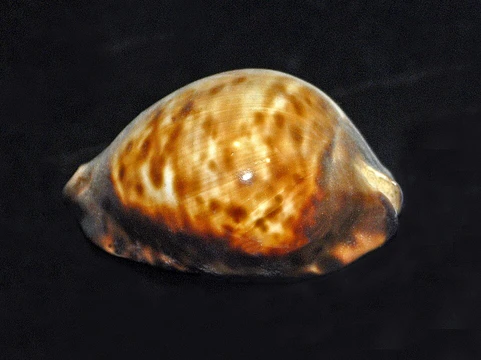
Mauritia mauritiana
A large Indo-Pacific cowry with a dark brown shell and amber dots.

Mauritia mauritiana, known as the humpback cowry, chocolate cowry, mourning cowry, and Mauritius cowry, is a species of tropical sea snail in the family Cypraeidae. It is notable for its large, smooth, and shiny shell, which typically reaches 65–80 mm in length, with a maximum recorded size of 130 mm.
Quick Facts
- Genus
- Mauritia (gastropod)
- Species
- mauritiana
Facts from the source article.
Lore & Background
The shell of Mauritia mauritiana has a dorsum surface that is generally dark brown, marked with distinct large yellowish or amber dots. The edges of the dorsum and the base are completely dark brown, and the aperture is long and narrow, lined with several dark brown teeth and clear spacing. In living specimens, the mantle is completely black and lacks sensorial papillae. This species is restricted to exposed habitats such as wave-washed basalt cliffs or breakwaters, living in tropical low intertidal water under rocks or in rocky crevices at depths from about 2 m down to 50 m.
Reader's Guide
Mauritia mauritiana is a well-known cowry within its Indo-Pacific range, occurring from South-East Africa to Hawaii. Its large, robust shell and distinctive dark brown coloration with amber spotting make it easily recognizable. The species is adapted to exposed, wave-washed environments, where it hides under rocks or in crevices in the low intertidal and subtidal zones. The completely black mantle of the living animal, without sensory papillae, is a characteristic feature. The shell's size range—from 43 mm to 130 mm—shows considerable variation across its distribution. The species has been documented in malacological literature, including works by Schilder and Schilder, Verdcourt, and Burgess, reflecting its importance in cowry studies. Its common names—humpback, chocolate, mourning, and Mauritius cowry—point to its appearance and geographic association.
Did You Know?
- The shell can reach up to 130 mm in length.
- The mantle of the living cowry is completely black and lacks sensorial papillae.
- The species occurs from South-East Africa to Hawaii.
Shell Form and Surface
The adult shell of Mauritia mauritiana departs sharply from what one might expect of a typical sea snail. Rather than coiling into a recognizable spiral, the mature specimen presents a rounded, almost egg-like profile with a convex dorsal surface and a flattened underside. The surface is remarkably smooth and highly polished, a quality that persists because the living animal keeps its mantle draped over the shell for nearly its entire life. These shells display striking color patterns that vary across the family, and the combination of form and ornamentation has prompted some shell specialists to recognize as many as sixty distinct genera and hundreds of species and subspecies within Cypraeidae. In a fully grown individual, no spire is visible at all. Running the length of the ventral face is a long, narrow aperture whose inner edges are lined with small teeth. Notably, cowries lack an operculum, the trapdoor-like structure found in many other gastropods. Juvenile shells, by contrast, bear little resemblance to the adult form and more closely echo the appearance of certain bubble snails, with color patterns that can make species-level identification difficult.
Habitat and Feeding
Mauritia mauritiana inhabits the warm waters of tropical and subtropical seas, where members of the cowry family rank among the most abundant and diverse shell-bearing groups encountered on coral reefs, rocky intertidal flats, and sandy substrates, particularly in island regions. Despite their conspicuous shells, these animals are largely nocturnal and cryptic, spending daylight hours concealed in a way that has left their feeding biology only partially understood. The prey most frequently documented across cowry species is sponges. Off the coasts of Australia, common cowry species have been observed consuming sponges, and on Caribbean coral reefs they are known to feed on sponge species that carry chemical defenses deterring other predators. This dietary specialization suggests a degree of ecological tolerance for compounds that would repel most other invertebrate grazers. The family's broad geographic spread across tropical and subtropical marine environments underscores its success as a group of small-to-large sea snails within the superfamily Cypraeoidea, occupying niches on reefs and in intertidal zones that few other gastropod families match in sheer abundance.
Predation and Shell Defense
The architecture of a cowry shell offers a formidable but imperfect shield. The long, narrow aperture that runs along the ventral surface is lined with small teeth, a feature that makes it extremely difficult for most predators to reach the soft body inside. Yet several specialized hunters have evolved strategies to overcome this barrier. Certain tropical crustaceans are strong enough to fracture the dorsal surface of the shell, gaining access from above. Mollusc-eating cone snails, including Conus textile, take a different approach: they inject venom into the cowry's flesh and then extend their stomach through the aperture to consume the animal entirely. Octopuses present yet another threat, using a specialized barb or tooth combined with an acidic secretion to bore a small hole through the shell wall, through which they deliver a lethal venom. Despite these vulnerabilities, the combination of the tooth-lined aperture, the smooth polished exterior, and the animal's nocturnal, cryptic behavior provides a layered defense that has allowed cowries to persist as one of the most widespread gastropod groups in tropical and subtropical marine ecosystems.
Taxonomic Placement and History
The genus Mauritia was established by Troschel in 1863, yet for nearly two centuries every cowry species was lumped into a single genus, Cypraea, originally named by Linnaeus in 1758. It was not until 2002 that taxonomists finally split the family into its many constituent genera, a revision that reshaped how conchologists organize the group. In the 2005 taxonomy of Bouchet and Rocroi, Cypraeidae sits alongside the family Ovulidae within the superfamily Cypraeoidea, which in turn falls under the clade Littorinimorpha in the broader group Hypsogastropoda. Six subfamilies were recognized in that framework, including Cypraeinae, Erosariinae, Erroneinae, Gisortiinae, Luriinae, Pustulariinae, and Zonariinae, though Mauritia itself remains unassigned to any subfamily. The World Register of Marine Species treats these subfamilies as an alternate representation of the family. This ongoing taxonomic refinement reflects the extraordinary morphological diversity within the group, where minor variations in shell form and color patterns have led some specialists to acknowledge hundreds of distinct species and subspecies.
Frequently Asked Questions
What is Mauritia mauritiana?
Mauritia mauritiana is a tropical sea snail in the cowry family Cypraeidae, native to the Indo-Pacific. It is one of the larger members of that family, instantly recognizable by its dark brown, amber-dotted shell.
How big does Mauritia mauritiana get?
Most shells fall in the 65-to-80 mm range, though individuals can be as small as roughly 43 mm and as large as a recorded 130 mm. That upper end makes it one of the biggest cowries you are likely to collect.
Where does Mauritia mauritiana live?
This species inhabits shallow Indo-Pacific waters, typically resting on the seafloor between 2 and 50 meters depth. It is a benthic cowry rather than a deep-water or pelagic one.
What does Mauritia mauritiana's shell look like?
The shell is large, smooth, and highly glossy, with a deep chocolate-brown ground color scattered with small amber dots. Its pronounced humpback outline sets it apart from flatter cowry relatives and gives rise to one of its common names.
What are the common names for Mauritia mauritiana?
Enthusiasts and collectors refer to it as the humpback cowry, chocolate cowry, mourning cowry, or Mauritius cowry. The chocolate and mourning names both come from its rich, dark brown coloration.
More in Cowries, Part 2 1-24
Spotted an error? Know more?
Reader corrections go straight into our review queue. Suggest an edit · How this site is sourced