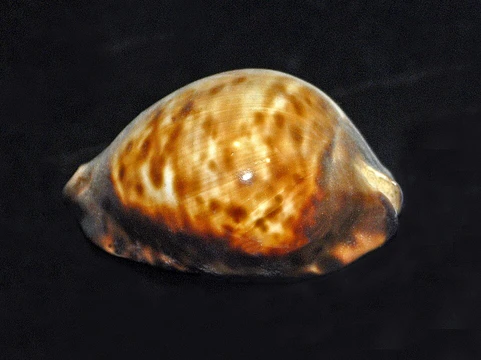
Naria poraria
A widely distributed cowry with a purple base and bright mantle.

Naria poraria, called the purple-based cowry or porous cowry, is a type of sea snail in the cowry family Cypraeidae. These fairly common cowries have smooth, shiny shells that typically measure 16 to 19 mm long, though they can be as small as 10 mm or as large as 28 mm. Shell color ranges from pale to dark brown, dotted with many small yellowish spots. The base and margins are purple—hence the common name—while the teeth are usually white. In living animals, the mantle is bright red or purplish, with long, slightly tree-shaped sensory papillae. The mantle’s lateral flaps can completely cover the shell and retract quickly into the shell opening. This species closely resembles Naria albuginosa, but that cowry has a paler purple base.
The species is widespread across much of the Indo-Pacific, from East Africa (Somalia, Aldabra, Kenya, the Mascarene Basin, Mauritius, Réunion, and Tanzania) through the Indian Ocean and Pacific Ocean, including the Chagos Archipelago, Seychelles, Sri Lanka, India, Malaysia, Indonesia, New South Wales, New Caledonia, Philippines, Samar Island, Polynesia, Marshall Islands, and Hawaii.
Naria poraria lives in shallow intertidal water on tropical reefs, mainly at depths of 3 to 10 meters. It is often found on dead corals, under large rocks, or in caves.
Quick Facts
- Taxon
- Naria poraria
Facts from the source article.
Lore & Background
The shells of Naria poraria are smooth and shiny, typically ranging from pale brown to dark brown with numerous small yellowish spots. The base and margins are purple, giving the species its common name, while the teeth are commonly white. In living specimens, the mantle is bright red or purplish, with quite long and slightly tree-shaped sensorial papillae. The lateral flaps of the mantle may hide the shell surface completely and can be quickly retracted into the shell opening. This species is quite similar to Naria albuginosa, though in the latter the purple color of the base is paler. Naria poraria lives in shallow intertidal water in tropical reef, mainly at 3 to 10 meters of depth, and is commonly found on dead corals, under large rocks, or in caves.
Reader's Guide
Naria poraria is a notable cowry species due to its wide distribution across the Indo-Pacific, from East Africa (including Somalia, Aldabra, Kenya, the Mascarene Basin, Mauritius, Réunion, and Tanzania) through the Indian Ocean and Pacific Ocean (including Chagos, the Seychelles, Sri Lanka, India, Malaysia, Indonesia, New South Wales, New Caledonia, Philippines, Samar Island, Polynesia, Marshall Islands, and Hawaii). Its shells reach an average length of 16 to 19 mm, with a minimum of 10 mm and a maximum of 28 mm. The species is quite common in its habitat, which consists of shallow intertidal waters in tropical reefs, primarily at depths of 3 to 10 meters. It is often found on dead corals, under large rocks, or in caves. The purple base and margins, combined with the bright red or purplish mantle and tree-shaped papillae, make it distinctive among cowries. Its similarity to Naria albuginosa is noted, with the key difference being the paler purple base of the latter. The species has been referenced in works such as Verdcourt's study of East African coast cowries and Burgess's book on living cowries.
Did You Know?
- The common name 'purple-based cowry' comes from the purple base and margins of the shell.
- The mantle of living Naria poraria is bright red or purplish with tree-shaped sensorial papillae.
- This species is widely distributed from East Africa to Hawaii.
- Naria poraria is quite similar to Naria albuginosa, but the latter has a paler purple base.
Taxonomic Identity & Systematic Placement
Naria is a genus of sea snails, classified as marine gastropod mollusks within the family Cypraeidae, commonly referred to as the cowries. Within this family, Naria occupies a specific position in the subfamily Erosariinae, a rank that groups together related genera based on shared characteristics. The genus encompasses multiple species, each representing a distinct taxonomic unit within the broader cowrie radiation. As a member of the gastropod class, Naria belongs to one of the most visually distinctive groups of marine invertebrates, a fact that has drawn sustained attention from naturalists and collectors alike. The systematic placement of Naria—genus within subfamily, subfamily within family—reflects a layered classification scheme that has been refined over many decades of malacological research. This hierarchical arrangement, from the broad family Cypraeidae down to the specific subfamily Erosariinae, provides the structural framework within which individual species are identified, compared, and understood in relation to their close relatives. The stability of this framework, alongside periodic taxonomic revisions, illustrates the ongoing scholarly commitment to accurately representing the diversity of these ocean-dwelling mollusks.
A Century and a Half of Taxonomic Scholarship
The classification of cowries, and by extension the genus Naria, has been shaped by an unbroken thread of scholarly work stretching back to the early nineteenth century. William J. Broderip contributed an early treatment of the Cypraeidae in 1837, publishing his observations in the Penny Cyclopaedia, a widely circulated reference work of the era. Friedrich Troschel devoted the latter decades of the 1800s to studying the dental structures of snails as a basis for natural classification, a project that spanned from 1856 to 1893 and was published by Nicolaische Verlagsbuchhandlung in Berlin. Heinrich C. Weinkauff produced a detailed catalog of the genus Cypraea in 1881, while John G. Jeffreys described Mediterranean molluscan specimens in 1883. Each of these works added layers of understanding, building a cumulative body of knowledge that would inform later taxonomic decisions. This long tradition of meticulous documentation underscores how the modern understanding of Naria and its relatives rests on generations of careful observation and classification.
Regional Documentation Across Oceans
The study of Naria and related cowries has been deeply informed by regional surveys conducted across multiple ocean basins and coastal regions. Thomas Iredale contributed two significant works focused on Australian waters: his 1930 Queensland molluscan notes, published in the Memoirs of the Queensland Museum, and his 1939 follow-up, Australian Cowries: Part II, appearing in the Australian Zoologist. These publications provided detailed accounts of cowrie species encountered in the waters surrounding Queensland and the broader Australian coastline. In a different geographic context, John G. Jeffreys documented Mediterranean molluscan fauna in 1883, publishing in the Annals and Magazine of Natural History. Meanwhile, W. R. Steadman and B. C. Cotton produced a classification key for cowries in 1946, published in the Records of the South Australian Museum. Together, these regional studies illustrate how cowrie taxonomy has been advanced through localized fieldwork and specimen examination across diverse marine environments, from the Pacific coast of Australia to the waters of the Mediterranean Sea.
Modern Synthesis and Open Resources
The contemporary understanding of cowries, including the genus Naria, benefits from a landmark 2017 publication by Frank Lorenz, titled Cowries: A guide to the gastropod family Cypraeidae. Volume 1, subtitled Biology and systematics, was published by ConchBooks in Harxheim and spans 644 pages, representing a comprehensive synthesis of the field's accumulated knowledge. This work stands as a modern reference that consolidates decades of taxonomic, biological, and systematic research into a single authoritative volume. Beyond print publications, digital resources have expanded access to cowrie-related materials. Wikimedia Commons hosts a collection of media related to Naria as a gastropod, providing open-access visual documentation that complements the scholarly literature. The combination of a thorough modern monograph with freely available digital media reflects how the study of marine gastropods has evolved from exclusive reliance on printed catalogs and museum specimens to a more accessible, multi-platform documentation ecosystem that supports both professional researchers and informed enthusiasts.
Frequently Asked Questions
What is Naria poraria?
Naria poraria is a small sea snail in the cowry family Cypraeidae, commonly called the purple-based cowry or the porous cowry. It is a fairly common species encountered in tropical marine environments.
What does a Naria poraria shell look like?
The shell has a smooth, glossy surface ranging from pale to dark brown, covered in numerous small yellowish spots. The base and margins carry a distinctive purple hue, and the teeth in the aperture are typically white.
How big is Naria poraria?
Most individuals fall in the 16-to-19-millimetre range, though the species spans from roughly 10 mm at the small end up to 28 mm at the large end.
What does a living Naria poraria look like?
The soft mantle is a vivid red or purplish shade and bears long, slightly tree-shaped sensory papillae. Its lateral flaps are broad enough to completely enclose the shell when the animal retracts.
Why is Naria poraria notable among cowries?
The combination of a purple base, spotted brown shell, and a bright red or purplish mantle makes it one of the more visually distinctive common cowries. It is also widely distributed, which makes it a frequent find for shell collectors in tropical regions.
More in Cowries, Part 2 1-24
Spotted an error? Know more?
Reader corrections go straight into our review queue. Suggest an edit · How this site is sourced