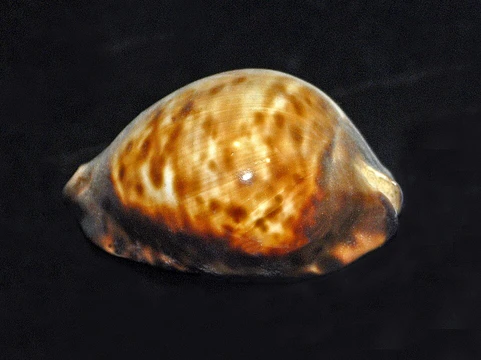
Ovatipsa chinensis
A nocturnal cowrie with a bright red mantle and spotted shell.

The Chinese cowrie (*Ovatipsa chinensis*) is a marine gastropod mollusk belonging to the cowry family, Cypraeidae. Its bright red mantle is entirely covered with short, protruding filaments. The shell is smooth and elongated, typically 25 to 50 mm long, with a light brown or yellowish color, clear dots on the upper surface, and a flat white base. In the subspecies *variolaria*, the shell is light brown with faint purple spots along the edges. This species lives in the Indian Ocean and central Pacific Ocean, including the Red Sea, East Africa, Australia, Indonesia, and the Philippines, at depths of 35 to 45 meters in intertidal waters. It is nocturnal, hiding under rocks and in cracks and crevices during the day. Recognized subspecies include *Ovatipsa chinensis amiges*, *O. c. chinensis*, *O. c. somaliana*, *O. c. variolaria*, and *O. c. violacea*.
Quick Facts
- Taxon
- Ovatipsa chinensis
Facts from the source article.
Lore & Background
The Chinese cowrie is found throughout the Indian Ocean and Central Pacific Ocean, including the Red Sea, East Africa, Australia, Indonesia, and the Philippines. It inhabits intertidal waters at depths of 35 to 45 meters. During the day, it hides under rocks in cracks and crevices, becoming active at night. The animal's mantle is bright red and completely covered by protruding short filaments. The shell is smooth and elongate, typically light brown or yellowish with clear dots on the dorsum and a flat white base. In the subspecies variolaria, the basic shell color is light brown with slight purple spots on the edges. Several subspecies have been recognized: Ovatipsa chinensis amiges, Ovatipsa chinensis chinensis, Ovatipsa chinensis somaliana, Ovatipsa chinensis variolaria, and Ovatipsa chinensis violacea.
Reader's Guide
The Chinese cowrie is a well-documented species within the family Cypraeidae, recognized for its distinctive bright red mantle and short filamentous projections. Its shell, ranging from 25 to 50 mm in length, is smooth and elongate, with a light brown or yellowish dorsum marked by clear dots and a flat white base. The subspecies variolaria adds slight purple spots along the shell edges. This cowrie is distributed across a broad range from the Indian Ocean to the Central Pacific, including the Red Sea, East Africa, Australia, Indonesia, and the Philippines, typically found in intertidal waters at depths of 35 to 45 meters. Its nocturnal habits and daytime concealment under rocks in cracks and crevices are characteristic. The species has been the subject of taxonomic study, with five recognized subspecies: amiges, chinensis, somaliana, variolaria, and violacea. References in literature include works by Copley (1945) on Kenyan coast collections, Verdcourt (1954) on East African cowries, and Drivas & Jay (1988) on shells of Réunion and Mauritius. The species is also noted in Hawaiian Shell News and the Bishop Museum collections.
Did You Know?
- The mantle of the Chinese cowrie is bright red and covered with protruding short filaments.
- Its shell is smooth and elongate, reaching 25 to 50 mm in length.
- The subspecies variolaria has a light brown shell with slight purple spots on the edges.
- This cowrie is nocturnal and hides under rocks in cracks and crevices during the day.
Frequently Asked Questions
What is Ovatipsa chinensis?
The Chinese cowrie is a small marine gastropod classified within the Cypraeidae family. It is a strictly nocturnal species that inhabits warm, shallow tropical waters across the Indian Ocean and central Pacific.
What does Ovatipsa chinensis look like?
Its smooth, elongated shell measures roughly 25 to 50 mm and is typically light brown or yellowish, dotted with distinct spots on the upper surface and finished with a flat white underside. The animal's soft mantle is a vivid red densely covered in short, stubby filaments.
Where can you find Ovatipsa chinensis in the wild?
This cowrie is encountered in intertidal zones at depths of about 35 to 45 meters. Its range stretches across the Indian Ocean, central Pacific, the Red Sea, the East African coast, Australian waters, Indonesia, and the Philippines.
Is Ovatipsa chinensis active during the day?
No—this species is entirely nocturnal, emerging to forage and move about only after dark. During daylight it typically remains tucked among reef structures and rubble.
What distinguishes the subspecies O. c. variolaria from the nominate form?
The variolaria form carries a light brown shell marked with subtle purple spotting concentrated along the edges. Otherwise it shares the same general body shape, size range, and habitat preferences as the typical Chinese cowrie.
More in Cowries, Part 2 1-24
Spotted an error? Know more?
Reader corrections go straight into our review queue. Suggest an edit · How this site is sourced