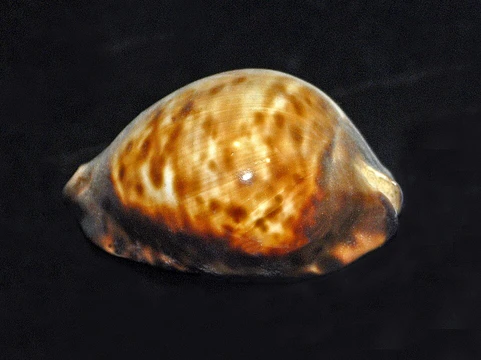
Chelycypraea
The only species in its genus, the tortoise cowry.

Chelycypraea is a genus of sea snail, a cowry, in the family Cypraeidae. It contains only one species, Chelycypraea testudinaria, commonly known as the tortoise cowry.
Quick Facts
- Genus
- Chelycypraea
- Species
- testudinaria
Facts from the source article.
Lore & Background
The shells of Chelycypraea testudinaria are quite uncommon. They are oval or sub-cylindrical, with a smooth and shiny dorsum. The basic color is whitish or yellowish, covered by very irregular dark brown patches and spots. The margins are white or pale brown, with some large dark dots. The base may be whitish, pale brown or pink, and the aperture is long and narrow, with white, short, fine teeth. In the living animal, the mantle is bluish-greyish and almost transparent, with lighter, rather long sensorial papillae. The mantle and foot are well developed, and the lateral flaps of the mantle can completely hide the dorsum surface.
These cowries live on coral reefs, in crevices and beneath large rocks in shallow subtidal waters at depths of 5 to 15 meters. Their distribution spans the Indian Ocean and the Pacific Ocean, including locations such as Aldabra, Chagos, the Comores, Kenya, Madagascar, the Mascarene Basin, Mauritius, Mozambique, Réunion, the Seychelles, Zanzibar, Tanzania, Malaysia, Samar Island, the Sulu Sea, Vietnam, and the Philippines, but excluding Hawaii.
Reader's Guide
Chelycypraea testudinaria is notable as the sole member of its genus, Chelycypraea, within the cowry family Cypraeidae. Its shells are variable in pattern and color, reaching up to 142 mm in length, making it a distinctive cowry among those found in the Indian and Pacific Oceans. The species is recorded from a wide range of localities across East Africa, the Mascarene Islands, and parts of Southeast Asia, though it is absent from Hawaii. The subspecies Chelycypraea testudinaria ingens was described by Schilder, F.A. & M. Schilder in 1939. The living animal's bluish-greyish, almost transparent mantle with long sensorial papillae and the ability of the lateral flaps to completely cover the dorsum are characteristic features. Its habitat on coral reefs in shallow subtidal waters, often in crevices or under rocks, is typical for many cowries. The species is referenced in works such as Drivas & Jay's 'Coquillages de La Réunion et de l'île Maurice' and Verdcourt's 'The cowries of the East African Coast'.
Did You Know?
- Chelycypraea testudinaria is the only species in the genus Chelycypraea.
- The shells can reach a maximum size of 142 mm.
- The living animal's mantle is bluish-greyish and almost transparent.
Taxonomic Placement and the Great Reorganization
Chelycypraea is a genus of marine gastropod mollusk belonging to the cowry family Cypraeidae. Described by Schilder in 1927, it sits within the subfamily Luriinae and more specifically in the tribe Austrocypraeini, a grouping named by Iredale in 1935. Its position reflects a broader taxonomic revolution: for nearly two centuries every cowry species was lumped into a single genus, Cypraea. It was not until 2002 that the family was split into numerous distinct genera, fundamentally reshaping how conchologists organize these shells. Under the 2005 Bouchet and Rocroi framework, Cypraeidae groups with Ovulidae under the superfamily Cypraeoidea, which itself falls within the clade Littorinimorpha and the larger Hypsogastropoda. The tribe Austrocypraeini also includes genera such as Annepona, Arestorides, Austrocypraea, Callistocypraea, Lyncina, Raybaudia, and Trona, placing Chelycypraea in a small but distinct company among its close relatives.
Shell Morphology and the Living Mantle
Like all members of Cypraeidae, Chelycypraea produces an adult shell that departs sharply from the spiral form most people associate with snails. The shell is very rounded, almost egg-shaped, with a glossy, polished surface and an ovate profile. The upper surface is typically convex while the underside is flattened, and in a fully adult specimen no spire is visible at all. Running along the length of the ventral side is a long, narrow aperture lined with small teeth. The remarkable smoothness and shine of cowry shells come from the living animal itself: the mantle nearly always fully covers the shell, keeping it perpetually polished. Juvenile shells of cowries look nothing like the adult form, more closely resembling the shells of bubble snails in the order Cephalaspidea, and they rarely display the adult color patterns, making young specimens difficult to identify to species. Chelycypraea, like its cowry relatives, also lacks an operculum entirely.
Habitat, Distribution, and Feeding Ecology
Cowries, including Chelycypraea, are among the most widely distributed and abundant gastropod groups in tropical and subtropical seas. They thrive on coral reefs, rocky intertidal flats, and sandy substrates throughout island regions. Despite their striking appearance, these snails are largely nocturnal and cryptic, which means their daily activities remain poorly documented. What is known about their diet points strongly toward sponges: off the coasts of Australia, common cowry species feed on sponges, and on Caribbean coral reefs they are recorded eating sponge species that are otherwise chemically defended against other predators. This suggests cowries have developed tolerances or strategies that allow them to exploit a food source many other animals cannot access. The combination of a broad tropical range, reef-associated habitat, and a sponge-based diet makes Chelycypraea a typical representative of the ecological niche occupied by the cowry family.
Predation and the Limits of Shell Defense
The cowry shell's narrow, tooth-lined aperture serves as a formidable barrier against most predators, making it difficult for would-be attackers to reach the soft body inside. Nevertheless, Chelycypraea, like other cowries, is not invulnerable. Certain tropical crustaceans are capable of breaking through the dorsum, the upper surface, of the shell. Some cone snails, such as Conus textile, take a different approach: they inject venom into the cowry's flesh and then extend their stomach through the aperture to consume the animal entirely. Octopuses represent yet another threat, using a specialized barb or tooth combined with an acidic secretion to bore a small hole through the shell, then injecting a venom that kills the snail from within. These diverse predation strategies illustrate that even the cowry's elegant shell design cannot deter every predator in a tropical reef ecosystem.
Frequently Asked Questions
What is Chelycypraea?
Chelycypraea is a single-species genus of marine gastropod belonging to the cowry family Cypraeidae. It is defined by one member: the tortoise cowry (Chelycypraea testudinaria).
What species does the genus Chelycypraea contain?
The genus holds exactly one species, Chelycypraea testudinaria, widely known as the tortoise cowry. No other species are currently recognized within it.
How large does the tortoise cowry grow?
Adults range from about 75 to 142 mm in shell length, with most specimens clustering around 90–110 mm. This makes them among the larger cowries encountered on tropical reefs.
At what depths is Chelycypraea testudinaria typically found?
The tortoise cowry inhabits shallow reef environments, generally between 5 and 15 metres below the surface. It is not a deep-water species.
Is there a recognized subspecies of the tortoise cowry?
Yes—Chelycypraea testudinaria ingens was described by F. A. Schilder and M. Schilder in 1939. It is the only subspecies currently acknowledged within the species.
More in Cowries, Part 2 1-24
Spotted an error? Know more?
Reader corrections go straight into our review queue. Suggest an edit · How this site is sourced