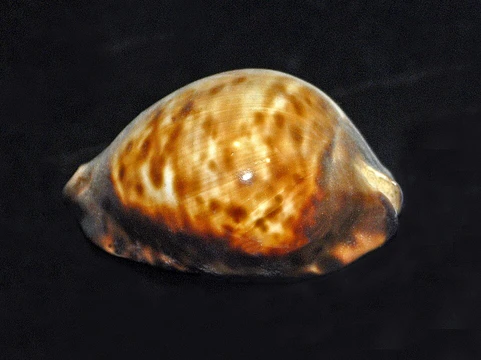
Lyncina vitellus
A widespread cowry with a pear-shaped shell and white-spotted dorsum.

Lyncina vitellus, called the calf cowry or Pacific deer cowry, is a marine gastropod mollusk in the cowry family Cypraeidae. Its shell is usually pear-shaped, smooth, and shiny, ranging from 20 to 100 mm in length, with an average of 35–45 mm. The dorsal surface can be pale or dark brown and is dotted with many small white spots. The margins and ends are lighter, while the base is white and features a wide, wavy opening with long labial teeth. Thin, vertical whitish lines run across the margins. Juvenile shells have two or three clearer transverse bands on the back. This species closely resembles *Lyncina camelopardalis*. In living animals, the mantle is grey-brown and nearly transparent, with long, whitish, tree-shaped papillae. The mantle and foot are well developed, and external antennae are present.
This cowry is found in the Red Sea and the Indian Ocean around Aldabra, Chagos, the Comoros, Kenya, Madagascar, the Mascarene Basin, Mauritius, Mozambique, Réunion, the Seychelles, Somalia, and Tanzania, as well as near Jeju Island, the Philippines, the Palau Islands, the Samoa Islands, Polynesia, Hawaii, and Vietnam. It lives in tropical intertidal and subtidal waters down to about 25 meters deep on coral reefs, usually under coral slabs or stones.
Quick Facts
- Genus
- Lyncina
- Species
- vitellus
Facts from the source article.
Lore & Background
The shells of Lyncina vitellus are usually pear-shaped, with a smooth and shiny dorsum that may be pale or dark brown and bears several small white spots. The margins and extremities are clearer, while the base is generally white, featuring a wide sinuous aperture and long labial teeth. The margins also show numerous thin vertical whitish lines. Juvenile forms have two or three clearer transversal bands on the shell dorsum. These shells are quite similar to those of Lyncina camelopardalis and may be confused with them.
In living specimens, the mantle is grey-brown and almost transparent, with long whitish tree-shaped papillae. The mantle and foot are very well developed, usually with external antennae. The species is distributed in the Red Sea, the Indian Ocean (including Aldabra, Chagos, the Comores, Kenya, Madagascar, the Mascarene Basin, Mauritius, Mozambique, Réunion, the Seychelles, Somalia, and Tanzania), and also along Jeju Island, the Philippines, Palau Islands, Samoa Islands, Polynesia, Hawaii, and Vietnam. They live in tropical intertidal and subtidal water at depths of about 0 to 25 meters on coral reefs, usually under coral slabs and stones.
Reader's Guide
Lyncina vitellus is a very common cowry species, recognized for its broad geographic range spanning from the Red Sea and Indian Ocean to the Pacific islands, including Hawaii and Polynesia. Its shells, which average 35–45 mm in length but can reach up to 100 mm, are frequently encountered by collectors and researchers. The species' habitat preferences—tropical intertidal and subtidal coral reefs, often under slabs and stones—make it a typical component of reef-associated mollusk communities. The similarity of its shells to those of Lyncina camelopardalis is noted in the literature, indicating a need for careful identification. The presence of multiple subspecies and formae (Lyncina vitellus dama, Lyncina vitellus polynesiae, and Lyncina vitellus vitellus orcina) reflects regional variation within the species. The living animal's grey-brown, almost transparent mantle with whitish tree-shaped papillae and well-developed foot and antennae contribute to its ecological role on the reef. The species' wide distribution and common status make it a representative example of the Cypraeidae family in tropical Indo-Pacific waters.
Did You Know?
- The shells of Lyncina vitellus can reach a maximum size of 100 mm.
- This species is found in the Red Sea, Indian Ocean, and as far as Hawaii and Polynesia.
Frequently Asked Questions
What is Lyncina vitellus?
It is a marine gastropod mollusk in the cowry family Cypraeidae, popularly called the calf cowry or Pacific deer cowry. It is a broadly distributed species found across shallow tropical reef habitats.
What does a Lyncina vitellus shell look like?
The shell is pear-shaped, smooth, and glossy, with a dorsal surface in pale or dark brown peppered with small white spots. The white base carries a wide, wavy aperture lined with long labial teeth, and thin vertical whitish lines trace the margins.
How big does Lyncina vitellus grow?
Most specimens measure roughly 35 to 45 millimeters in length, though the species can range from 20 up to 100 mm. Young shells often show two or three distinct transverse bands on the back that fade as the animal matures.
Where can I find Lyncina vitellus in the wild?
This cowry lives in shallow tropical waters, typically from the surface down to about 25 meters depth. It is a widespread species across Pacific and Indian Ocean reef systems.
What subspecies of Lyncina vitellus are recognized?
Three subspecies are listed: L. v. dama, L. v. polynesiae, and L. v. vitellus (with the form orcina sometimes included under the latter). They are set apart by subtle variations in dorsal coloration and spotting density.
More in Cowries, Part 2 1-24
Spotted an error? Know more?
Reader corrections go straight into our review queue. Suggest an edit · How this site is sourced