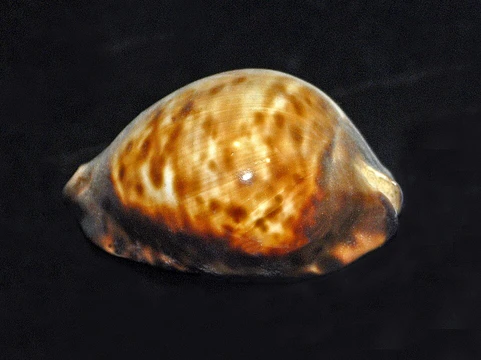
Palmadusta diluculum
A common cowry with zigzag bands and dark spots on a white base.

Palmadusta diluculum, called the day-break cowry, is a marine gastropod mollusk in the cowry family Cypraeidae. These fairly common sea snails typically measure 25 to 29 mm in length, with a maximum of 36 mm and a minimum of 25 mm. Their shells are somewhat pear-shaped and oval, colored brown or violet-chesnut, marked by two or more zones of white zigzag bands across the back and distinctive dark spots on the white base. The shell tips are edged with dark chesnut areas. In living specimens, the mantle is thin and smooth. The subspecies *Palmadusta diluculum virginalis* is smaller, with less pronounced or absent terminal spots and no dark spots on the base.
This species is widespread across the Western Indian Ocean, found along Sri Lanka, Aldabra, Eritrea, Kenya, Madagascar, the Mascarene Basin, Mauritius, Mozambique, Réunion, the Seychelles, Somalia, and Tanzania. It is a demersal tropical cowry living in intertidal shallow waters on sandy to muddy bottoms, under stones and blocks of dead coral. Two subspecies are recognized: *Palmadusta diluculum diluculum* and *Palmadusta diluculum virginalis*.
Quick Facts
- Genus
- Palmadusta
- Species
- diluculum
Facts from the source article.
Lore & Background
The shell of Palmadusta diluculum is somewhat pyriformly ovate, with a basic coloration of brown or violet-chesnut. It features two or more zones of white dorsal zigzag-bands and distinctive dark spots on the white base. The extremities are edged with dark chesnut areas. In the living cowry, the mantle is thin and smooth. The subspecies Palmadusta diluculum virginalis is smaller, with terminal spots less accentuated or absent, and dark spots on the base are totally missing. This demersal tropical cowry inhabits intertidal shallow waters in sandy to muddy areas, under stones and blocks of dead coral. Its distribution spans the Western Indian Ocean along Sri Lanka, Aldabra, Eritrea, Kenya, Madagascar, the Mascarene Basin, Mauritius, Mozambique, Réunion, the Seychelles, Somalia, and Tanzania.
Reader's Guide
Palmadusta diluculum is a notable cowry for its distinctive dorsal zigzag-banding and dark spotting on a white base, which sets it apart from many other cowries. Its common name, day-break cowry, likely references these light markings. The species is widespread across the Western Indian Ocean, occurring in shallow intertidal habitats under stones and dead coral, making it accessible to collectors. The subspecies Palmadusta diluculum virginalis, with reduced or absent terminal spots and no dark base spots, represents a morphological variant that has been formally recognized. The species has been documented in works such as Felix Lorenz's study on Palmadusta diluculum and its close allies, as well as in Burgess's The Living Cowries. Its presence in multiple countries from East Africa to the Mascarene Basin underscores its adaptability to sandy and muddy substrates. The thin, smooth mantle of the living animal is a characteristic shared with many cowries, but the shell's coloration and pattern remain key identifiers for this taxon.
Did You Know?
- The shell reaches a maximum size of 36 mm.
- The basic coloration is brown or violet-chesnut.
- The subspecies Palmadusta diluculum virginalis lacks dark spots on the base.
- It is found under stones and blocks of dead coral in intertidal shallow waters.
More in Cowries, Part 2 1-24
Spotted an error? Know more?
Reader corrections go straight into our review queue. Suggest an edit · How this site is sourced