Bistolida kieneri
A small cowry with blotched shell, found in Indo-Pacific waters.

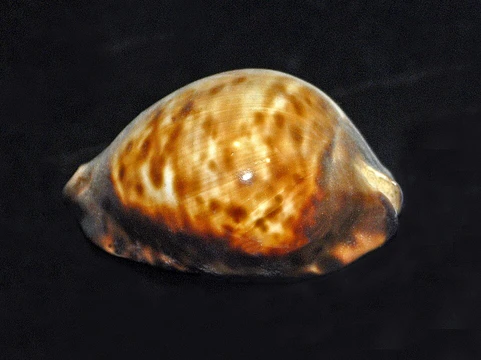
Bistolida kieneri, called Kiener's cowry, is a marine gastropod mollusc in the cowry family Cypraeidae. Its shell is oval, smooth, and shiny, averaging 12–15 mm in length but ranging from 8 mm to 24 mm. The shell’s whitish base color is marked with irregular greenish or bluish blotches or transverse bands, plus small brown spots along the edges of both sides. Two larger brown blotches appear at the extremities. The underside is mostly whitish, with a narrow, sinuous aperture lined with short teeth. In living animals, the mantle is very thin and transparent, with short papillae and external antennae. Recognized subspecies include *Bistolida kieneri depriesteri*, *B. kieneri kieneri* (synonym *Erronea reductesignata*), and *B. kieneri schneideri*. This species and its subspecies occur in East Africa, the Indian Ocean, and the western Pacific Ocean, specifically around Aldabra, Chagos, the Comoros, Kenya, Madagascar, the Mascarene Basin, Mauritius, Mozambique, Réunion, the Seychelles, Tanzania, South Africa, India, Malaysia, Thailand, Vietnam, the Philippines, and Samoa. These cowries live in tropical shallow water, hiding under rocks or corals during the day because they avoid light. They feed on algae or coral polyps, emerging only at dawn or dusk.
Quick Facts
- Genus
- Bistolida
- Species
- kieneri
Facts from the source article.
Lore & Background
The shells of Bistolida kieneri reach an average length of 12 to 15 mm, with a minimum of 8 mm and a maximum of 24 mm. They are oval-shaped, smooth, and shiny, with a whitish base color overlaid by irregular greenish or bluish blotches or transverse bands, and small brown spots along the edges of both sides. The extremities bear two larger brown blotches. The base is mainly whitish, with a narrow sinuous aperture lined with several short teeth. In living specimens, the mantle is very thin and transparent, with short papillae and external antennae.
This species and its subspecies occur across a wide range from East Africa and the Indian Ocean to the western Pacific Ocean, including locations such as Aldabra, Chagos, the Comores, Kenya, Madagascar, the Mascarene Basin, Mauritius, Mozambique, Réunion, the Seychelles, Tanzania, South Africa, India, Malaysia, Thailand, Vietnam, the Philippines, and Samoa. The cowries inhabit tropical shallow water, typically hiding during the day under rocks or corals, as they fear light and emerge only at dawn or dusk to feed on algae or coral polyps.
Reader's Guide
Bistolida kieneri is a common cowry species within the family Cypraeidae, recognized for its modest size and distinctive shell patterning. The species is divided into three recognized subspecies: Bistolida kieneri depriesteri, Bistolida kieneri kieneri (with the synonym Erronea reductesignata), and Bistolida kieneri schneideri. Its distribution spans a broad region of the Indian and western Pacific Oceans, indicating a wide ecological tolerance within tropical shallow-water habitats. The cowry's behavior—hiding under rocks or corals during daylight and feeding at dawn or dusk—reflects its adaptation to avoid light and predators. The thin, transparent mantle with short papillae and external antennae is typical of living cowries and aids in respiration and sensory perception. While not commercially prominent, the species contributes to the biodiversity of coral reef ecosystems and is of interest to malacologists and shell collectors due to its variable coloration and the taxonomic distinctions among its subspecies. The references documenting this species include Burgess's 1970 work 'The Living Cowries', which remains a standard text on cowry biology and identification.
Did You Know?
- The shell of Bistolida kieneri ranges from 8 mm to 24 mm in length.
- This cowry hides under rocks or corals during the day because it fears light.
- Three subspecies are recognized: B. k. depriesteri, B. k. kieneri, and B. k. schneideri.
Frequently Asked Questions
What is Bistolida kieneri?
Bistolida kieneri, commonly called Kiener's cowry, is a small marine snail in the cowry family Cypraeidae. It is a tropical Indo-Pacific species that inhabits shallow coastal waters.
How large does Bistolida kieneri get?
Most individuals measure roughly 12 to 15 mm in shell length, though the full range stretches from 8 mm to 24 mm. This keeps it firmly in the small end of the cowry spectrum.
Where can I find Bistolida kieneri in the wild?
The species ranges from the East African coast and the Mascarene and Chagos island groups westward through the Indian Ocean and eastward into the western Pacific as far as Thailand and Malaysia. During the day the animal typically tucks itself under rocks or coral in shallow tropical water.
What does the shell of Bistolida kieneri look like?
The glossy, oval shell has a pale whitish ground color broken up by irregular greenish or bluish patches and bands, with small brown flecks along the lateral edges and two larger brown marks at each end. The ventral side is mostly white and features a narrow, wavy opening fringed with tiny teeth.
What subspecies of Bistolida kieneri are recognized?
Three subspecies are currently acknowledged: B. k. kieneri, B. k. depriesteri, and B. k. schneideri. They are set apart mainly by subtle shifts in shell coloration and blotch pattern across their respective ranges.
More in Cowries, Part 2 1-24
Spotted an error? Know more?
Reader corrections go straight into our review queue. Suggest an edit · How this site is sourced